

Cold Rolled Steel Sheet Metal: Why SPCC Beats Hot Rolled?
Vistas: 1 Autor: Allen Xiao Fecha de publicación: 2026-06-19


Achieving seamless geometric alignments on intricate electronic chassis requires raw stock with exceptional surface uniformity. Specifying cold rolled steel sheet metal provides product designers with a highly predictable, flat, and dimensionally accurate alloy that excels in close-tolerance B2B hardware applications. This material is cold-processed below its recrystallization temperature to refine its crystal grain structure, delivering superior mechanical properties and a pristine cosmetic finish.
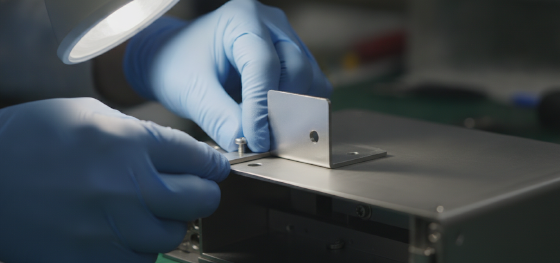
Utilizing low-grade structural steels often introduces severe flatness defects and irregular thicknesses that throw off programmable bending machinery, leading to angular variations on the assembly floor. Heavy-scale hot rolled plates also require extensive pre-treatment acid washes to remove oxides, whereas cold-worked alloys feature a clean, scale-free surface that is immediately ready for high-speed cutting.
Balancing the material's improved yield strength against your specific forming limits separates successful, repeatably assembled server chassis from distorted hardware. Let's examine how cold-reduction milling alters mechanical performance, explore its primary uses in high-density IT hardware, and review the best cutting and coating techniques to maximize product life.
contenido:
What Makes Cold Rolled Steel Different?
Ideal Applications in Electronics and IT Racks
Cutting, Bending, and Powder Coating CRS
Get High-Precision CRS Enclosures Fast
FAQ: Critical Questions About Cold Rolled Steel Sheet Metal
What Makes Cold Rolled Steel Different?
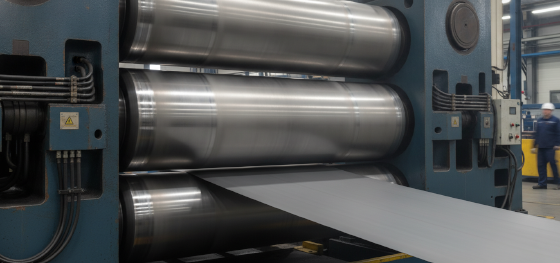
How does cold-rolling milling improve the mechanical properties of raw steel?
Cold rolling compresses hot-rolled pickled sheets through high-pressure reduction rolls at room temperature, dramatically increasing the metal's yield strength, surface hardness, and thickness precision.
To leverage the full physical potential of cold rolled steel sheet metal, engineers must understand how cold reduction alters the underlying iron structure. Modern fabrication facilities classify this material class as SPCC under standard commercial specifications. Because the steel is rolled at room temperature, the grain boundaries are elongated along the direction of travel, creating a highly dense metallurgical matrix.
This grain elongation delivers an exceptional dimensional tolerance, typically within ±0.05mm, which is far tighter than standard hot rolled steel. Additionally, cold working eliminates the dark, flaky mill scale commonly found on hot-processed plates, leaving an exceptionally smooth, oily surface that serves as a pristine foundation for high-end cosmetic coatings.
Ideal Applications in Electronics and IT Racks
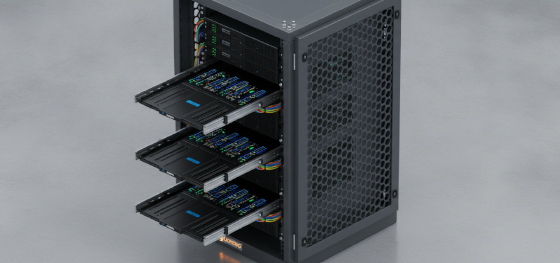
Why is cold-rolled steel specified for server racks and computer brackets?
It provides the precise flatness, high stiffness-to-thickness ratio, and structural consistency required to support heavy server motherboards and rail systems.
High-density IT hardware must survive continuous structural loads without sagging or flexing. Server rack sliders, network switch casings, and computer card-guides require tight clearances to allow modular cards to slide smoothly. Utilizing thin, rigid SPCC sheets allows us to build compact, strong structures that maximize internal airflow.
The material's excellent surface flatness is also critical for EMI shielding. Seamless, flat interfaces on cold-worked panels prevent electromagnetic leakage, protecting sensitive digital components from signal degradation. This makes SPCC the standard material choice for critical telecommunication frames and advanced server rooms.
Cutting, Bending, and Powder Coating CRS
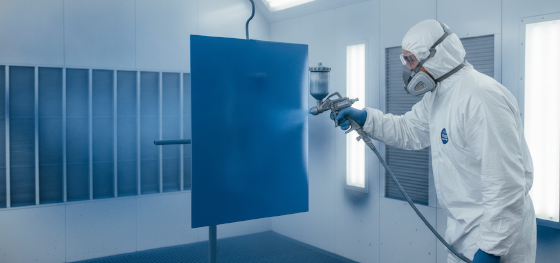
How do precision fabricators cut and coat cold-rolled steel to prevent rust?
We execute high-purity laser cutting to protect the clean edge, bend the steel on multi-axis press brakes, and apply electro-static paint coatings to seal the surface.
Processing cold-rolled sheets requires careful attention to the material's increased hardness. Unlike soft, hot-rolled coils, SPCC exhibits higher initial yield limits, requiring higher tonnage to initiate plastic deformation on press brakes. Our programmers adjust our CAD unfolding models to compensate for this high-strength springback.
To ensure a lifetime corrosion barrier, we execute multi-stage surface preparation. The raw steel undergoes automatic degreasing and chemical etching to remove the rust-preventative mill oil. We then apply an electrostatic recubrimiento en polvo, baking the panels in curing ovens to form a continuous, durable paint layer that bonds tightly to the smooth steel surface, preventing moisture ingress.
Get High-Precision CRS Enclosures Fast
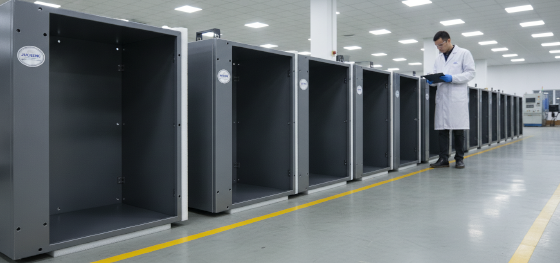
How does JUCHENG guarantee tight-tolerance cold-rolled assemblies?
We operate high-power fiber laser cutters and advanced press brakes managed by skilled operators, matching our tooling die clearances to your selected gauge to eliminate bending cracks.
Selecting this premium material de chapa metálica ensures that your custom cabinets and mounting brackets remain structurally rigid under continuous mechanical stress. JUCHENG integrates advanced shearing, punching, and forming systems into our full-service production lines. This allows us to transition your 3D models into fully finished, durable hardware with extreme dimensional accuracy.
We process a wide range of SPCC gauges to fit your specific engineering load requirements. Our technical department provides a 24-hour free DFM analysis to check your CAD models for flange limits and tool access before production. Supported by our no MOQ policy and rapid delivery guarantee, we manage your project from initial flat pattern cutting to final, fully integrated packaging and assembly.
FAQ: Critical Questions About Cold Rolled Steel Sheet Metal
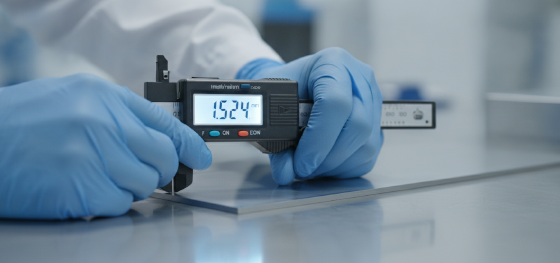
What causes cracking during the bending of hard cold-rolled sheets?
Cracking occurs when a tight bend is executed parallel to the rolling grain direction of the plate, or when the inner radius is set below the material's physical elongation limits. We prevent cracking by adjusting our nested flat layouts to bend across the grain, and maintaining a generous minimum bend radius.
Why must cold-rolled steel be thoroughly degreased before powder coating?
Cold-rolled sheets are coated in a thin layer of rust-preventative oil at the steel mill to block moisture during transit. If this oil is not completely removed, the electro-static paint powder will fail to bond to the steel surface, resulting in paint bubbling, peeling, and localized rust underneath.
What is the difference between SPCC and SPHC mild steels?
SPCC represents cold-rolled carbon steel, offering a highly reflective, smooth surface and exceptionally tight thickness tolerances. SPHC represents hot-rolled steel, which is processed at high temperatures, resulting in a rough, scale-covered surface and wider dimensional tolerances, though it is highly cost-effective for thick structural plates.
How does JUCHENG prevent thickness variations in cold rolled steel sheet metal orders?
Calibramos continuamente nuestros láseres de fibra y topes traseros de plegadora CNC para compensar las variaciones menores de espesor en las láminas de acero crudo. Nuestro equipo utiliza software avanzado de desplegado 3D para calcular los parámetros exactos de elongación del material, y realiza verificaciones dimensionales completas con máquina de medición por coordenadas (CMM) en los ensamblajes terminados antes del empaque final.



ㆍPrivacidad: Respetamos su privacidad. Aquí puede encontrar un ejemplo de un acuerdo de confidencialidad. Al enviar este formulario, acepta nuestros términos y condiciones y política de privacidad.
