


Managing hardware budgets for low-to-medium volume production requires a highly critical mathematical strategy. Procurement teams often celebrate the low upfront expense of wooden or foam patterns, completely ignoring the massive cleanup bills hidden downstream. Analyzing your comparative die casting vs sand casting cost early prevents you from falling into the traditional "low-NRE trap" that destroys your ongoing profit margins.
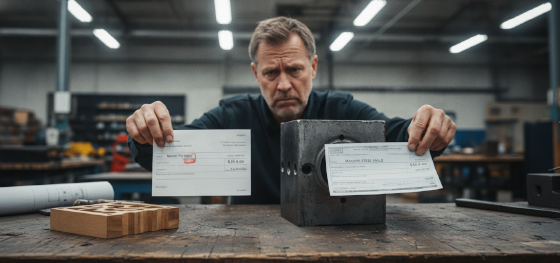
Revelar las partidas ocultas de la fábrica mantiene seguro su flujo de caja continuo durante todo el ciclo de desarrollo. Cada segundo que su pieza pasa enfriándose dentro de la prensa incrementa directamente su costo continuo costo de fundición a presión. Controlar estos gastos continuos determina si sus márgenes minoristas se mantienen sostenibles durante todo el ciclo de vida del producto.
Demanding absolute financial transparency separates elite manufacturing partners from low-tier brokers. Let's dissect the core tooling and post-processing variables that determine unit pricing, analyze the exact volume tipping points, and explain how to secure the most profitable casting technology.
contenido:
Tooling Expenses: Permanent Steel Dies vs. Expendable Sand Molds
Hidden Post-Machining Overhead: Paying for Secondary Finishing
Volume Tipping Points: When Permanent Molds Win the Budget Battle
Sourcing Agility: Choosing the Correct Technology with JC Rapid
FAQ: Honest Answers About Surface Roughness and Molds
Tooling Expenses: Permanent Steel Dies vs. Expendable Sand Molds
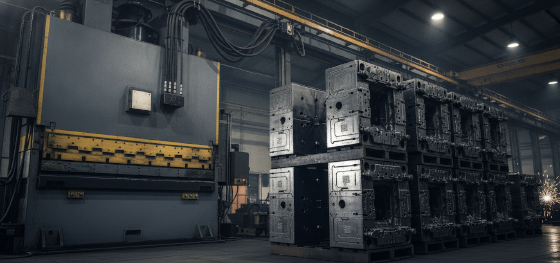
Why do expendable molds require such low initial investments compared to permanent steel tooling?
Because standard sand foundries manually pack cheap, abundant green sand around a simple wooden pattern, avoiding the expensive machining of complex H13 tool steel cavities entirely.
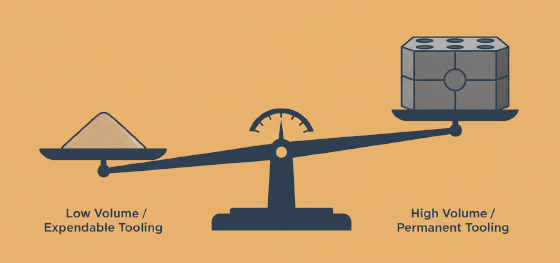
Sourcing raw patterns cheaply is the ultimate secret to launching small runs. If you only need five prototype brackets, paying forty thousand dollars for a permanent steel tool is financial suicide; utilizing sand casting is the undisputed king of short-run prototyping.
Balancing this low-NRE advantage against high labor costs is crucial. While the mold price remains low, the manual labor required to build and destroy a sand mold for every single part you inject drives up your piece part price aggressively.
Hidden Post-Machining Overhead: Paying for Secondary Finishing
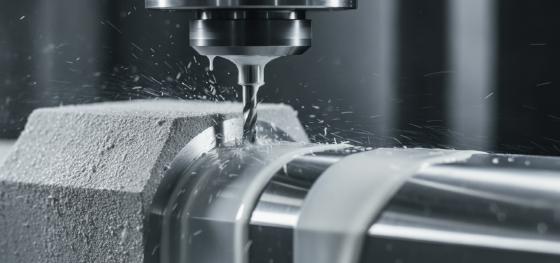
Why does a raw sand-cast component require extensive, expensive secondary CNC processing?
Because pouring molten metal into compacted sand leaves the final part with a highly textured, sandpaper-like finish that cannot hold tight tolerances or seal O-ring grooves.
Shaving off several millimeters of rough material requires extensive, highly expensive secondary mecanizado CNC de 5 ejes. This slow, manual-intensive cleanup drastically inflates your overall die casting post processing cost, making the cheap sand part incredibly expensive to finish.
Managing this finishing bottleneck requires moving to permanent steel dies. High-pressure injection captures the mirror-smooth surface of the polished steel mold perfectly, allowing your hardware to exit the press with excellent net-shape accuracy and minimal machining needs.
Volume Tipping Points: When Permanent Molds Win the Budget Battle
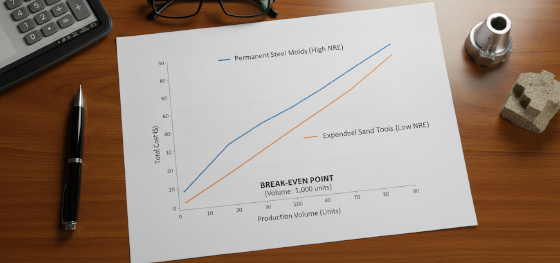
How do engineers determine the exact production volume where steel tooling becomes cheaper than sand?
By calculating the exact crossover point where the accumulated piece-price and machining savings of high-pressure injection offset the initial upfront tooling expense completely.
Pushing past five hundred units completely shifts the financial math. The comparison matrix below outlines how the rapid injection of metal quickly outperforms slow, manual sand casting processes.
| Cantidad de producción | Sand Casting Cost (Amortized) | Low-Volume Die Casting Cost |
|---|---|---|
| 100 Units | $35.00 (Cheaper) | $150.00 (High NRE) |
| 1,000 Units | $35.00 | $18.00 (Tooling amortized) |
| 5,000+ unidades | $35.00 | $8.50 (Lowest overall expense) |
Analyzing the die casting vs sand casting cost from a total cost of ownership perspective is non-negotiable. If your annual volume is two thousand pieces, paying the upfront tool fee will save you tens of thousands of dollars in secondary milling labor over the life of the project.
Sourcing Agility: Choosing the Correct Technology with JC Rapid
Why must hardware teams rely on experienced contract manufacturers for structural components?
Because raw casting houses that do not own in-house CNC shops will ignore your post-processing requirements, delivering rough parts that require expensive third-party machining.
JC Rapid offers a highly detailed, complimentary DFM review to show you exactly how to optimize your wall thicknesses and gating systems to minimize your die casting vs sand casting cost. We operate both sand casting and automated high-pressure injection lines in-house.
Deje de pagar por diseños sobreingenierizados y tarifas de envío innecesarias. Envíe sus archivos CAD complejos a nuestro equipo de ingeniería hoy. Realizaremos un análisis completo de flujo DFM manual y entregaremos una cotización manual extremadamente precisa y garantizada dentro de las veinticuatro horas posteriores a la presentación.
FAQ: Honest Answers About Surface Roughness and Molds
Does the complexity of the internal gating system increase my die casting vs sand casting cost?
Sí, los canales de corredera complejos consumen más metal en bruto por inyección. Diseñamos rutas de compuerta altamente optimizadas para minimizar el exceso de chatarra, manteniendo su desperdicio de material excepcionalmente bajo.
¿Puedo fundir zinc y aluminio en el mismo molde de acero?
No. Debido a que diferentes metales se contraen a velocidades completamente diferentes, verter aluminio en un molde diseñado para zinc resultará en piezas que no cumplen con sus tolerancias dimensionales.
¿Cobran tarifas adicionales por los Informes de Prueba de Material obligatorios?
Proporcionar certificaciones químicas completas (CoA) y certificados de cumplimiento RoHS con cada entrega es nuestra práctica estándar, incluido completamente sin costo adicional.
¿Qué tan rápido pueden sus ingenieros entregar un presupuesto manual final?
Evitamos por completo los estimadores automatizados inexactos. Nuestro equipo técnico revisa sus archivos CAD manualmente y entrega un presupuesto extremadamente preciso y garantizado dentro de las veinticuatro horas posteriores a la presentación.

