


La autoridad visual en electrónica de consumo a menudo se decide por la auditoría "Piano Black". Para los diseñadores industriales, una superficie de alto brillo es la máxima expresión de lujo, sin embargo, sigue siendo el acabado más implacable en la sala de inyección. En el panorama intransigente de Acabados superficiales en moldeo por inyección, los métodos tradicionales a menudo producen piezas marcadas por "Fantasmas": líneas de soldadura microscópicas y marcas de flujo que se vuelven evidentes bajo reflexión especular. Cuando un proyecto exige un acabado espejo SPI A-1 sin el costo y la carga ambiental de la pintura secundaria, el moldeo por inyección de alto brillo mediante Moldeo por Ciclo Térmico Rápido (RHCM) es la elección de ingeniería obligatoria. Esta tecnología utiliza gestión térmica dinámica para eliminar defectos superficiales en su origen. Jucheng Precision opera como una casa cosmética de alta fidelidad, utilizando herramientas especializadas calentadas por vapor y aceite para garantizar que sus carcasas, biseles y paneles de visualización posean el alma cristalina y el reflejo impecable que su marca necesita para dominar el mercado.

Eliminar la "Crisis de la Línea de Soldadura" requiere ir más allá de las temperaturas estáticas del molde. Las líneas de soldadura ocurren cuando dos frentes de polímero fundido se encuentran pero no logran fusionarse perfectamente debido a una superficie fría del molde. Esto resulta en una muesca microscópica en V que dispersa la luz, creando una "cicatriz" visible en la pieza. Jucheng Precision elimina estos artefactos de fabricación utilizando tecnología RHCM: calentando rápidamente la superficie del molde por encima del punto de Transición Vítrea (Tg) de la resina justo antes de la inyección. Esto asegura que los frentes de fusión se fusionen en una estructura monolítica y sin costuras. Una vez que la cavidad se llena, la herramienta se enfría rápidamente para asegurar la estabilidad dimensional. Esta guía deconstruye la física de la línea de soldadura, la mecánica térmica del ciclo rápido, y por qué nuestra asesoría técnica es la elección obligatoria para equipos de hardware que buscan una estética lista para la venta minorista sin el "Impuesto de Pintura"."
Anatomía del Fracaso: Por qué Fallan los Moldes de Alto Brillo Tradicionales
Dinámica RHCM: Dominando el Ciclo Térmico Rápido
Soberanía del Material: Eligiendo Resinas para Autoridad Especular
Rigor del Herramental: La Necesidad del Acero Espejo S136
Economía Estratégica: Saltándose la Línea de Pintura de Forma Segura
Protocolo JUCHENG: Ejecución de Alto Brillo Cero Defectos
Anatomía del Fracaso: Por qué Fallan los Moldes de Alto Brillo Tradicionales
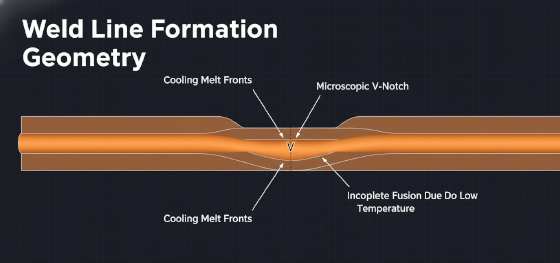
El estancamiento molecular en el frente de flujo es el principal arquitecto del rechazo cosmético. En el moldeo por inyección estándar, la herramienta se mantiene a una temperatura constante y relativamente fría para asegurar tiempos de ciclo rápidos. A medida que el plástico fundido—generalmente ABS o Policarbonato—alcanza las extremidades más lejanas de la pieza, comienza a perder energía térmica. Cuando dos de estos frentes de flujo en enfriamiento se encuentran alrededor de un saliente o una abertura, son demasiado viscosos para entremezclar sus cadenas poliméricas. Simplemente se "tocan", dejando un espacio microscópico en la superficie. Para una pieza mate, esto es invisible; para una pieza de alto brillo, esta "Línea de Tejido" actúa como un cañón que atrapa la luz, creando un defecto visual permanente. Además, el moldeo tradicional a menudo resulta en marcas de "Hesitación de Flujo" donde el plástico se detiene brevemente, dejando una ondulación que ninguna cantidad de presión de máquina puede aplanar. el moldeo por inyección de alto brillo exige una lógica física diferente—una donde la superficie del molde esté temporalmente tan caliente como la propia masa fundida, permitiendo una fusión "Sin Costuras" que logra una autoridad especular absoluta.
Dinámica RHCM: Dominando el Ciclo Térmico Rápido
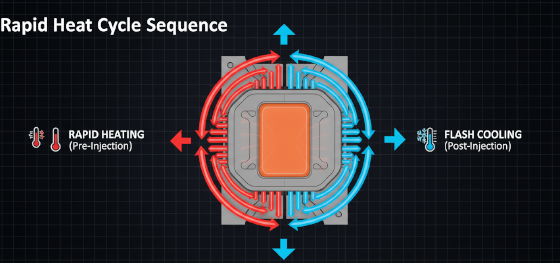
Thermal velocity dictates the success of mirror-like replication. Rapid Heat Cycle Molding (RHCM) eliminates the "Cold Tool" problem by utilizing a pulsating thermal strategy. Before the injection phase begins, Jucheng Precision technicians pump high-pressure steam or super-heated oil through the mold's internal channels, spiking the cavity surface temperature to 150°C in seconds. This prevents the plastic's "Skin" from freezing prematurely. The molten polymer enters a red-hot tool, flowing with the viscosity of water and replicating every micron of the SPI A-1 polish. Because the surface is molten, weld lines literally vanish. Immediately after the cavity is packed, the system switches to high-velocity chilled water, quenching the part to its solidification point. This "Thermal Snap" ensures that the part doesn't warp upon ejection. We don't just "mold parts"; we orchestrate a thermodynamic event that ensures your high-gloss housings emerge from the tool with a depth of color and surface perfection that traditional molding simply cannot replicate.
Soberanía del Material: Eligiendo Resinas para Autoridad Especular
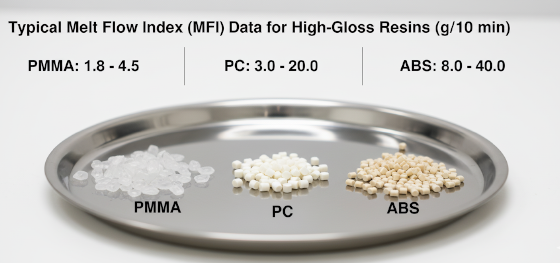
Chemistry defines the "Gloss Ceiling" of your component. Not all Los materiales de moldeo por inyección are suitable for mirror finishes. Amorphous resins like ABS, Polycarbonate (PC), and PMMA (Acrylic) are the undisputed kings of the high-gloss world because they lack the crystalline structure that creates surface "haze." However, for RHCM to be effective, the material must possess a high Melt Flow Index (MFI). Jucheng Precision engineers partner with you to select specialized "High-Gloss" grades from leaders like Sabic or Covestro. These resins are formulated to resist "Shear Burning" at the high velocities required by the RHCM process. If your part is intended for an automotive interior, we might recommend a PC/ABS blend to balance high-gloss aesthetics with the necessary impact resistance. We ensure that your material choice supports the thermal cycle, preventing the "Silver Streaks" (splay) that plague amateur high-gloss operations.
Rigor del Herramental: La Necesidad del Acero Espejo S136

Manufacturing a mirror is an exercise in steel purity. A el moldeo por inyección de alto brillo tool is only as good as the steel's molecular consistency. Standard P20 tool steel contains microscopic impurities and "Pits" that prevent it from achieving a true optical shine. At Jucheng Precision, we exclusively utilize S136 through-hardened stainless steel for our RHCM high-gloss molds. S136 possesses the extreme hardness (up to 52 HRC) needed to resist the thermal fatigue of rapid heating and cooling cycles. More critically, it can be hand-polished to an SPI A-1 diamond buff finish, achieving a surface roughness (Ra) of less than 0.01µm. Our facility houses 150+ CNC machines and specialized polishing bays where our veteran model makers spend hundreds of hours ensuring your mold cavity is a perfect mirror. This tooling rigor is what ensures your parts emerge without a single blemish, providing the visual authority needed for premium consumer electronics and medical displays.
Economía Estratégica: Saltándose la Línea de Pintura de Forma Segura

Sustainability is a byproduct of manufacturing efficiency. For decades, the only way to achieve a "Piano Black" finish was to mold a part and then send it to a secondary spray painting line. This process is expensive, has a high scrap rate due to dust inclusions, and generates significant VOC (Volatile Organic Compound) emissions. Utilizing el moldeo por inyección de alto brillo via RHCM allows you to achieve that identical look "In-Mold." By eliminating the paint line, JUCHENG helps you reduce your total part cost by 20% to 30% and shortens your production lead time by weeks. Furthermore, an RHCM part is 100% recyclable because it lacks the contaminated layers of primer and paint. We provide the manufacturing insurance needed to secure a "Retail-Ready" look that is as economically sound as it is environmentally responsible. We don't just "cut costs"; we engineer waste out of the project.
Protocolo JUCHENG: Ejecución de Alto Brillo Cero Defectos
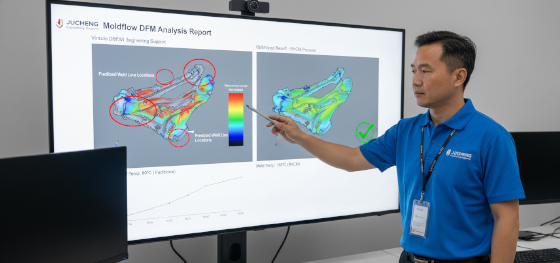
Engineering success at Jucheng Precision is built on the foundation of predictive simulation. We don't just "hope" your high-gloss parts look good; we verify them in the digital realm. When you upload a CAD file to our facility, our veteran engineers perform a comprehensive "Gloss Audit" using advanced Moldflow technology. We predict the exact locations of weld lines and "Jetting" risks, adjusting the gating and thermal cycle before the first block of steel is machined. Our integrated facility, equipped with over 150 CNC machines and specialized RHCM injection bays, ensures your hardware arrives retail-ready. Stop gambling your R&D budget on parts that require expensive paint to hide molding flaws. Not sure if your wall thickness is uniform or your material choice is optimal for a mirror finish? Upload your 3D CAD file to JUCHENG today for a Free DFM Review. Our experts will identify the optimal Acabados superficiales en moldeo por inyección for your brand, ensuring your transition to production is seamless, beautiful, and profitable.

