


El tradicional accesorio pesado de aluminio es una reliquia de una era en la que la fabricación era lenta y rígida. En el panorama moderno de alta velocidad de aplicaciones de la industria de impresión 3D, el cuello de botella para un lanzamiento exitoso de un producto no es la velocidad del husillo CNC, sino la espera de tres semanas para que un taller de herramientas frese un dispositivo de sujeción personalizado. Cada día que una línea de producción permanece inactiva debido a un calibre de inspección faltante o un nido de ensamblaje roto es un día de capital perdido. Este es el vacío estratégico llenado por plantillas y accesorios impresos en 3D. Es un giro técnico que permite a los ingenieros tratar el hardware de la fábrica con la misma agilidad iterativa que un prototipo. Al reemplazar las placas de metal pesadas y costosas con polímeros de alta resistencia optimizados topológicamente, las empresas pueden reducir los plazos de entrega de semanas a horas, mejorando radicalmente la seguridad física de su fuerza laboral.

JUCHENG ha pasado una década integrando la tecnología aditiva en el corazón de los entornos de fabricación ajustada. Entendemos que una plantilla es más que un soporte; es una interfaz de precisión que debe sobrevivir al aceite, el calor y el impacto constante. Un accesorio mal diseñado conduce a "trabajo desechado" y lesiones por esfuerzo repetitivo para el operador. Nuestra instalación utiliza sistemas avanzados de MJF y FDM industrial para producir herramientas funcionales que cierran la brecha entre las limitaciones de 3 ejes y la necesidad ergonómica. Esta guía va más allá de las maquetas visuales básicas para explorar la física estructural del refuerzo de fibra de carbono, la lógica económica de la liquidación de configuraciones y por qué el enfoque integrado de JUCHENG para plantillas y accesorios impresos en 3D es el eslabón final obligatorio en una cadena de suministro verdaderamente ágil.
La rentabilidad en el piso de ensamblaje se gana eliminando la fricción de la interacción humano-máquina. No solo está comprando un bloque de plástico; está diseñando un entorno personalizado que previene el error humano y acelera el rendimiento. Ya sea que esté construyendo un nido de alineación complejo para un colector aeroespacial o una simple guía de perforación para un electrodoméstico, la lógica de la impresión es su mayor activo competitivo. Analicemos los pilares técnicos de las herramientas aditivas industriales y veamos cómo JUCHENG transforma la visión digital en una realidad estructural en el taller.
Soberanía ergonómica: Protegiendo el rendimiento del operador
Fortificación del material: Por qué la fibra de carbono y el ASA dominan el piso
Libertad geométrica: Diseñando grippers conformables para robótica
Recálculo económico: Comparando CNC de aluminio vs. plantillas impresas en 3D
Estándar integrado de JUCHENG: Validando la herramienta funcional
Soberanía ergonómica: Protegiendo el rendimiento del operador
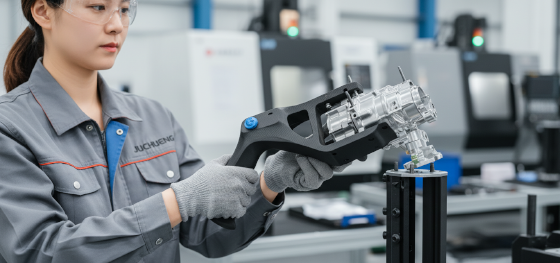
La fatiga es un saboteador silencioso de la calidad. En entornos de ensamblaje de alto volumen, el peso de una herramienta de inspección manual o una guía de perforación manual impacta directamente la tasa de rechazo. Tradicionalmente, estas herramientas se fresaban de aluminio o acero porque era la única forma de garantizar la rigidez. Sin embargo, una plantilla de aluminio de 5 kg manejada por un operador ocho horas al día provoca fatiga, tiempos de ciclo más lentos y un mayor riesgo de lesiones por esfuerzo repetitivo (LER). plantillas y accesorios impresos en 3D permiten un replanteamiento radical del diseño centrado en el ser humano. Al utilizar polímeros ligeros pero rígidos, JUCHENG puede reducir la masa de una herramienta manual hasta en un 70%.
We go beyond simple weight reduction by engineering "Organic Grips." Because 3D printing allows for complex, anatomical shapes at no extra cost, we can design handles that fit the natural contours of the human palm, reducing the clamping force required by the operator. This "Ergonomic Sovereignty" means your assembly line moves faster and with fewer errors. We can also integrate "No-Mar" surfaces—utilizing soft TPU inserts inside a rigid nylon frame to prevent the fixture from scratching a high-polish automotive trim or a sensitive medical device. By designing the tool for the human hand, JUCHENG ensures that your factory’s most valuable asset—its workforce—remains efficient and safe throughout the entire production shift.
Fortificación del material: Por qué la fibra de carbono y el ASA dominan el piso
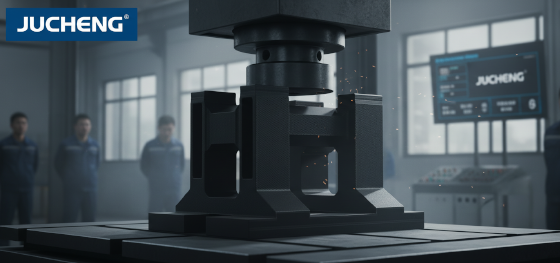
The primary criticism of plastic tooling is that it "won't survive" the harsh environment of a metalworking shop. This is a technical misconception born from experience with low-grade hobbyist materials. Industrial plantillas y accesorios impresos en 3D at JUCHENG are constructed from reinforced composites that possess metal-like stiffness. Our primary weapon for structural fixtures is Nylon-CF (Carbon-Fiber Reinforced Polyamide). This material utilizes microscopic carbon fibers to provide a tensile modulus that rivals soft aluminum, ensuring the jig doesn't deflect when a drill bit or a high-torque wrench is applied.
For outdoor environments or components exposed to intense sunlight and temperature shifts, we utilize **ASA** (Acrylonitrile Styrene Acrylate). Unlike standard ABS, which yellow and become brittle under UV radiation, ASA is a weather-resistant survivor. We use it to build inspection gauges for automotive exterior body panels and agricultural machinery. These "Material Fortifications" allow our fixtures to survive thousands of wash-down cycles, chemical exposure to coolants, and constant mechanical impacts. We treat material selection as an engineering audit; if a jig needs to hold an H7 bore during a heavy assembly press-fit, we select the composite with the necessary compressive strength. This level of technical oversight ensures your plastic tooling performs as a structural partner, not just a temporary mockup.
Libertad geométrica: Diseñando grippers conformables para robótica

Traditional machining is a slave to the "Line-of-Sight." If a milling tool cannot reach it, the jig cannot hold it. This results in boxy fixtures that often fail to secure organic or complex 3D shapes effectively. aplicaciones de la industria de impresión 3D in the robotics sector exploit a different logic: "Conformal Geometry." We can print robotic grippers (End-of-Arm Tooling) that are the exact negative of your part’s complex surfaces. This allows for a much more secure "wraparound" grip, eliminating the part-slippage that leads to assembly line shutdowns.
JUCHENG’s engineers utilize topological optimization to design grippers that are not only perfectly contoured but also hollowed for weight savings. We integrate internal air channels for vacuum suction directly into the structure of the part—a feat that would require complex drilling and manifold assembly in metal. This integration reduces the mass of the robot's arm, allowing it to move faster and stop with more precision. For a high-speed automotive assembly line, saving 200ms on every robotic cycle translates to thousands of extra units per year. By leveraging the geometric freedom of additive manufacturing, we deliver "Digital Grippers" that are faster, safer, and much more accurate than their legacy metal counterparts, locking in the efficiency of your automated systems.
Recálculo económico: Comparando CNC de aluminio vs. plantillas impresas en 3D
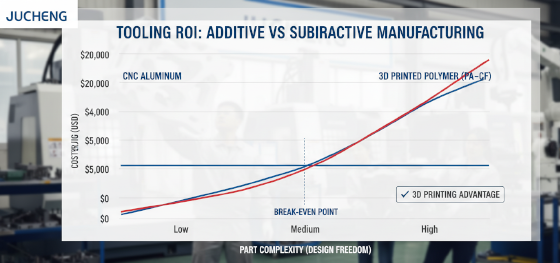
Economics govern the factory floor, and the cost structure of plantillas y accesorios impresos en 3D is radically different from traditional tool-room work. When you mill a jig from a solid block of aluminum, you are paying for three things: the raw metal, the 5-axis machine time, and the highly skilled labor of the machinist. If the design changes, the entire cost is lost. Additive manufacturing replaces this with a "Complexity-Agnostic" cost model. Whether a jig has a simple flat face or a complex internal lattice, the print cost is primarily based on material volume and time.
At Jucheng Precision, we perform a "Total Cost of Quality" (TCQ) audit for our clients. We often find that while a CNC-machined jig might be more durable over a five-year lifespan, the agility of 3D printing provides a better ROI for iterative production. You can replace a worn 3D printed part five times for the cost of one aluminum part. This allow you to update your tooling as your product design evolves, avoiding the "Sunk Cost" trap that forces companies to stick with outdated designs because their tooling was too expensive to replace. For low-to-medium volume production, the 3D printed path is a financial shield, preserving your capital for market development rather than shop-floor metal. We help you find the "Breakeven Moment," ensuring your tooling budget is optimized for the actual lifecycle of your product.
Estándar integrado de JUCHENG: Validando la herramienta funcional
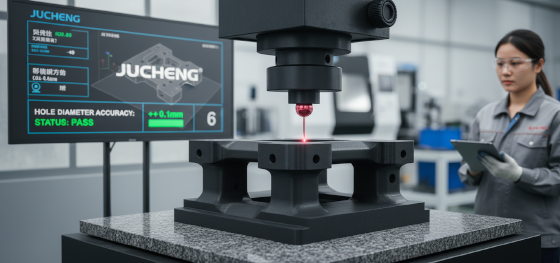
The final hallmark of a professional manufacturing partner is the transition from "model" to "verified tool." A jig is only useful if its dimensions are a technical truth. Jucheng Precision operates a unified quality ecosystem where our additive and subtractive departments share the same high-resolution metrology lab. We don't just "hit print" on your plantillas y accesorios impresos en 3D; we validate them against your master CAD data.
We utilize high-precision CMM (Coordinate Measuring Machine) probes and laser scanners to provide a 100% inspection report for every critical jig. We verify the "True Position" of every locating pin and the "Surface Profile" of every conformal face. This transparency is vital for our aerospace and automotive partners who must prove their assembly line consistency to external auditors. When you receive a tooling package from JUCHENG, you aren't just getting plastic shapes; you are getting verified engineered solutions that are ready to go to work. We bridge the gap between lean manufacturing theory and physical, shop-floor excellence. Whether you are scaling up a new assembly line or looking to optimize a legacy production cell, our expertise in high-performance additive tooling ensures your vision is delivered with absolute integrity. Contact Jucheng Precision today for a technical DFM review and see how our 3D printed fixture protocols can clarify and armor your next factory breakthrough.

