


La velocidad es una droga peligrosa en la fabricación. Cuando observas la proceso de impresión 3D, la mayoría de las tecnologías están obsesionadas con láseres y calor, pero estas fuentes de energía crean sus propios cuellos de botella en términos de volumen de construcción y distorsión térmica. impresión 3d por inyección de aglutinante ofrece una alternativa radical al tomar prestada su lógica principal de la impresora de inyección de tinta de oficina. En lugar de usar calor de alta potencia para fundir material punto por punto, utiliza una matriz de múltiples boquillas para rociar un agente aglutinante líquido sobre un lecho de polvo, capa por capa. Este proceso de construcción "en frío" elimina las ataduras de la deformación inducida por calor, permitiendo la producción de moldes de fundición de arena masivos o lotes de preformas metálicas complejas a una velocidad que deja a los sistemas basados en láser en el polvo.
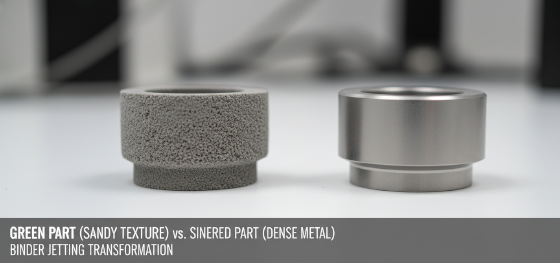
En JUCHENG, analizamos la fabricación aditiva a través de la lente fría de la integridad mecánica. Entendemos que, aunque la inyección de aglutinante es un milagro de rendimiento, introduce un desafío significativo de segunda etapa: la transición de una pieza "verde" frágil a un componente funcional completamente denso. Para los ingenieros de las industrias de fundición y automotriz, esta tecnología es un cambio de juego para la creación rápida de herramientas y la producción de machos de arena. Sin embargo, para aquellos que buscan resistencia metálica de misión crítica, las compensaciones en porosidad y contracción deben gestionarse meticulosamente. Esta guía va más allá del bombo de marketing para explorar la realidad hidrodinámica de la unión por inyección de tinta, los cambios arquitectónicos en el trabajo moderno de fundición, y por qué el enfoque de JUCHENG en DMLS de alta densidad a menudo sirve como la corrección necesaria para diseños que requieren invencibilidad estructural absoluta.
La verdadera eficiencia no se trata solo del tiempo en la máquina; se trata de la fiabilidad del resultado final. En el mundo de la fusión líquido-sobre-polvo, el éxito se encuentra en la química del aglutinante y la paciencia del horno de sinterización. Ya sea que esté construyendo un núcleo interno complejo para un bloque de motor de alto rendimiento o una serie de maquetas metálicas de baja densidad, la lógica del chorro es una herramienta poderosa. Desglosemos las leyes físicas de la orquestación de gotas y veamos cómo JUCHENG navega el abismo entre la arena cruda y la realidad ingenieril.
Lógica de inyección de tinta en un lecho de polvo: Mecánica de la unión
Acelerando la fundición: Moldes de arena digitales
Fragilidad de la pieza verde: Supervivencia en el horno de sinterización
Prediciendo la contracción: Matemáticas geométricas en la inyección de aglutinante
Selección técnica de JUCHENG: Cuando DMLS supera al chorro
Lógica de inyección de tinta en un lecho de polvo: Mecánica de la unión
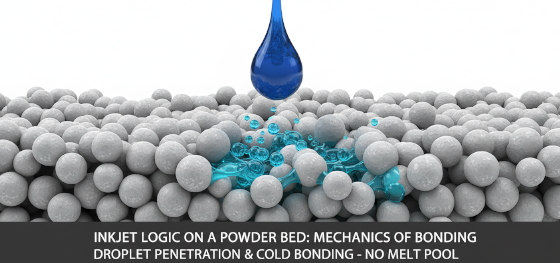
Para dominar impresión 3d por inyección de aglutinante, primero debe comprender el concepto de saturación localizada. La máquina opera con un cabezal de impresión recíproco que contiene miles de boquillas diminutas, similar a las impresoras de inyección de tinta industriales de alta gama. A medida que el cabezal barre un lecho de arena o polvo metálico, deposita un volumen preciso de resina líquida. Esta resina actúa como un pegamento químico, humedeciendo la superficie del polvo y penetrando en los espacios entre partículas mediante acción capilar. A diferencia de los sistemas basados en láser que luchan contra la física de la expansión y contracción térmica, la inyección de aglutinante es un proceso de "temperatura ambiente" durante la fase de construcción. Esto significa que no se acumulan tensiones residuales en la pieza mientras se forma, lo que permite la creación de piezas masivas y estables que permanecen planas y fieles en la placa de construcción.
La brillantez técnica aquí es la velocidad de deposición. Debido a que el cabezal de impresión puede expulsar millones de gotas por segundo, una sola capa se puede completar en menos de un minuto, independientemente de cuántas piezas haya en el lecho. En JUCHENG, calibramos el volumen de gota y la "relación polvo-aglutinante" para cada construcción específica. Si la saturación es demasiado alta, la pieza pierde resolución a medida que el líquido se filtra en el polvo circundante; si es demasiado baja, la pieza carece de la "resistencia en verde" necesaria para sobrevivir al manejo posterior a la impresión. Este equilibrio es el desafío principal de la etapa de inyección. Al gestionar la hidrodinámica de la unión, producimos preformas con alta fidelidad, asegurando que las cavidades internas y las geometrías externas complejas de su diseño se capturen con precisión nítida antes de que entren al calor del horno.
Acelerando la fundición: Moldes de arena digitales
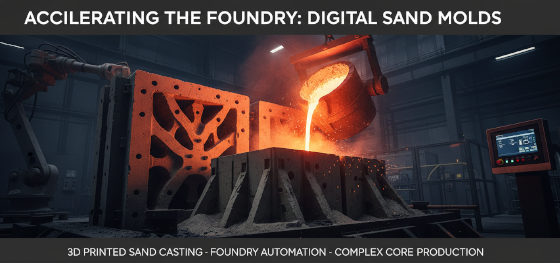
The industry that has most aggressively adopted impresión 3d por inyección de aglutinante is the traditional foundry. In the past, creating a complex sand mold for a large engine block or a turbine housing required weeks of pattern-making and manual labor. If the design changed, the entire pattern had to be rebuilt. Binder jetting erases this bottleneck by printing the sand mold directly from a CAD file. This is "Digital Sand Casting." We use high-purity silica or ceramic sand mixed with a high-performance binder to build molds that can withstand the violent thermal shock of molten iron or aluminum.
The value for the engineer is found in "Impossible Geometry." Because the binder jet can create internal cores with undercut features and organic vents that no physical pattern could ever pull out of a mold, you can design parts for maximum fluid efficiency. JUCHENG utilizes this digital foundry approach to shorten lead times for cast prototypes from months to days. This agility allows automotive and heavy-machinery designers to iterate on their thermodynamic models with real-world cast metal parts, ensuring that the cooling performance of a production engine is verified long before the final assembly line is built. By digitizing the oldest manufacturing craft on earth, binder jetting has turned the foundry into a high-speed innovation lab.
Fragilidad de la pieza verde: Supervivencia en el horno de sinterización
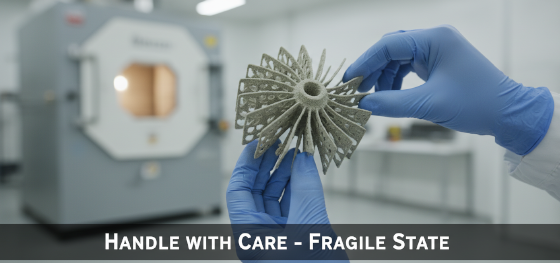
When we move from sand to metal, the proceso de impresión 3D in binder jetting becomes a two-stage marathon. The part that comes out of the powder bed is known as a "Green Part." It is essentially a delicate sandcastle made of metal dust held together by a tiny amount of glue. In this state, the part has zero mechanical strength; a firm squeeze with a human hand will crumble it into dust. The real challenge of metal binder jetting is the "Debinding and Sintering" phase. The green preform must be moved into a high-temperature furnace where the binder is burned away and the metal particles are heated until they fuse together.
This transition is a technical high-wire act. As the binder vanishes, the part is momentarily unsupported at a molecular level. If the furnace ramp-rate is too fast, the internal gases will expand and cause the part to explode or bloat. At Jucheng Precision, we manage this "Thermal Metamorphosis" through a multi-stage cycle in a controlled-atmosphere furnace. We account for the fact that as the metal fuses, the part will shrink significantly—often by as much as 20% in volume. For parts requiring high functional strength, we may also perform "Infiltration," where a second metal with a lower melting point (like bronze) is drawn into the pores of the steel preform to create a dense, composite solid. This multi-step journey is why binder jetting is a process of metallurgical patience. It offers massive speed in the printing stage, but it requires a master's touch in the thermal stage to ensure the part doesn't lose its soul in the fire.
Prediciendo la contracción: Matemáticas geométricas en la inyección de aglutinante
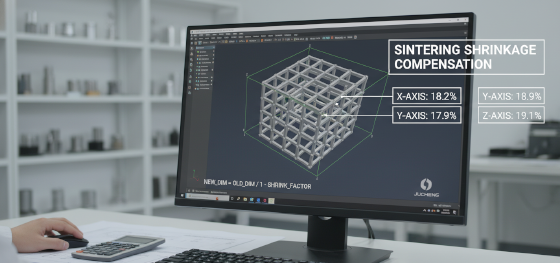
How do you maintain a +/- 0.1mm tolerance on a part that shrinks by 20%? This is the central engineering riddle of impresión 3d por inyección de aglutinante. Unlike CNC machining, where you cut the part to its final size, binder jetting requires you to design a part that is physically larger than it should be. The "Sintering Math" is the most valuable intellectual property in an industrial shop. You must calculate not just the linear shrink, but the "Gravity Sag" that occurs as the part softens in the furnace. Large overhangs and tall vertical walls will deform under their own weight if not correctly oriented or supported by ceramic fixtures.
At Jucheng Precision, our CAM engineers utilize advanced simulation software to predict these movements. We apply "Non-Uniform Scaling" to your CAD models, compensating for the fact that parts often shrink differently in the X and Z axes due to powder settling and bed friction. This predictive logic is essential for functional preforms. While binder jetting will never match the absolute precision of a 5-axis mill, our ability to control the shrink ensures that your large metal prototypes have the "near-net-shape" accuracy needed for functional assembly. We treat the shrinkage not as an error, but as a manufacturing parameter that must be engineered, allowing us to deliver complex, large-scale metal preforms that other shops simply cannot hold to tolerance.
Selección técnica de JUCHENG: Cuando DMLS supera al chorro
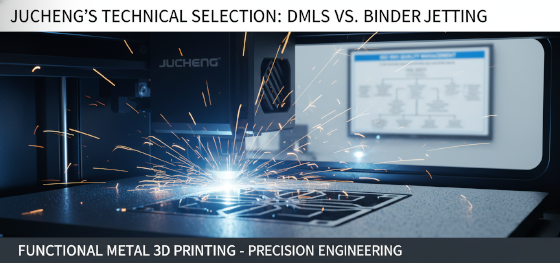
Choosing a manufacturer is a move of technical trust. At Jucheng Precision, we act as unbiased advisors for your proceso de impresión 3D. We are honest with our clients: binder jetting is the champion of speed and large-scale sand molding, but it has limitations for functional metal parts. Because the resulting metal parts are often porous (unless infiltrated), they lack the extreme fatigue strength and 99.9% density provided by JUCHENG’s core competency: DMLS (Direct Metal Laser Sintering).
If you are building a visual metal mock-up or a complex sand mold, we will direct you toward our high-speed Binder Jetting line to save you money and time. However, if your design involves high-pressure hydraulics, rotating aerospace nodes, or medical implants, we will pivot your project toward our DMLS and 5-Axis CNC cell. This technical honesty is the cornerstone of our brand. We don't just "push" the technology we have; we provide the solution that satisfies the physics of your design. When you receive a component from JUCHENG, you are getting the benefit of a diversified manufacturing hub that understands when to use the speed of the jet and when to use the precision of the laser. Contact our engineering team today for a comprehensive DFM review and let our multi-technology protocols clarify and secure your next manufacturing breakthrough.

