


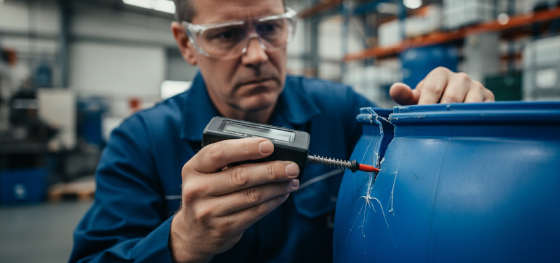
Standing next to the clamping unit, the violent pneumatic hiss of 100 PSI air expanding molten polymer is a sound that defines high-volume hollow fabrication. Last month, a tier-one automotive supplier handed me a ruptured coolant reservoir. Running my thumb along the torn edge, I instantly felt the fatal flaw: severe corner thinning. The previous manufacturer failed to program the parison correctly, allowing the plastic to stretch like a cheap balloon until it burst under minimal kinetic vibration. Specifying a blow molding machine requires brutally precise thermodynamic control to prevent structural suicide.
Choosing between extrusion blow operations and traditional high-pressure injection dictates the absolute financial survival of your custom container project. These two technologies operate under entirely hostile physics. Injection aggressively crams solid plastic into a highly restricted steel void, guaranteeing surgical micron-level tolerances. Conversely, blow molding expands a glowing tube of soft resin outward against a chilled aluminum wall, prioritizing massive volumetric scale and cheap tooling over tight internal geometry.
Mastering this specific manufacturing matrix eliminates catastrophic non-recurring engineering (NRE) losses. Procurement engineers must ruthlessly evaluate pinch-off flash, uncontrollable internal diameters, and raw tooling amortization curves. Precision hardware scaling relies strictly on matching the designated forming process to the component's exact burst pressure limit.
contenido:
Blow Molding vs Injection Molding: How Do Mechanics Differ?
When Should You Specify Blow Molding for Custom Plastics?
When MUST You Avoid Blow Molding in Production?
How Does Parison Programming Prevent Wall Thinning?
What Are the True Tooling Costs for Hollow Parts?
How Does Jucheng Optimize Hollow Fabrication in Shenzhen?
What Are the Most Critical Blow Molding FAQs?
Blow Molding vs Injection Molding: How Do Mechanics Differ?

Does blow molding create parts the same way as injection? Absolutamente no. El moldeo por inyección utiliza émbolos hidráulicos para inyectar resina fundida hacia adentro en una cavidad de acero cerrada, mientras que el moldeo por soplado utiliza aire comprimido para inflar un tubo de plástico hueco hacia afuera contra un molde abierto.
Los sistemas de inyección de alta presión bloquean placas masivas de acero H13 con cientos de toneladas de fuerza. La máquina dispara termoplástico líquido en cada grieta microscópica, estableciendo un control absoluto sobre las dimensiones geométricas exteriores e interiores. Si un plano exige un orificio interno perfectamente cilíndrico para aceptar un rodamiento a presión, el moldeo por inyección lo ejecuta sin fallos.
Las operaciones de soplado sacrifican completamente el control interno por la velocidad externa. La extrusora deja caer un tubo de plástico hueco al rojo vivo (la preforma) entre dos mitades de molde de aluminio. El molde se cierra, pellizcando el fondo, y un pasador de soplado lanza aire comprimido en la parte superior. El plástico se infla, golpea las paredes de aluminio enfriadas y se congela instantáneamente. Solo controlas la forma exterior; la superficie interior permanece caótica y sin dimensiones matemáticas.
| Métrica de Fabricación | Moldeo por Soplado por Extrusión (EBM) | Moldeo por Inyección Estándar | Impacto en Ingeniería |
|---|---|---|---|
| Objetivo Geométrico | Recipientes huecos grandes de una sola pieza | Estructuras sólidas o con nervaduras complejas | La inyección no puede fabricar botellas cerradas |
| Control de Tolerancia Interna | Cero (Pared interna impredecible) | Extremo (Precisión a nivel de micras) | El moldeo por soplado falla en requisitos de ajuste a presión |
| Inversión Inicial en Herramientas (NRE) | Very Low (Soft aluminum molds) | Massive (Hardened H13 steel) | EBM slashes startup prototyping budgets |
| Operating Pressures | Low (100 to 150 PSI Air) | Brutal (10,000+ PSI Hydraulic) | Low pressure enables cheaper mold metals |
When Should You Specify Blow Molding for Custom Plastics?

Is air-expansion the only way to manufacture large industrial fluid tanks? Yes. Specify this technology exclusively for single-piece, seamless hollow geometries like automotive fuel tanks, medical fluid reservoirs, and massive chemical transport drums.
Attempting to CNC machine or injection mold a fifty-gallon chemical drum is physically impossible without splitting the design into two halves and welding them together. Any post-process weld seam introduces a catastrophic failure point prone to leaking aggressive industrial acids. EBM extrudes the container as one continuous, seamless polymer membrane, guaranteeing absolute watertight integrity.
Furthermore, it dominates the lightweighting sector. Modern machines utilize co-extrusion heads that drop multiple layers of different plastics simultaneously. You can blow a lightweight HDPE gas tank with a microscopic internal EVOH barrier layer to trap hydrocarbon emissions perfectly, satisfying strict automotive regulatory demands without adding physical weight.
When MUST You Avoid Blow Molding in Production?

Can a blown part handle high-pressure hydraulic fluid? Never. Relying on an air-expanded vessel to contain extreme kinetic pressure guarantees a violent, explosive rupture along the notoriously weak pinch-off line.
When the two mold halves slam shut on the extruded parison, they physically crush and weld the bottom plastic together. This welded seam, known as the pinch-off, possesses significantly lower tensile strength than the continuous side walls. If engineers subject this vessel to high internal PSI, the container will instantly split open exactly at this welded seam, destroying the system.
You must immediately upgrade to solid CNC machining or complex injection molding whenever the blueprint demands sharp internal corners, rigid mounting bosses, or cross-sectional structural webs. The soft parison simply cannot stretch into deep, sharp 90-degree mold recesses without tearing itself apart. Attempting to blow mold load-bearing structural geometries is an expensive exercise in failure.
How Does Parison Programming Prevent Wall Thinning?

Why do blown parts always burst at the corners? Because plastic stretches thinner the further it has to travel. Without digital intervention, the corners of a square mold pull the molten resin to its absolute breaking limit.
Combating this physics problem requires advanced Parison Wall Thickness Programming. The extrusion head contains a dynamic hydraulic core that physically moves up and down as the plastic tube drops. The machine controller intentionally thickens the plastic tube in the exact zones that will eventually be blown into the deep corners of the mold.
By the time the high-pressure air stretches that specific thick band of plastic outward, it thins out perfectly to match the rest of the container's wall thickness. Elite technicians calibrate this 100-point profile mathematically. Ignoring this step yields dangerous, paper-thin corners that snap instantly when a forklift drops the pallet.
What Are the True Tooling Costs for Hollow Parts?
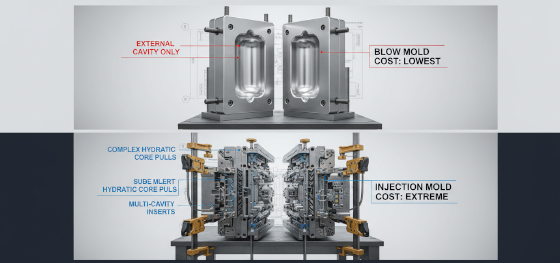
Is aluminum tooling significantly cheaper than steel dies? Massively. Because the pneumatic expansion pressure rarely exceeds 150 PSI, fabricators can safely carve molds from soft, inexpensive aerospace aluminum rather than hardened H13 tool steel.
An injection mold for an automotive dashboard requires machining a massive exterior cavity and a highly complex, precision-matched interior core. This dual-sided CNC milling incinerates fifty thousand dollars of NRE budget. A blow mold only requires carving the exterior shell halves. The compressed air essentially acts as a free, invisible internal core.
This structural simplicity slashes upfront capital requirements by up to seventy percent. Aluminum also boasts extreme thermal conductivity, allowing the molten plastic to chill incredibly fast. Faster cooling cycles drastically drive down the machine hourly rate, making EBM fiercely economical for low-margin, high-volume fluid containers.
How Does Jucheng Optimize Hollow Fabrication in Shenzhen?
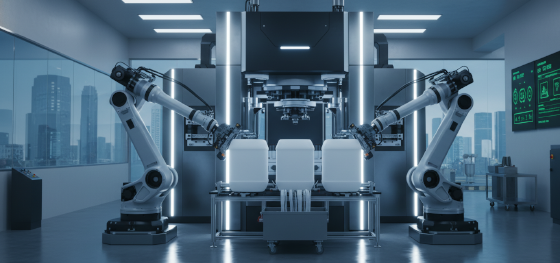
Can a single facility handle both complex blow molding and precision CNC machining? Yes. Operating deep within the [2026] Shenzhen precision manufacturing hub, Jucheng merges advanced pneumatic extrusion directly alongside 150-machine CNC fleets.
Navigating global hardware procurement demands the absolute elimination of fragmented supply chains. Blown parts frequently require secondary operations to achieve tight tolerances on the threaded neck or mounting flanges. We route freshly molded reservoirs straight from the press into our 5-axis milling centers to face-mill the critical seal zones, guaranteeing zero fluid leakage.
Our engineering teams intervene aggressively during the CAD review phase. Backed by strict ISO9001:2015 and IATF16949 automotive protocols, our Free DFM reviews identify fatal deep-draw ratios before we cut the aluminum mold. We dictate survivability without enforcing strict MOQ penalties on your R&D iterations.
What Are the Most Critical Blow Molding FAQs?

Resolving hardcore thermodynamic variables prevents devastating burst failures when transitioning custom hollow designs into aggressive mass production.
What causes the heavy flash at the top and bottom of the part?
Unlike injection molding which produces zero flash, EBM pinches a continuous tube of plastic at both ends. The excess material physically hangs outside the mold cavity and is crushed flat by the steel pinch plates. This "tail" and "moile" flash must be aggressively trimmed off manually or via automated robotic blades after demolding.
Why does the parison sag before the mold even closes?
Gravity brutally attacks the molten plastic. As the heavy tube extrudes downward, its own weight stretches the top thinner while the bottom pools thickly. If the cycle is too slow or the resin's melt strength is too weak, this "parison droop" completely ruins the programmed wall thickness distribution, ruining the entire batch.
What is Injection Stretch Blow Molding (ISBM)?
ISBM combines both technologies for maximum strength. It first injects a solid, test-tube-like "preform" into a steel mold to secure perfect threaded neck tolerances. The machine then physically stretches this hot preform with a core rod while simultaneously blowing high-pressure air. This biaxial stretching aligns the polymer chains, creating ultra-strong, crystal-clear PET water bottles.

