


For any CNC machinist, pure copper is often synonymous with frustration. It is arguably one of the most difficult materials to machine efficiently. The material is gummy, it drags against the cutting edge, and it creates long, stringy chips that wrap around tooling like a bird's nest. These "copper nests" force operators to pause machines frequently to clear debris, destroying cycle times and risking damage to sensitive surface finishes. Yet, the electrical and thermal industries demand the high conductivity that only copper can provide. This creates a fundamental conflict between design performance requirements and manufacturing reality.
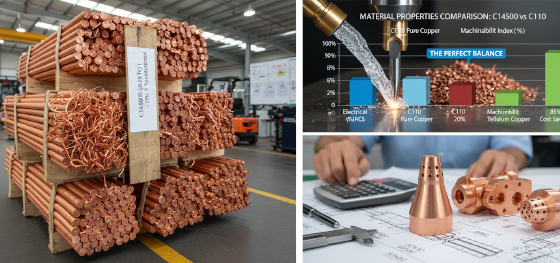
The solution lies in a specific, often underutilized alloy: c14500 tellurium copper machining. By introducing a tiny fraction of tellurium into the copper matrix, this material transforms from a machinist's nightmare into a production dream. It is widely regarded as the "Problem Solver" of the copper family, bridging the gap between the conductivity of pure elements and the machinability of brass.
At Jucheng Precision, we specialize in precision manufacturing for the electronics and automotive sectors. We often advise clients to switch to C14500 for high-volume electrical components. Why? Because while the raw material cost per kilogram is slightly higher than pure C110 copper, the massive gain in machining speed and process reliability can reduce your total part cost by up to 50%. This guide will dive deep into the properties, processing strategies, and economic advantages of this remarkable alloy.
The Metallurgy: Why Tellurium Changes Everything
Properties: 93% IACS Meets 85% Machinability
Best Practices for Machining C14500
Critical Applications: Nozzles and Connectors
The JUCHENG Calculation: Volume and Cost Savings
The Metallurgy: Why Tellurium Changes Everything
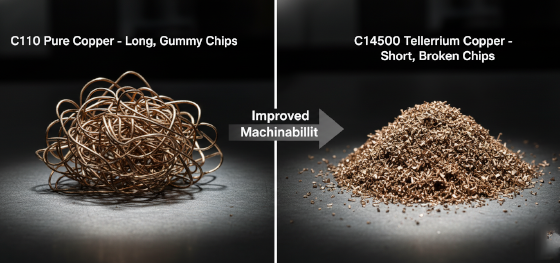
To understand why C14500 is superior for machining, we must first understand what makes pure copper so difficult. In standard C110 Electrolytic Tough Pitch (ETP) copper or C101 Oxygen-Free copper, the grain structure is soft, continuous, and highly ductile. When a cutting tool engages with pure copper, the material does not want to separate. Instead, it creates a "plastic flow." The tool essentially plows through the metal rather than cutting it cleanly. This generates immense heat and produces continuous ribbons of waste material that are dangerous to both the operator and the machine.
C14500 Tellurium Copper is an alloy typically composed of 99.5% copper and 0.5% tellurium (Te), sometimes with a trace of phosphorus (0.004-0.012%) to aid in deoxidation. While 0.5% sounds like a negligible addition, its impact on the metal's microstructure is revolutionary. Tellurium is insoluble in copper at room temperature. This means it does not dissolve into the copper crystal lattice. Instead, it precipitates out, forming microscopic copper telluride particles dispersed uniformly throughout the matrix.
These microscopic particles act as internal "stress risers" or chip breakers. When the shear stress of the cutting tool is applied during c14500 tellurium copper machining, these precipitates create weak points that cause the chip to fracture immediately. Instead of a long ribbon, you get small, manageable chips that fall away from the cutting zone. This phenomenon is very similar to how lead works in C360 brass, but tellurium provides a cleaner, more conductive alternative for specific applications.
Properties: 93% IACS Meets 85% Machinability
Engineering material selection is almost always a game of trade-offs. Usually, when you alloy copper to make it harder, stronger, or easier to machine, you destroy its electrical and thermal conductivity. For example, Beryllium Copper (C172) is strong but has lower conductivity. Brass is easy to machine but is a terrible conductor compared to copper.
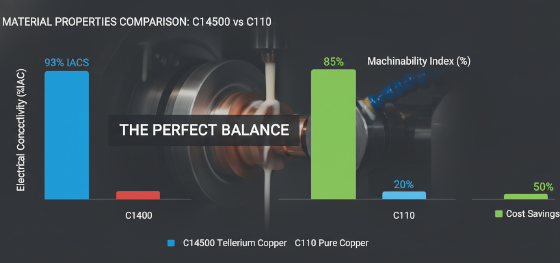
C14500 es único porque minimiza esta compensación mejor que casi cualquier otra aleación. Veamos los números que importan a los ingenieros. La conductividad del cobre recocido puro se define como 100% IACS (Estándar Internacional de Cobre Recocido). El cobre teluro C14500 conserva una impresionante clasificación de 90% a 93% IACS . Esto significa que para el 99% de las aplicaciones de transmisión de potencia del mundo real—como pines de alta corriente, bloques de conexión a tierra y puntas de soldadura—la diferencia de rendimiento entre C14500 y el cobre puro es insignificante.
Ahora considere el Índice de Maquinabilidad. Si el latón de corte libre C360 es el estándar al 100%, el cobre puro tiene un índice lamentable del 20%. Es gomoso, blando y notoriamente difícil de mantener tolerancias ajustadas. C14500 tiene un índice de 85%. Esto es un aumento de cuatro veces en maquinabilidad en comparación con el cobre puro. Esta clasificación del 85% permite a Jucheng Precision operar nuestros tornos suizos y centros de mecanizado de 5 ejes a altas RPM con velocidades de avance agresivas. Podemos lograr acabados superficiales tipo espejo (Ra 0.4 o mejor) directamente de la máquina sin necesidad de costosas operaciones secundarias de pulido o desbarbado.
Best Practices for Machining C14500
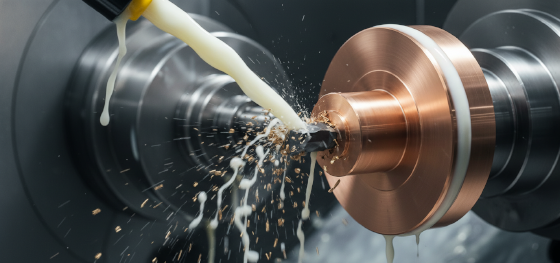
Si bien C14500 es de "mecanizado libre", lograr la pieza perfecta aún requiere experiencia específica. En Jucheng Precision, hemos desarrollado un conjunto de procedimientos operativos estándar para maximizar el potencial de esta aleación.
Primero está la Geometría de la Herramienta. Aunque C14500 rompe bien las virutas, sigue siendo relativamente blando. Recomendamos usar herramientas de carburo pulido con un ángulo de ataque positivo. Un ángulo de ataque positivo ayuda a cortar el metal limpiamente en lugar de empujarlo, lo que mantiene las fuerzas de corte bajas y la generación de calor al mínimo. Las herramientas recubiertas, como TiCN o AlTiN, pueden extender la vida útil de la herramienta, pero para el mejor acabado superficial absoluto, el carburo sin recubrir, afilado y pulido a menudo es el ganador para prevenir la acumulación de material en el filo de corte.
Segundo es la Gestión de Virutas y Refrigerante. Aunque las virutas son pequeñas, aún pueden acumularse en agujeros profundos. El refrigerante de alta presión (refrigerante a través del husillo si está disponible) es esencial al perforar agujeros ciegos profundos en componentes de C14500 como boquillas de gas. El refrigerante no solo evacua las virutas sino que también mantiene bajo control la expansión térmica. El cobre se expande significativamente con el calor; mantener la pieza fría es crítico para mantener tolerancias dimensionales de +/- 0.005 mm.
Finalmente, debemos abordar el Desbarbado. Aunque C14500 deja menos rebabas que el cobre puro, aún pueden ocurrir en las trayectorias de salida. Debido a que estas piezas a menudo se usan en entornos de alto voltaje, una sola rebaba suelta puede causar un cortocircuito catastrófico (arco eléctrico). Jucheng emplea una combinación de ciclos rígidos de desbarbado en máquina y procesos secundarios de tamborado térmico o magnético para garantizar que cada pieza esté 100% libre de rebabas antes de que entre a la sala de control de calidad.
Critical Applications: Nozzles and Connectors

¿Dónde brilla este material? Es la opción preferida en cualquier lugar donde necesite alta conductividad combinada con geometrías complejas que requieran extensas operaciones de perforación, torneado o fresado.
Boquillas de Corte por Plasma y Gas: Esta es quizás la aplicación más común. Las boquillas de corte son consumibles que están expuestos a calor extremo. Necesitan excelente conductividad térmica para alejar el calor de la punta y evitar que se derrita. Sin embargo, también presentan intrincados agujeros internos diminutos que dan forma al flujo de gas. C14500 permite a los fabricantes perforar estos agujeros profundos, rectos y precisos sin que la broca se desvíe o se rompa, lo cual es un riesgo constante con el cobre puro.
Conectores Eléctricos de Alto Volumen: Para pines de carga de vehículos eléctricos, enchufes banana y aparamenta industrial, la fiabilidad y el volumen son clave. Estas piezas a menudo tienen perfiles complejos con roscas, ranuras y moleteado. C14500 ofrece la resistencia al arco y la conductividad necesarias para una transferencia de potencia segura, al tiempo que permite la producción en masa de millones de unidades en tornos suizos.
Pistolas y Puntas de Soldadura: Similar to cutting nozzles, MIG and TIG welding tips require the same balance of thermal management and precision bore geometry. The anti-galling properties of Tellurium copper also help in preventing the welding wire from sticking to the tip during operation.
The JUCHENG Calculation: Volume and Cost Savings

This is the "Secret Sauce" we share with our customers during our Free DFM (Design for Manufacturability) reviews. Many engineers default to C101 or C110 pure copper, assuming that "purer is better." They design a pin and specify C101. However, they fail to account for the machine time.
Let's break down a hypothetical example of manufacturing 10,000 electrical pins.
Scenario A (Pure C110 Copper): The raw material cost is lower. However, the machine must run at 30% speed to prevent bird-nesting. The operator must stop the machine every hour to clear chips. Tool life is short. Cycle time per part is 3 minutes.
Scenario B (C14500 Tellurium Copper): The raw material cost is 15-20% higher. However, the machine runs at 100% speed. Chips break automatically, allowing for "lights-out" unmonitored production. Tool life is tripled. Cycle time per part is 45 seconds.
In high-volume manufacturing, machine time is almost always the most expensive variable. The massive reduction in cycle time with C14500 easily offsets the higher material cost, often resulting in a total project cost reduction of 30% to 50%.
If you need 10 prototypes, stick with C110 if you wish; the material availability is better for small chunks. But if you are scaling to production, switching to C14500 is a financial and technical necessity. At Jucheng Precision, we specialize in helping companies make this transition. We can source high-quality C14500 and verify it with our in-house spectrometer. Contact us today, and let us help you optimize your copper parts for speed, quality, and cost.

