


Las esquinas internas afiladas son los fantasmas que acechan a la ingeniería de precisión. En el mundo estéril y perfecto del modelado CAD, un ángulo interno de 90 grados son solo dos líneas que se cruzan. Pero en el piso de un taller de mecanizado de alta velocidad, esa misma esquina es una imposibilidad física. Cada herramienta sustractiva en un arsenal CNC, desde una fresadora de cara masiva hasta una fresa de punta microscópica, es redonda. Es un cilindro que gira a miles de revoluciones por minuto. Este fundamental geométrico es la razón principal por la cual el diseño del radio de esquina CNC es el capítulo más crítico en cualquier conjunto de pautas de diseño para mecanizado CNC. Ignorar la redondez de la herramienta no solo complica la fabricación; aumenta los costos e invita a fallas estructurales.
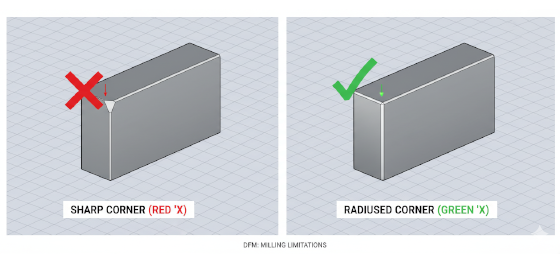
En Jucheng Precision, vemos miles de diseños donde la "estética del cuadrado" crea fricción de fabricación innecesaria. Cuando un diseñador insiste en una esquina afilada dentro de un bolsillo, sin darse cuenta está pidiendo una producción más lenta, herramientas especializadas más caras o procesos secundarios de electroerosión que inflan el presupuesto en un 300%. Nuestro objetivo como su socio de fabricación es alinear su intención de diseño con la realidad física del husillo. Esta guía desglosa la física de los filetes internos, la lógica económica del dimensionamiento del radio y las soluciones inteligentes como los huesos de perro que le permiten encajar componentes cuadrados en espacios redondeados sin arruinarse.
La eficiencia en la producción CNC se mide por el diámetro de la herramienta que puede utilizar. Un radio más grande permite una herramienta más grande y rígida, lo que se traduce en una eliminación de material más rápida y una calidad de superficie superior. Examinemos los pilares técnicos del diseño de esquinas que aseguran que sus componentes sean tan rentables como precisos.
Física de la redondez: por qué no existen los agujeros cuadrados
Correlación costo-radio: dimensionamiento para la eficiencia
Dinámica de bolsillos profundos: gestión de la longitud de la herramienta y la vibración
Diseño de cuadratura funcional: socavados y alivios
DFM colaborativo: detección temprana de errores de esquina
Física de la redondez: por qué no existen los agujeros cuadrados
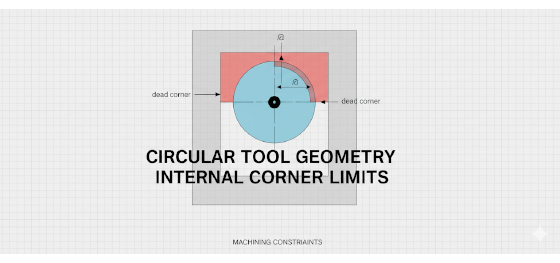
Para dominar el diseño del radio de esquina CNC, debe visualizar la trayectoria de la herramienta como un baile entre un cilindro giratorio y un bloque sólido. Una fresa es esencialmente una varilla giratoria con dientes. A medida que viaja a lo largo de un contorno, talla un camino que refleja su propio diámetro. Cuando esa herramienta llega a una esquina interna, solo puede acercarse a la esquina tanto como su propio radio lo permita. Si tiene una fresa de 10 mm, la esquina más afilada que puede crear físicamente es un radio de 5 mm. La ley de la fresa es absoluta: una herramienta redonda no puede tallar una esquina cuadrada.
Los diseñadores inexpertos a menudo colocan esquinas internas afiladas de 90 grados en sus archivos CAD porque quieren que una pieza específica se "asiente" perfectamente dentro de otra. Sin embargo, intentar lograr esto mediante fresado estándar requiere herramientas increíblemente pequeñas y múltiples configuraciones. Incluso entonces, la herramienta aún dejará un radio mínimo. La única forma de lograr una esquina interna realmente afilada de 90 grados en metal es mediante electroerosión por descarga eléctrica EDM o brochado, ambos agregan tiempo y gastos significativos al proyecto. En el pautas de diseño para mecanizado CNC used at Jucheng Precision, we advocate for "Fillet Optimization." By designing your internal corners with a radius slightly larger than the tool being used (e.g., specifying a 3.2mm radius for a 6mm tool), you prevent the tool from "burying" itself in the corner, which reduces heat and prevents the chatter that leads to surface defects.
Correlación costo-radio: dimensionamiento para la eficiencia
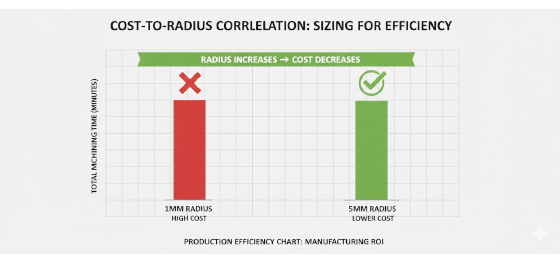
There is a direct, often exponential relationship between the size of your corner radii and the final price on your invoice. This is the "Economy of the Fillet." Small radii require small-diameter cutting tools. Small tools have less mass, which means they are less rigid and more prone to snapping under pressure. To prevent breakage, the machinist must reduce the spindle speed and the feed rate, resulting in significantly longer cycle times. A pocket with a 1mm corner radius might take four times longer to machine than the same pocket with a 5mm radius.
At Jucheng Precision, our DFM team identifies these cost-drivers during the first review. We suggest the "Plus-Ten-Percent" rule: if your assembly allows it, make the corner radius 110% of the radius of a standard tool size. For example, if we intend to use a 10mm end mill (5mm radius), designing a 5.5mm internal corner radius allows the tool to sweep through the corner without coming to a complete stop or engaging 100% of its surface area. This reduces the mechanical load on the spindle and allows us to maintain a constant feed rate. By slightly relaxing your el diseño del radio de esquina CNC, you enable JUCHENG to use more aggressive material removal strategies, passing those time savings directly back to your project’s budget. Remember, in CNC manufacturing, "sharp" is expensive, and "round" is efficient.
Dinámica de bolsillos profundos: gestión de la longitud de la herramienta y la vibración
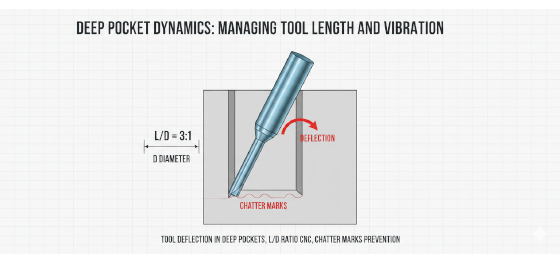
The challenge of corner radii becomes significantly more complex as the depth of the pocket increases. In pautas de diseño para mecanizado CNC, we refer to this as the "L/D Ratio"—the ratio of tool length to its diameter. If you design a pocket that is 50mm deep with 2mm corner radii, the machinist must use a 4mm tool that is long enough to reach the bottom. A tool that is 12 times longer than its diameter is like a piece of wet spaghetti; it will vibrate, deflect, and likely snap before it finishes the cut.
The rule of thumb we follow at Jucheng Precision is the "1/3 Rule": the internal corner radius should be at least one-third of the depth of the pocket. If your pocket is 30mm deep, your corner radii should ideally be 10mm or larger. This allows us to use a rigid, large-diameter tool that can reach the floor of the cavity without the vibration that ruins surface finishes. If a design absolutely mandates a small radius in a deep cavity, we are forced to use "staged machining," utilizing progressively smaller tools to nibble away at the corners. This adds multiple tool changes and hours of extra machine time. By aligning your el diseño del radio de esquina CNC with the depth of your features, you ensure that JUCHENG can deliver a part that is structurally sound and aesthetically clean, free from the "chatter scars" that occur when tools are pushed beyond their physical limits.
Diseño de cuadratura funcional: socavados y alivios
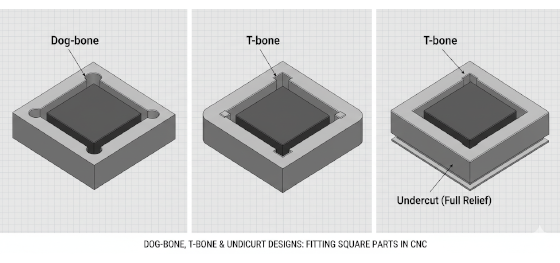
If your assembly requires a perfectly square object—like a PCB or a battery—to fit flush into a machined pocket, you might think you are stuck with expensive sharp corners. This is where "Relief Design" provides an engineering workaround. Instead of trying to cut a square corner, you can cut "past" the corner. The most common solution is the "Dog-Bone" or "T-Bone" relief. In this design, the CNC tool drills or mills a small circular area at each corner that extends beyond the 90-degree intersection.
This creates a clearance space where the sharp corner of the mating part can sit without interference. It is a brilliant way to achieve functional squareness while still using large, fast-cutting tools. Another option is the "Corner Undercut," where a tool enters from the side or bottom to relieve the corner. At Jucheng Precision, we help our clients implement these features during the DFM phase. We analyze the fitment requirements and suggest the least invasive relief pattern that satisfies your assembly logic. By embracing the circular nature of el diseño del radio de esquina CNC and utilizing these reliefs, you can maintain the "square" function of your assembly while exploiting the "round" efficiency of the CNC machine. It is the ultimate "cheat code" for cost-effective precision manufacturing.
DFM colaborativo: detección temprana de errores de esquina

The final hallmark of a world-class manufacturing partner is the ability to provide feedback before the first chip is cut. At Jucheng Precision, we don't just quote what is on the print—we audit it for survival. Our engineering team utilizes advanced software to perform a full "Radius Sweep" of your CAD model. We flag any internal corner that is too small for the pocket depth or that will require non-standard, fragile tooling. We treat pautas de diseño para mecanizado CNC as a collaborative conversation.
By working together during the design phase, we can often suggest radius modifications that look nearly identical to your original vision but can be machined 50% faster. We provide our clients with detailed DFM reports that highlight these opportunities for cost reduction. Whether you are building a prototype for a high-end consumer device or a production run of heavy-duty industrial manifolds, our expertise in el diseño del radio de esquina CNC ensures your components are delivered with absolute integrity and optimized pricing. We don't just follow the lines; we understand the physics behind them. Contact Jucheng Precision today for a free technical review and see how our design-for-manufacturing protocols can clarify and elevate your next precision project.

