


Los desastres en adquisiciones a menudo comienzan con una mala comprensión de la escalabilidad de fabricación. Las startups de hardware suelen quemar el 40% de su capital semilla simplemente porque utilizaron el método de fabricación incorrecto para una prueba piloto de veinte unidades. La narrativa de marketing en torno a la fabricación aditiva promete una revolución "sin herramientas", implicando que evitar moldes equivale a ahorrar dinero. Esta es una media verdad financiera peligrosa. Si bien la impresión 3D es, sin duda, el rey indiscutible del prototipo de "cantidad uno", su estructura económica colapsa en el momento en que intentas escalar. El debate sobre el costo del moldeo al vacío vs impresión 3d no es sobre tecnología; es sobre el "Punto de Equilibrio" matemático. Es el momento preciso donde el alto precio unitario de una pieza sinterizada por láser se cruza con la eficiencia amortizada de un molde de silicona. No identificar este punto de cruce transforma un pedido de prototipado rutinario en una variación masiva de partida que ningún CFO aprobará. Jucheng Precision opera como su salvaguarda financiera aquí, utilizando nuestra fábrica de doble capacidad para enrutar su pedido basado en el costo total del proyecto, no solo en la novedad tecnológica.

La Trampa Lineal: Por Qué la Impresión Nunca se Vuelve Más Barata
Mecánica de Amortización: Diluyendo el Costo de la Herramienta
The Crossover: Comparing Costs by Quantity
Variables Ocultas: Impacto de la Mano de Obra Post-Procesado
La Trampa Lineal: Por Qué la Impresión Nunca se Vuelve Más Barata
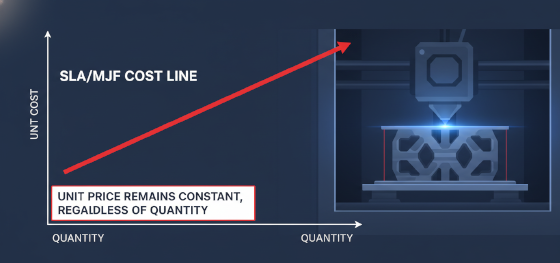
La fabricación aditiva sufre de una notable falta de "Economías de Escala". Considere la física de una máquina SLA o MJF: el láser debe trazar cada vector de cada capa. Si imprimir un colector complejo toma cuatro horas, imprimir diez de ellos toma cuarenta horas. El tiempo de máquina es lineal. El consumo de resina es lineal. En consecuencia, el precio por pieza se mantiene obstinadamente plano. Un proveedor podría ofrecer un descuento trivial del 5% por un pedido en lote, pero los factores fundamentales de costo no cambian. Estás pagando por "ocupación de máquina"."
Esta "Trampa Lineal" es financieramente invisible a bajos volúmenes pero se vuelve catastrófica a altos volúmenes. Si una pieza SLA de alta resolución cuesta $150 imprimirla, pedir treinta unidades resulta en una factura de $4,500. No hay eficiencia ganada porque el láser no puede moverse más rápido solo porque pediste más. Para un gerente de adquisiciones, esto representa un escenario de "costo unitario fijo", que es el enemigo de la producción en lotes. Estás pagando efectivamente una prima por un proceso "sin configuración" que ya no necesitas. Es por eso que la impresión 3D a menudo se caracteriza como la forma más cara posible de fabricar la pieza número 100, incluso si fue la forma más barata de fabricar la primera.
Mecánica de Amortización: Diluyendo el Costo de la Herramienta
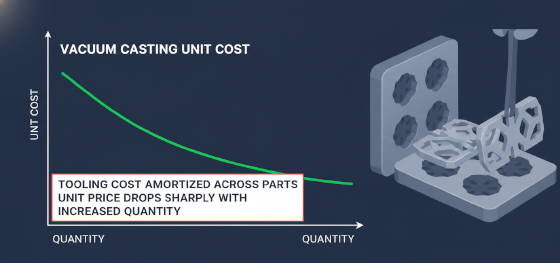
El vaciado al vacío introduces an upfront hurdle that magically lowers the finish line. To create the first part, we must build a master pattern and pour a silicone mold. For this separate amortization example, assume the master and first-mold setup costs $600, the casting rate is $40 per part, and one mold yields the required 20 accepted parts; these are illustrative inputs, not a company quotation. For a single unit, this is prohibitively expensive compared to the $150 print. However, the silicone mold is a multiplier. It can produce 20 to 25 copies before degrading. The cost of the liquid polyurethane resin and the labor to pour it is significantly lower than printing resin—perhaps only $40 per part.
Here is where the math of amortization takes over. If you order 20 parts, that initial $600 tooling cost is divided by 20, adding only $30 to each unit. Your total unit cost becomes $30 (tooling share) + $40 (part cost) = $70. Compare this to the flat $150 SLA print. You have effectively slashed your unit price by more than 50% simply by committing to a small batch. This curve only gets better as you maximize the mold life. By utilizing the mold to its full potential, you are diluting the setup cost into insignificance, transforming a "costly tooling process" into a high-efficiency production engine. The crossover depends on the quoted setup and per-part costs, usable mold life, and required acceptance scope rather than a universal quantity threshold.
The Crossover: Comparing Costs by Quantity
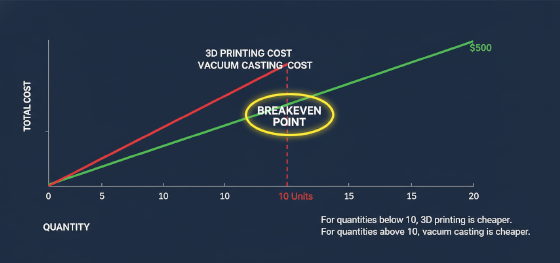
Identifying the exact moment to pivot from additive manufacturing to silicone molding requires simple algebra. For a separate hypothetical handheld-enclosure comparison, assume printing costs $150 per accepted part, the master and first silicone mold together cost $600, and each accepted casting costs $50. These illustrative rates are not a company quotation; compare the same finish, inspection, and delivery scope.
With these assumptions and no replacement mold required, five parts cost $750 by printing or $850 by casting. The totals are equal at six parts: 6 x $150 = $600 + 6 x $50 = $900. Casting is lower from seven parts while the same assumptions remain valid; at ten parts the totals are $1,500 and $1,100. At fifty parts, printing totals $7,500, while casting totals $600 + 50 x $50 = $3,100 plus the cost of any replacement molds. Fifty accepted castings require two molds only if each yields 25 accepted parts; at 20 accepted parts per mold, three molds are needed. Obtain replacement-mold prices separately rather than charging for another master or assuming replacements are free. Calculate the final savings from a like-for-like quotation.
Variables Ocultas: Impacto de la Mano de Obra Post-Procesado

Quoted piece price rarely tells the whole story. Labor is the silent killer of prototyping budgets. 3D printed parts, particularly SLA and MJF, do not emerge from the machine ready for the boardroom. They are covered in support structures or loose powder. Achieving a glossy, consumer-grade finish on a printed part requires aggressive manual sanding, filling, and painting. If you order twenty printed casings, a technician must hand-sand twenty individual parts. That is twenty hours of skilled labor billed at shop rates, often doubling the effective cost of the part.
Vacuum casting eliminates this redundant labor through "Master Pattern Efficiency." We invest significant labor into finishing just one single master pattern. We sand it, polish it, and paint it to perfection. The silicone mold then captures that texture down to the micron. Every part pulled from that mold emerges with that identical high-quality finish already applied. There are no layer lines to sand. There are no support scars to fill. You are paying for the finishing labor once, but receiving the benefit twenty times. When you factor in the "Cost of Finishing," the value proposition of casting becomes even more dominant for cosmetic prototypes.
JUCHENG Strategy: Optimized BOM Routing
Financial stewardship is a core component of our engineering service. Jucheng Precision does not simply execute orders; we optimize your Bill of Materials (BOM). When you submit a project, our quoting engine analyzes the geometry and quantity to determine the most fiscally responsible production route. If you need three functional brackets, we route them to our MJF machines. If you need fifteen cosmetic housings, we immediately flag the order for vacuum casting to save you money.
We act as your manufacturing CFO. Our "Bridge to Production" methodology ensures you are never overpaying for a prototype simply because of technological inertia. We provide transparent cost-benefit breakdowns, showing you exactly where the break-even point lies for your specific design. Stop guessing with your budget. Leverage our integrated factory floor to ensure every dollar spent on prototyping delivers maximum physical value. Contact our team today for a comprehensive cost analysis of your next project.

