


La precisión es una promesa hecha en el software CAD pero a menudo rota en el piso de la fábrica. Cuando se trata de plásticos de ingeniería, lograr Tolerancias de Mecanizado de Delrin consistentes es la prueba definitiva de la madurez técnica de un fabricante. El Delrin es un material que los ingenieros aman por su rigidez y maquinabilidad, pero su alto coeficiente de expansión térmica lo convierte en un "objetivo móvil" durante el ciclo de fabricación.
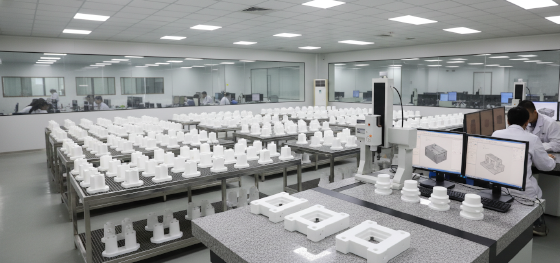
En Jucheng Precision, no vemos las tolerancias como una sugerencia; las vemos como un contrato obligatorio. El éxito en mecanizado cnc de pom delrin acetal requiere un dominio de las variables ambientales que la mayoría de los talleres simplemente ignoran. Ya sea que esté diseñando un microengranaje de alta velocidad o un cuerpo de válvula médica, comprender las fuerzas invisibles que desplazan sus dimensiones es crítico. Esta guía explora el rigor de ingeniería necesario para mantener las piezas de acetal dentro de las especificaciones más estrictas posibles.
Mantener una tolerancia de +/- 0.02 mm en plástico no se logra por suerte; se logra mediante una combinación de disciplina térmica, herramientas especializadas y metrología avanzada. En esta inmersión profunda, revelaremos los protocolos de fabricación que JUCHENG utiliza para estabilizar el Acetal y ofrecer resultados que otras instalaciones afirman que son imposibles para los polímeros.
contenido:
Definiendo el Estándar de Oro: Límites de Precisión del Acetal
La Trampa de la Expansión Térmica: Gestionando el Cambio Ambiental
Dinámica de Herramientas: Por Qué los Bordes Desafilados Destruyen las Tolerancias
Gestión de Tensiones Internas: Estabilidad Mediante el Recocido
Verificación y Validación: El Papel de la Inspección con MMC
Definiendo el Estándar de Oro: Límites de Precisión del Acetal
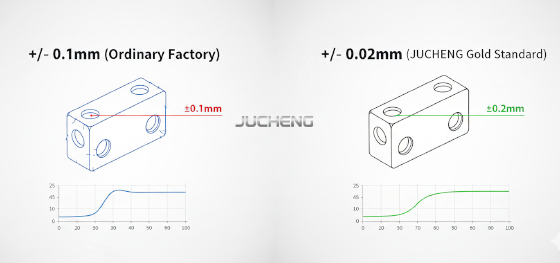
En el vasto mundo de los polímeros, el Delrin (Polioximetileno) se destaca como uno de los materiales más dimensionalmente estables disponibles para los ingenieros. Sin embargo, el término "precisión" varía enormemente dependiendo de a quién le pregunte. Un taller de mecanizado de propósito general podría considerar +/- 0.1 mm un éxito para una pieza de plástico. En Jucheng Precision, operamos en un escalón diferente. Para ensamblajes mecánicos críticos, logramos rutinariamente Tolerancias de Mecanizado de Delrin tan ajustadas como +/- 0.02 mm en componentes de tamaño pequeño a mediano. Este nivel de precisión es esencial para cojinetes de ajuste a presión, engranajes de alta velocidad y colectores deslizantes donde cualquier juego excesivo podría provocar vibraciones o fallas.
Lograr este estándar de oro requiere un cambio fundamental en cómo abordamos mecanizado cnc de pom delrin acetal. We recognize that Delrin is a semi-crystalline material. Its crystalline regions provide the strength, while the amorphous regions provide the flexibility. If the machining process is too violent, it can disrupt this balance, leading to localized "spring-back" where a feature physically moves after the tool has retracted. By utilizing high-speed spindles and maintaining a constant chip load, JUCHENG ensures that the material is sheared cleanly, preventing the elastic deformation that often ruins tight-tolerance specifications. We set the bar at the highest level because we understand that in the world of high-end robotics and medical devices, a few microns are the difference between a prototype that works and one that is destined for the scrap heap.
La Trampa de la Expansión Térmica: Gestionando el Cambio Ambiental

The single greatest enemy of precision in plastic is heat. Delrin has a coefficient of thermal expansion that is roughly five times higher than that of common steels. This means that a part can physically grow or shrink based on the temperature of the room or the friction of the cut. If a part is measured immediately after a heavy roughing pass while it is still warm to the touch, the dimensions recorded will be entirely false once the part cools down to room temperature. This "Thermal Trap" is where most manufacturers fail to maintain consistent Tolerancias de Mecanizado de Delrin.
Jucheng Precision solves this through a rigorous "Thermal Equilibrium" protocol. Our facility is climate-controlled to a stabilized temperature of 20 degrees Celsius. We allow raw material blanks to acclimatize to the shop floor for 48 hours before the first chip is cut. During the mecanizado cnc de pom delrin acetal process, we utilize high-pressure air-cooling or specialized flood coolants to carry heat away from the shear zone. Crucially, we utilize "rest cycles" between roughing and finishing passes. This allows any thermal energy trapped in the part to dissipate, ensuring that the final precision cuts are made into a stable, cold material. By managing the thermodynamics of the manufacturing environment, we eliminate the uncertainty of size-shift, providing our clients with parts that remain within spec from the production floor to the final assembly site.
Dinámica de Herramientas: Por Qué los Bordes Desafilados Destruyen las Tolerancias
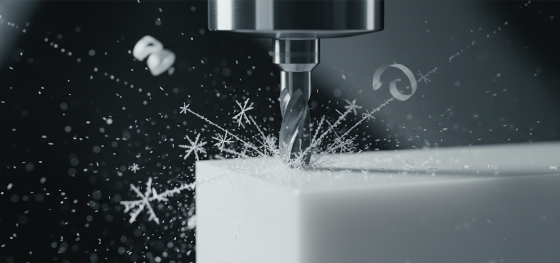
In metal machining, you can often "force" a tool through the material. In plastic, if the tool is not perfectly sharp, the material will simply deflect or bend away from the pressure. This deflection is the silent killer of Tolerancias de Mecanizado de Delrin. When a dull tool pushes against the plastic, it creates a compressive force. The tool thinks it is cutting the correct dimension, but once it moves away, the plastic "bounces back," leaving the part oversized or the bore undersized.
At Jucheng Precision, our tooling philosophy for mecanizado cnc de pom delrin acetal is built on the "Sharp Edge Mandate." We exclusively utilize high-positive rake carbide tools that are polished to a mirror finish. A sharp, polished edge reduces friction and allows the tool to slice through the acetal chains with minimal pressure. We also monitor tool life with extreme precision; the moment an edge shows even microscopic rounding, it is retired. This ensures that the cutting force remains constant throughout a production run, preventing the dimensional drift that occurs as tools wear down. Furthermore, we utilize specialized single-flute cutters for deep bores to ensure that chips are evacuated instantly. If chips are re-cut, they generate heat and localized pressure, both of which are fatal to maintaining tight tolerances. Our focus on the micro-mechanics of the cut is why JUCHENG can deliver complex acetal geometries that other shops simply cannot hold to print.
Gestión de Tensiones Internas: Estabilidad Mediante el Recocido
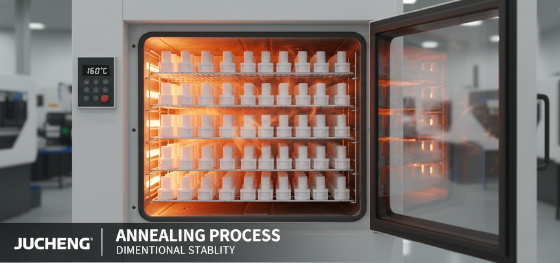
Residual internal stress is the "ghost" that causes parts to warp days after they are machined. All raw Delrin stock arrives at the shop with a certain amount of stress trapped inside from the extrusion process. When we remove large amounts of material during mecanizado cnc de pom delrin acetal, we are effectively cutting the "molecular ropes" that hold that stress in check. The result is a part that bows, twists, or cups. If your design features thin walls or a long aspect ratio, internal stress is the primary obstacle to achieving reliable Tolerancias de Mecanizado de Delrin.
Jucheng Precision employs a mandatory "Stress-Relief Annealing" cycle for all ultra-high-precision Delrin projects. We place the raw material or the rough-machined parts into a specialized oven, slowly heating them to a temperature just below their melting point and holding them there for several hours. This allows the polymer chains to relax and realign into their most stable state. The slow cooling phase that follows "locks" the material into this relaxed state. By the time we perform the final precision cut, the material is "dead"—meaning it no longer has the urge to warp or move. This extra technical step is what allows JUCHENG to deliver long, slender shafts and thin-walled manifolds that remain perfectly straight and within spec, even when exposed to fluctuating environmental conditions in the field.
Verificación y Validación: El Papel de la Inspección con MMC
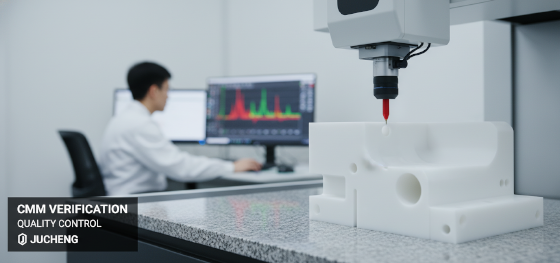
You cannot manage what you cannot measure. The final pillar of JUCHENG’s tolerance strategy is our investment in high-end metrology. While calipers and micrometers are fine for general work, they are insufficient for validating Tolerancias de Mecanizado de Delrin in the +/- 0.02mm range. The heat of a human hand holding a plastic part can change its dimension by several microns, leading to false readings and poor data.
Our quality control department utilizes high-resolution Coordinate Measuring Machines (CMM) and vision systems that measure parts without physical contact or excessive handling. We perform our measurements in a stabilized environment where the part has reached thermal equilibrium. Every high-precision order of mecanizado cnc de pom delrin acetal at Jucheng Precision comes with a comprehensive inspection report, providing a digital audit trail of every critical feature. This level of transparency is essential for our clients in the aerospace and medical industries, where documentation is as important as the physical part. When you partner with JUCHENG, you aren't just buying a part; you are buying the verified certainty that your Delrin components will fit and function exactly as intended. Contact our engineering team today for a free technical review and see how our precision manufacturing protocols can stabilize your next project.

