


Pocos sonidos son tan desalentadores en un taller de mecanizado de precisión como el agudo y cristalino "chasquido" de una pieza transparente que falla durante la etapa final de producción. Es posible que haya pasado horas perfeccionando el acabado superficial de una carcasa compleja, solo para que un solo orificio de montaje arruine toda la pieza durante los últimos diez segundos del ciclo. Esta es la realidad de trabajar con polimetilmetacrilato (PMMA). Es un material que exige respeto absoluto, especialmente cuando el proyecto implica perforar acrílico sin que se agriete. Debido a que el acrílico es un polímero sensible a las muescas, cualquier defecto menor creado durante el proceso de perforación actúa como un concentrador de tensiones, lo que provoca una falla inmediata o una red retardada de grietas conocida como agrietamiento por tensión.

En Jucheng Precision, consideramos mecanizado CNC de acrílico que es un arte de presión controlada y gestión térmica. Simplemente no "empujamos" una broca a través del plástico; diseñamos el encuentro entre la herramienta y la pieza de trabajo para neutralizar la fragilidad inherente del material. El acrílico no se comporta como el aluminio o el acero; no tiene la ductilidad para deformarse con gracia bajo un borde romo. Prefiere romperse. Esta guía se basa en más de una década de producción de plásticos de alto volumen, detallando las estrategias profesionales que utilizamos para garantizar tasas de rendimiento del 100% incluso en los colectores transparentes y dispositivos médicos más delicados.
La perforación exitosa es la diferencia entre una pieza que parece chatarra industrial y una que mantiene la claridad óptica y la integridad estructural durante años. El agrietamiento generalmente ocurre en dos hitos específicos: la entrada inicial de la broca y la ruptura final en la salida. Comprender la física de estos momentos es esencial para cualquier ingeniero que busque ir más allá de los resultados de aficionado hacia la fabricación de grado profesional. Exploremos la mecánica de la falla y las soluciones especializadas que JUCHENG emplea para eliminar estos riesgos por completo.
contenido:
La física del agrietamiento: cuña y calor
Dominio de las herramientas: el secreto del ángulo de inclinación cero
Control del proceso: avances, velocidades y ciclos de picoteo
Soporte y refrigeración: prevención del estallido de salida
Alivio de tensiones: recocido posterior a la perforación para longevidad
La ventaja de JUCHENG en plásticos de precisión
La física del agrietamiento: cuña y calor
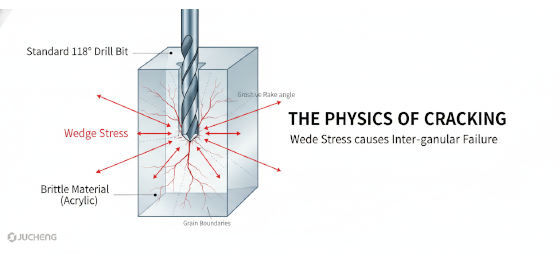
Para resolver el problema de perforar acrílico sin que se agriete, we must first analyze the standard drill bit. Most twist drills designed for metal have a 118-degree or 135-degree point angle and a sharp, positive rake. While this is perfect for slicing through tough steel, it acts as a destructive wedge in acrylic. As the bit enters the material, the sharp edges "grab" the plastic. Because acrylic cannot stretch, the pressure from this grabbing action creates micro-fractures that radiate outward from the center of the hole. If the material is thin, these fractures can instantly travel the entire width of the part.
Heat is the second invisible enemy. Acrylic has a relatively low glass transition temperature. As the drill bit spins, friction at the cutting face generates intense thermal energy. Because plastic is a poor conductor of heat, that energy doesn't dissipate into the chips; it stays concentrated at the hole. If the temperature exceeds the material's limit, the acrylic begins to melt and fuse to the flutes of the drill. Once the flutes are clogged, the bit is no longer cutting—it is a hot, blunt object being forced through a brittle solid. This localized thermal expansion puts immense internal stress on the part, leading to cracking minutes or even hours after the machining is complete. JUCHENG manages these forces through a combination of tailored tooling and aggressive cooling strategies.
Dominio de las herramientas: el secreto del ángulo de inclinación cero

The single most important factor in professional plastic drilling is the geometry of the cutting edge. At Jucheng Precision, we never use standard "out of the box" bits for our high-end acrylic projects. We utilize specialized bits with a "Zero Rake" grind. A standard metal bit has a positive rake that pulls the tool into the material. In contrast, our plastic-specific tools are ground so that the cutting edge is perpendicular to the rotation. This ensures that the drill scrapes the acrylic away in thin, powdery curls rather than biting and pulling. This scraping action keeps the vertical force consistent and prevents the bit from "diving" as it enters or exits.
We also modify the point angle to be much steeper, typically between 60 and 90 degrees. A steeper point allows the drill to center itself more effectively on the surface and ensures a gradual entry into the material. This minimizes the initial shock that often triggers surface cracks. For deep holes, we use high-helix flutes that are polished to a mirror finish. This reduces friction as the chips travel up the drill body, preventing the thermal buildup that causes the acrylic to weld itself to the tool. By controlling the tool's interaction at the micron level, we transform a violent cutting process into a gentle, controlled erosion of material.
Control del proceso: avances, velocidades y ciclos de picoteo
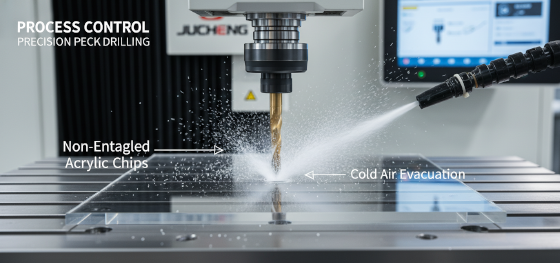
Correct parameters are vital for success. In metal machining, we often push for speed to reduce cycle times. In acrylic, speed is a dangerous variable. If the RPM is too high, you generate friction heat too fast for the cooling system to handle. If the feed rate is too slow, the tool "dwells" in one spot, rubbing against the plastic and causing it to melt. The golden rule we follow at Jucheng is to maintain a high feed per revolution to ensure the tool is always cutting fresh, cool material. Each tooth of the drill should take a definitive bite of plastic to carry the heat away in the chip.
Our CNC programmers utilize a technique called "Peck Drilling" (G83 cycle). Instead of a continuous plunge, the drill enters the hole for a short distance and then retracts completely out of the hole to clear the chips. This allows the tool to be hit with a blast of cool air before it dives back in. For a 1-inch thick manifold block, we might perform thirty or forty "pecks." This prevents the flutes from clogging and ensures that the temperature remains well below the melting point of the PMMA. This methodical approach is the only way to achieve consistent results in high-volume mecanizado CNC de acrílico projects where quality cannot be compromised for speed.
Soporte y refrigeración: prevención del estallido de salida

The most common failure point in perforar acrílico sin que se agriete is the "blowout" at the bottom of the hole. As the drill approaches the end of the part, the material wall becomes incredibly thin. Without support, the downward pressure of the spindle will simply burst through that last layer, leaving a jagged, shattered exit. Jucheng solves this using a rigid "Sacrificial Backer Board." We clamp the acrylic workpiece tightly against a flat piece of high-density material. This provides a continuous physical support system, tricking the material into thinking it is much thicker than it actually is. The result is a clean, razor-sharp exit hole with zero chipping.
Coolant selection is another critical area where many shops fail. Standard oil-based metalworking fluids can chemically attack acrylic, leading to immediate surface crazing. We avoid these entirely. Instead, we use high-pressure cold air guns or specialized water-soluble coolants that are verified for plastic compatibility. The air blast serves a dual purpose: it removes the thermal energy from the tool tip and physically clears the static-charged acrylic dust away from the hole. Keeping the cutting zone clear of debris prevents the drill from re-cutting old chips, which is a major source of friction and subsequent cracking.
Alivio de tensiones: recocido posterior a la perforación para longevidad

Even with perfect drilling techniques, the act of machining introduces internal stresses into the polymer matrix. Over time, these stresses can lead to spontaneous cracking, especially if the part is exposed to cleaning alcohols or varying temperatures. At Jucheng Precision, we offer post-machining annealing as a high-value engineering service. We place the finished acrylic parts in a controlled thermal oven, slowly raising the temperature and then cooling it at a specific rate over several hours.
This thermal cycle allows the long polymer chains to relax and realign, effectively "healing" the internal stresses created by the drill bit. This is a mandatory step for medical manifold blocks and aerospace enclosures where the part must remain optically perfect for decades. By integrating annealing into our workflow, we ensure that the "clear" part we ship today doesn't develop "spiderwebs" six months from now. It is this attention to the long-term lifecycle of the material that separates a high-end manufacturer from a basic job shop.
La ventaja de JUCHENG en plásticos de precisión

Mastering the nuances of perforar acrílico sin que se agriete is just one part of our broader capability in precision plastic fabrication. Jucheng Precision operates a state-of-the-art facility equipped with high-speed 5-axis CNC centers specifically calibrated for low-vibration plastic work. We understand that transparency is often the most critical requirement of your design, and we treat every part with the silken-glove care it deserves. Our quality control team utilizes high-magnification inspection to verify that every hole is free of micro-cracks before it leaves our floor.
We don't just follow your blueprints; we partner with you during the DFM phase to suggest hole placements and radii that maximize the strength of the acrylic. Whether you are developing a prototype for a new diagnostic device or scaling up production of complex lighting lenses, our expertise ensures that your vision is realized with perfect clarity. Don't leave your transparent designs to chance. Trust the engineers who understand the delicate soul of acrylic. Contact Jucheng Precision today to discuss your project and receive a quote that reflects our commitment to excellence.

