


Before requesting a fuel pump tappet prototype, decide what the sample must establish: the external envelope, the relationship between moving components, or the manufacturing state of a working contact surface. Those are different questions. A part that fits a package can still provide little evidence about roller support, plunger contact, or the condition of a surface after treatment.
This guide addresses component development and manufacturing review, rather than vehicle diagnosis or replacement. The useful starting point is an interface drawing that separates what belongs to the tappet from what belongs to the cam, pump plunger, and surrounding guide. That separation makes a prototype request more precise and prevents a visually convincing sample from being accepted for a task it was never built to perform.
Start with the architecture actually being developed
Do not assume that every pump follower uses the same construction. A sliding contact, a roller arrangement, and a multipart housing create different manufacturing and inspection questions. Even within a roller design, the method of supporting and retaining the roller can change which features must be checked together. Identify the actual assembly before applying advice from a catalog photograph or another engine program.
One example of structural variation appears in a Schaeffler patent publication describing a particular two-part tappet construction. The document is evidence of a specific proposed architecture, not a universal production drawing or evidence that Jucheng Precision supplies that design. Its practical lesson for a buyer is to specify the intended construction instead of treating the component name as a complete specification.
Mark the moving and stationary interfaces on the drawing. Depending on the approved design, these may include the outer guiding surface, roller support features, retention details, and the area that transfers motion to the pump plunger. State which component establishes each reference. A dimension measured on a loose housing does not automatically describe the same relationship after the roller and retaining parts have been assembled.
Give each sample a defined job
An envelope model is useful when the team needs to examine packaging or handling. A machined housing sample can support a drawing review and preliminary assembly study. Neither should be described as a durability-qualified fuel pump tappet merely because it resembles the intended assembly. The purchase order should connect the sample’s construction to the decision that will be made from it.
| Sample scope | Useful development question | Evidence still needed |
|---|---|---|
| External envelope model | Does the proposed package occupy the intended space? | Contact behavior, material state, and assembly function |
| Machined housing and support features | Can the specified interfaces be inspected and assembled? | Effects of the final blank route and subsequent operations |
| Assembly in a defined material and surface state | Are the specified component relationships present in that state? | Application-specific functional and endurance validation |
For a fuel pump tappet development request, Jucheng Precision’s prototyping discussion is most useful when it starts with these separate sample objectives. Send the assembly view as well as the individual component files. The scope can then distinguish an interface study from a request that also depends on specialist forming, treatment, assembly, or testing. Those additional operations need explicit confirmation rather than an assumption based on the prototype’s appearance.
Record exclusions next to the sample objective. If the roller, pin, or pump plunger will come from another source, identify their drawing revisions and who supplies the inspection references. If the sample will not receive the intended production treatment, label that limitation in the delivery documentation. This preserves its value as a development tool without overstating what it proves.

Separate the blank route from the final contact condition
Machining from stock can offer a direct way to explore a small quantity of geometry before committing to tooling. A formed blank followed by local machining may become relevant at another development stage. The routes are not automatically equivalent: stock direction, local wall distribution, machining allowance, and the order of subsequent operations can affect which features remain stable and accessible for inspection.
The choice is therefore conditional. If the immediate question concerns the assembly envelope and reference relationships, a machined sample may be appropriate. If the decision concerns the behavior or consistency of a proposed formed construction, a stock-machined substitute leaves that question open. Ask the supplier to state where the sample follows the intended route and where it deliberately departs from it.
Material grade alone is also incomplete. Identify the required condition at each acceptance stage, including any specified heat treatment, surface treatment, or finishing operation. Avoid generic instructions such as “make the contact harder.” A change intended to affect one surface may also require review of geometry, adjoining components, treatment coverage, and the inspection method. Numerical requirements must come from the approved design and its validation basis.
Jucheng Precision’s surface finishing service information can support a discussion about the required final surface and the division of work. It does not establish that a particular coating, heat treatment, or contact-performance target has already been qualified for this pump. Keep that distinction visible when comparing quotations that include different finishing scopes.
Inspect relationships after the operations that can change them
Build the inspection sequence around changes in state. A housing can be dimensionally checked before assembly, but a support relationship affected by retention or assembly should also be reviewed in the relevant assembled condition. Similarly, a feature influenced by a specified treatment needs an acceptance definition that identifies whether measurement occurs before or after that operation.
Consider a hypothetical development review in which a housing drawing and a roller-support drawing are revised separately. Each loose component meets its own dimensions, yet the assembly review uses an older reference model. The immediate response should be configuration reconciliation: confirm the mating revisions, then inspect the relationship using the agreed references. Removing material from a sample simply to make it move would obscure the reason for the discrepancy.
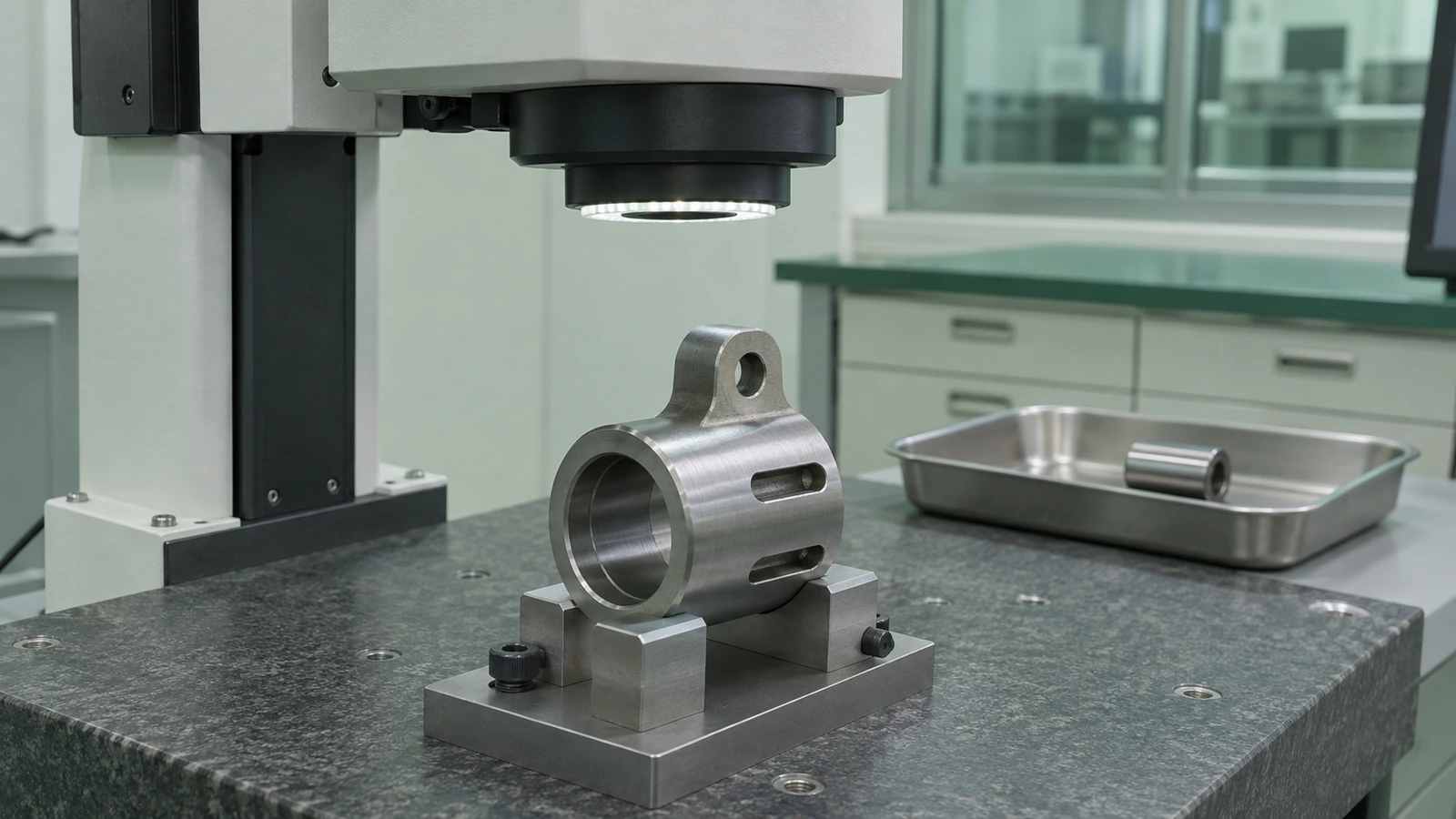
A practical inspection plan identifies the feature, its reference, the condition of the part, and the evidence to retain. For example, an outer guide feature may be checked on the housing, while the relationship between a roller support and the plunger-contact reference may require an assembly fixture or another agreed method. The method must resolve the actual characteristic; a photograph alone cannot establish alignment or surface condition.
Keep nonconformance decisions separate from engineering changes. If a sample differs from the drawing, record the deviation. If the drawing itself changes, issue a controlled revision and decide which earlier samples remain useful. This is particularly important when a supplier is providing only part of a multipart assembly and cannot inspect the complete system without additional components.
Prepare a request that can be quoted consistently
The minimum useful package contains controlled component files, an assembly reference, the sample objective, the proposed material condition, the required final state, and the characteristics that matter to the review. Add quantities by sample type, rather than a single quantity that mixes envelope models with functional-development assemblies. Identify externally supplied parts and any requirements that remain under engineering review.
When discussing a fuel pump tappet with Jucheng Precision, ask which interfaces can be produced and inspected within the proposed component scope, and which depend on additional specialist processes or customer-supplied parts. This links the company’s machining and prototype work to a concrete development decision without implying that a component supplier is qualifying the complete fuel system.
Questions that affect purchasing and sample control
Can different sample types share one part number?
They need a clear identification system that prevents confusion. If the project uses one base number, add controlled identifiers for construction, material condition, and intended use. A packaging model and a treated development assembly should not arrive with indistinguishable labels or inspection records.
What should happen to a sample modified during a fit review?
Record the modification, its reason, and whether the sample remains eligible for any planned evaluation. Preserve the original inspection result. An informal fit adjustment should not silently become the accepted manufacturing definition for the next order.
For a focused component review, send Jucheng Precision the drawings and sample objectives. The first useful outcome is an agreed manufacturing and inspection scope, with unresolved treatment, assembly, and system-validation responsibilities explicitly identified.

