


Cada centímetro cúbico de material dentro de una pieza funcional es una partida en su factura de producción. En el mundo de alto riesgo de la fabricación aditiva, "sólido" suele ser sinónimo de "derrochador". A diferencia del mecanizado CNC tradicional, donde el costo está impulsado por el tiempo que lleva eliminar metal, los gastos de impresión 3D son fundamentalmente proporcionales al volumen de material consumido. Si está diseñando una carcasa del tamaño de una palma con una sección transversal interna sólida de 20 mm, efectivamente está pagando para ocultar resina de ingeniería costosa o polvo de nailon donde nadie lo verá ni lo usará. Es por eso que el vaciado de modelos 3D para ahorrar costos es la palanca más efectiva que un ingeniero puede utilizar para optimizar el ROI del proyecto. Sin embargo, vaciar no es una tarea simple de hacer clic en un botón en CAD; es una operación técnica que introduce nuevos riesgos físicos, desde inestabilidad estructural hasta el peligroso efecto de "ventosa".
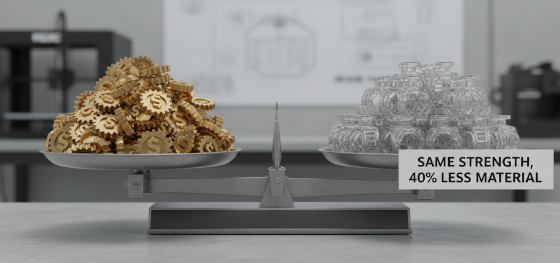
En Jucheng Precision, consideramos el diseño para impresión 3D como una disciplina de eficiencia volumétrica. Entendemos que para una startup que construye un dispositivo médico portátil o una empresa aeroespacial que prototipa una carcasa de satélite, una reducción del 40% en material puede significar la diferencia entre un producto viable y un proyecto cancelado. Pero una pieza vaciada sin la ingeniería adecuada es un pasivo. La resina no curada atrapada puede provocar grietas retardadas, y el polvo no sinterizado puede actuar como un disipador de calor no deseado que deforma todo el conjunto. Esta guía va más allá de los tutoriales básicos para explorar la mecánica real de la optimización de paredes, la física crítica de los orificios de escape y por qué los protocolos integrados de DFM de JUCHENG aseguran que sus diseños vaciados sean tan estructuralmente sólidos como financieramente eficientes.
La rentabilidad en la producción 3D se logra dominando el vacío interno. No solo está ahorrando dinero; está diseñando un componente más ligero, más rápido de imprimir y más estable. Ya sea que trabaje con resinas SLA de alta pureza o nailon MJF robusto, entender la lógica del vaciado es esencial. Analicemos los pilares técnicos de la reducción volumétrica y veamos cómo la previsión técnica puede convertir la integridad de sus diseños más ambiciosos en una realidad física y rentable.
Economía volumétrica: reducción de masa para ahorrar presupuesto
Trampas internas: por qué los orificios de escape son obligatorios
Estructura de paredes: optimización de muros para diseños vaciados
Peligros tecnológicos: ventosas y pasteles de calor
Autosoporte geométrico: estrategia de celosía interna
Lógica de cotización de JUCHENG: comparación de ROI entre sólido y vaciado
Economía volumétrica: reducción de masa para ahorrar presupuesto
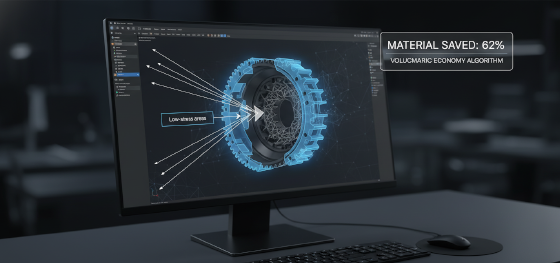
The primary economic driver for el vaciado de modelos 3D para ahorrar costos is the direct reduction in raw material consumption. In additive manufacturing, unlike CNC milling, you pay for what remains on the build plate, not what is removed. A 100mm cube printed solid in high-performance resin might cost $400 in material alone. That same cube, hollowed to a 3mm wall thickness, consumes only 20% of that material, slashing the cost by $320 instantly. This math applies to almost every high-end polymer, from Machining PEEK-adjacent resins to the carbon-filled nylons used in the ciencia de los materiales de impresión 3D market.
Beyond the raw resin price, hollowing also impacts the "Time-to-Spindle" efficiency. In technologies like FDM or DMLS, fewer paths for the laser or nozzle to trace mean shorter build times. While SLA build times are largely determined by height, reducing the volume of material per layer reduces the exothermic heat generated during the cure, which leads to better dimensional stability. At JUCHENG, we leverage these volumetric savings to provide our clients with more competitive lead times. We treat every internal void as a financial victory, ensuring that your budget is allocated toward the surfaces that matter—the functional walls and assembly fits—rather than the dead weight of a solid core. By optimizing the mass of your component, you aren't just saving pennies; you are re-engineering the economics of your entire product launch.
Trampas internas: por qué los orificios de escape son obligatorios
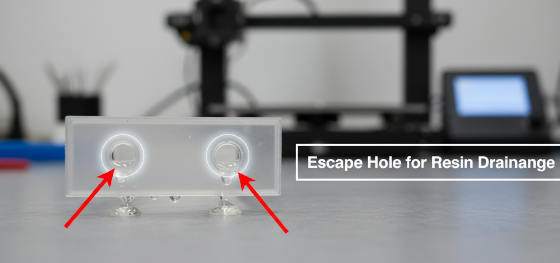
Creating a hollow cavity is an engineering failure if you don't provide a way for the trapped material to leave. In the diseño para impresión 3D cycle, the concept of the "Trapped Volume" is the primary cause of post-processing scrap. In SLA or DLP printing, an enclosed hollow space will trap liquid, uncured resin inside. Once the part moves to the post-curing chamber, that trapped liquid will expand under UV heat, causing the part to explode or develop "weeping" cracks where the resin eventually leaks out. Similarly, in powder-bed systems like SLS or MJF, trapped nylon powder will stay inside the part, effectively acting as a solid core and negating any weight-saving benefits.
To achieve el vaciado de modelos 3D para ahorrar costos safely, you MUST design "Escape Holes" into your part. At JUCHENG, we recommend a minimum hole diameter of 3mm to 5mm to allow for efficient drainage and air-flow during the cleaning stage. We suggest placing at least two holes: one to allow the fluid or powder to exit, and another to allow air to enter (preventing a vacuum lock). Ideally, these holes should be placed in non-cosmetic areas or integrated into the functional design, such as a hidden mounting point. Without these vents, your "cost-saving" hollow part becomes a chemical bio-hazard or a heavy block of baked powder. We perform a mandatory "Trap Audit" during our DFM reviews to identify these sealed chambers, ensuring that your designs are optimized for a clean, dry, and stable final state.
Estructura de paredes: optimización de muros para diseños vaciados
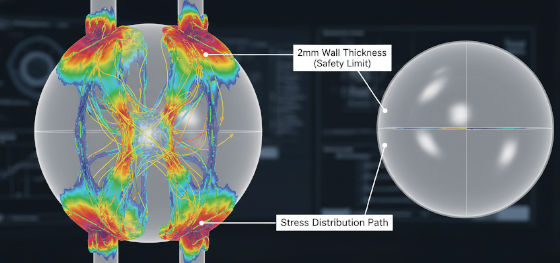
How thin can you go before the part collapses under its own weight? This is the structural high-wire act of functional shelling. If the walls are too thick, you haven't saved enough material to justify the effort. If they are too thin, the part will be fragile, prone to warping during the cooling phase, or fail the first time it is dropped. In diseño para impresión 3D, the target for wall thickness is determined by the material modulus. For a rigid resin or a standard nylon, JUCHENG recommends a minimum shell thickness of 2mm to 3mm for functional parts. Anything thinner risks a "paper-skin" effect, where the surface feels brittle and lacks the tactile quality of a production-grade part.
Successful shelling also requires an audit of "Geometric Consistency." You should avoid sharp transitions between a thick solid section and a thin hollow shell. These "Stress Bottlenecks" lead to warping as the material cools at different rates. We use generous fillets and internal tapers to distribute the mechanical load evenly across the part’s geometry. When el vaciado de modelos 3D para ahorrar costos, we treat the shell as a structural membrane. For large enclosures, we may suggest varying the wall thickness—keeping it thick near mounting points for strength and thinning it out in the center of flat panels for weight savings. This "Topological Intelligence" ensures that your hollow part doesn't behave like a flimsy mockup, but like a structurally engineered component capable of surviving the brutal vibration and impact of industrial service.
Peligros tecnológicos: ventosas y pasteles de calor
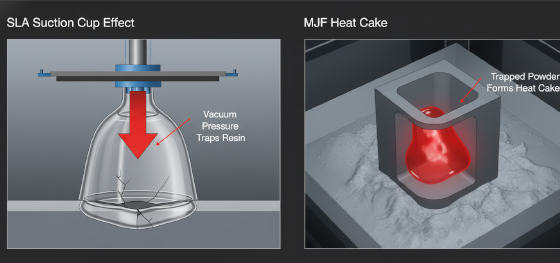
Each 3D printing technology has its own "Vengeance" for poorly hollowed models. In SLA and DLP (the "bottom-up" systems), hollowing out a part can create a "Suction Cup." As the build plate lifts the part out of the resin for the next layer, the air trapped inside the hollow cavity creates a vacuum. This suction force is massive enough to tear the part off the supports or cause "peel failure" where the layers shift. el vaciado de modelos 3D para ahorrar costos in resin requires an escape hole placed close to the build plate to break this vacuum instantly.
In powder-bed systems like MJF, the hazard is "Heat Cakes." A large hollow space filled with powder acts as a thermal insulator. During the intense infrared fusion cycle, the heat trapped inside that volume can cause the loose powder to "sinter" or bake into a solid, un-removable mass. This ruins the weight-saving goal and creates internal stress that can warp the exterior skin. At JUCHENG, we utilize advanced thermal simulation to identify these heat-traps. We don't just "shell" the part; we engineer the internal voids to allow for heat dissipation. If the cavity is too large for a simple void, we might suggest an open-lattice approach to maintain airflow. Understanding these technological hazards is what separates a world-class manufacturing facility from a basic service bureau. We don't just follow your CAD; we protect your part from the physics of its own creation.
Autosoporte geométrico: estrategia de celosía interna
What if your design requires a large internal volume but must also withstand heavy crushing loads? A hollow part will buckle, but a solid part is too expensive. This is where el vaciado de modelos 3D para ahorrar costos meets "Internal Latticing." Instead of a completely empty void, we fill the cavity with a skeletal, bio-inspired structure. This provides the best of both worlds: a 60% to 80% reduction in material mass with a 90% retention of structural rigidity. Lattices act like internal scaffolding that remains permanently inside the part.
JUCHENG’s engineers utilize advanced generative design software to optimize these internal lattices. For aerospace brackets, we might use an octa-tet or gyroid cell to maximize stiffness. For ergonomic grips, we use flexible TPU lattices to create a "Digital Foam." Crucially, these lattices must be designed for "Clean-out." If the lattice is too dense, the resin or powder will still be trapped. We ensure the lattice "unit cell" is large enough to allow for thorough ultrasonic cleaning or bead blasting. By engineering the void with these skeletal structures, we deliver parts that are incredibly light but functionally invincible, proving that diseño para impresión 3D is as much about what is *inside* the part as what is outside.
Lógica de cotización de JUCHENG: comparación de ROI entre sólido y vaciado
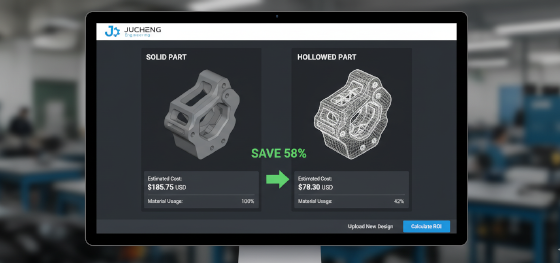
Transparency in pricing is the final hallmark of a professional manufacturing partner. At Jucheng Precision, we believe our clients should have the data to make their own economic decisions. Our automated quoting engine doesn't just provide a single number. We often present our clients with a "Volumetric Comparison." We show you the cost of building your part solid versus the cost of building it hollowed with optimized walls and escape holes. We have seen projects where a simple DFM adjustment to the hollow shell reduced the part price from $250 to $85.
This level of collaborative engineering is why JUCHENG is the preferred partner for global hardware innovators. We act as an extension of your R&D team, auditing your CAD files not just for manufacturability, but for financial efficiency. We understand that in the race to market, every dollar saved on a prototype is a dollar earned for production. Whether you are building a large-format automotive dashboard or a complex medical sensor, our el vaciado de modelos 3D para ahorrar costos protocols ensure your vision is realized without the burden of unnecessary mass. Contact Jucheng Precision today for a comprehensive technical review and see how our volumetric optimization can clarify and secure your next breakthrough.

