


La navegación ortopédica exige una claridad óptica absoluta en el campo quirúrgico. Cuando un asistente robótico guía a un cirujano durante una fusión espinal o un reemplazo articular complejo, el hardware físico no puede obstruir la telemetría crítica de rayos X o resonancia magnética necesaria para verificar la colocación de los tornillos. Las herramientas quirúrgicas estándar y los implantes forjados en acero inoxidable o titanio, aunque increíblemente resistentes, crean artefactos blancos densos y brillantes en una pantalla de fluoroscopia, enmascarando por completo las estructuras biológicas que se encuentran debajo. Navegar por este "punto ciego" clínico requiere el despliegue estratégico de Mecanizado de PEEK de grado médico. La poliéter éter cetona (PEEK) es el rey indiscutible de los termoplásticos de alto rendimiento, con un módulo de flexión que imita fielmente al hueso cortical humano y que, al mismo tiempo, es completamente transparente a las imágenes radiológicas. Jucheng Precision opera como un santuario de polímeros de alta fidelidad en el centro de fabricación de precisión de Shenzhen, proporcionando la precisión submicrónica necesaria para procesar este material brutalmente difícil. Dentro del marco más amplio de Fabricación de Robótica Médica, we transform raw, expensive PEEK billets into life-saving spinal cages and radiolucent targeting guides for project-specific requirements. The device manufacturer must verify intended reprocessing and reuse on the finished device.
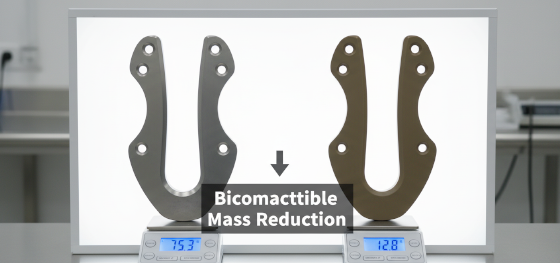
Establishing a resilient launch for PEEK hardware demands the rejection of "General Purpose" machining logic. Amateurs often treat a $500 block of implant-grade PEEK like a piece of cheap Delrin, ignoring the massive internal residual stresses generated during the extrusion process. Residual stresses can contribute to distortion when stock is machined. Check the stock supplier’s guidance and whether the stock has already been stress-relieved before deciding if further annealing is needed. This guide covers radiolucency, when stress relief may help, and why manufacturing controls do not replace finished-device validation.
Independencia visual: la ventaja radiotransparente sobre el titanio
Patología termodinámica: los peligros de la tensión residual interna
El mandato del recocido: erradicar la desviación dimensional
Integridad microscópica: velocidades, avances y ejecución sin rebabas
Protocolo JUCHENG: trazabilidad USP Clase VI y pureza médica
Preguntas frecuentes: hardware quirúrgico de PEEK
Independencia visual: la ventaja radiotransparente sobre el titanio
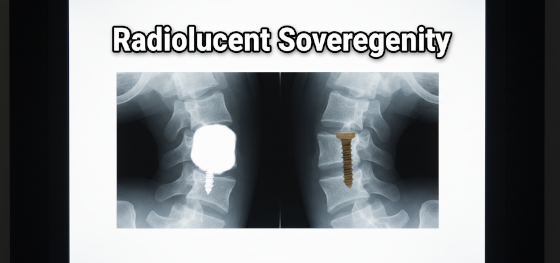
La visibilidad diagnóstica dicta el éxito de la cirugía robótica guiada por imágenes. La razón principal por la que los ingenieros pasan del titanio grado 5 al PEEK es su radiotransparencia inherente. Debido a que el PEEK es un polímero orgánico de baja densidad (aprox. 1,3 g/cm³), los rayos X lo atraviesan sin dispersarse. Esta "soberanía visual" permite al cirujano monitorear el crecimiento óseo, el progreso de la fusión y la alineación de las herramientas en tiempo real sin el resplandor de "estrella" asociado con los implantes metálicos. Además, el PEEK elimina el riesgo de "corrosión galvánica" que ocurre cuando metales diferentes interactúan dentro del cuerpo humano. Al utilizar el mecanizado CNC de 5 ejes, entregamos guías de orientación ortopédicas complejas y jaulas implantables que poseen la columna mecánica de una aleación sin la interferencia óptica, asegurando que su asistente robótico opere con una "visión" sin obstáculos."
Patología termodinámica: los peligros de la tensión residual interna
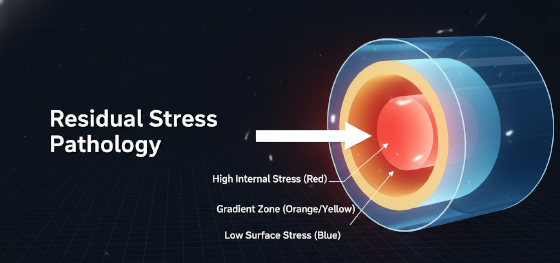
Geometric rebellion occurs when a highly crystalline polymer is violently relieved of its constraints. Extruded PEEK rods and plates are "frozen" in a state of high internal tension as they cool rapidly during production. When a CNC cutter removes the outer skin of this material to form a delicate surgical tool, the internal stresses are suddenly unleashed. If unmanaged, the part will literally bend, twist, or split in half while still clamped in the vise. This "Thermodynamic Pathology" is the primary cause of scrap when inexperienced shops attempt to process PEEK. The material fights the tool, leading to unpredictable dimensional drift that ruins the tight tolerances required for robotic end-effectors. Whether the stock needs further stress relief depends on its grade, manufacturing history, part geometry and dimensional requirements.
El mandato del recocido: erradicar la desviación dimensional
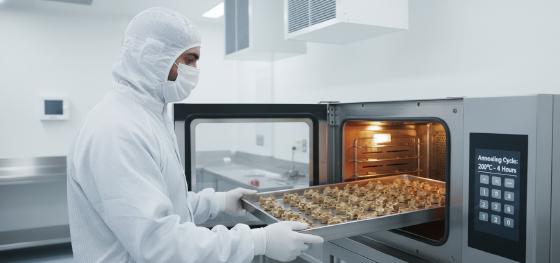
Two annealing steps are not mandatory for every PEEK part. Some stock is supplied stress-relieved. If substantial stock removal or a warp-prone geometry makes dimensional drift a concern, consider intermediate stress relief before final machining. Select the procedure for the exact grade, stock condition and section size using supplier guidance, and verify dimensions on representative parts. Annealing does not establish performance through steam cycles; check critical dimensions and function on the finished device after the intended reprocessing regimen.
Integridad microscópica: velocidades, avances y ejecución sin rebabas
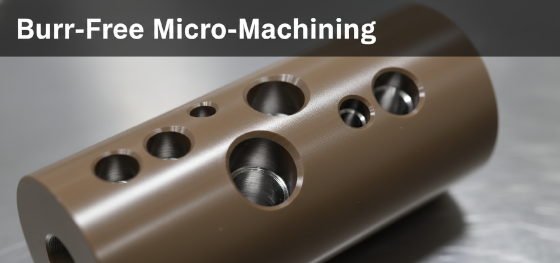
Cutting mechanics must respect the heat-sensitive nature of the polymer. PEEK is notoriously abrasive and a poor conductor of heat. If a CNC spindle runs too fast or feeds too slowly, the friction generates immense localized heat. Instead of cleanly shearing a chip, the tool begins to "melt and smear" the plastic, resulting in "Galling" and microscopic "Burrs." In the context of a surgical instrument, a plastic burr that detaches inside a patient is a catastrophic biological risk. Jucheng Precision eliminates this "Thermal Fuzz" by utilizing specialized, razor-sharp solid carbide tooling with polished flutes. We program highly aggressive feed rates combined with massive volumes of synthetic, medical-safe coolant to evacuate the heat instantly. This "Cold-Cut" philosophy produces surgical-grade edges and smooth bearing bores that require zero manual deburring. Machining alone does not make an instrument ready for clinical use. Finished-device release depends on the applicable inspection, cleaning and validation requirements.
Protocolo JUCHENG: trazabilidad USP Clase VI y pureza médica
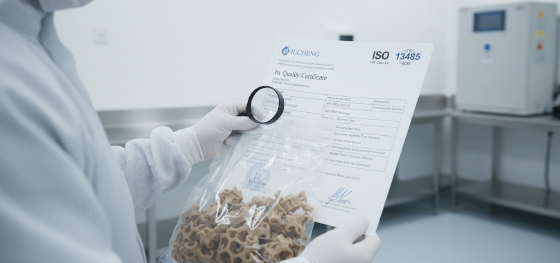
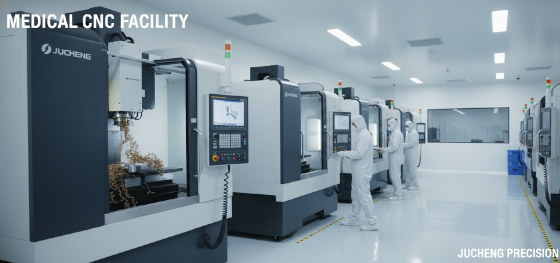
Manufacturing excellence at Jucheng Precision is built on the foundation of the documented pedigree. We recognize that "Implant-Grade" or "Surgical-Grade" PEEK (such as Invibio or Solvay) is an investment of hundreds of dollars per kilogram. Our facility operates under a strict ISO 13485 quality management system, ensuring that every billet is accompanied by a Certificate of Analysis (COA) for lot traceability. A COA and grade-specific USP Class VI or ISO 10993 test data can support the assessment, but they do not establish finished-device biocompatibility. Evaluate the final finished device for the intended type and duration of contact, taking manufacturing and any applicable sterilization into account. We maintain dedicated "Plastic-Only" CNC machines to ensure zero cross-contamination from metal shavings or non-medical cutting fluids. Manufacturing records can support the device manufacturer’s documentation, but do not replace finished-device validation or establish regulatory conformity.
Preguntas frecuentes: hardware quirúrgico de PEEK
Pregunta: What is the tightest tolerance JUCHENG can hold on a PEEK surgical component?
Respuesta: With 5-axis CNC machining and stress relief where needed, we routinely hold tolerances of +/- 0.01mm (0.0004") on critical bores and mating surfaces, ensuring zero-backlash assembly.
Pregunta: How many times can a machined PEEK component be autoclaved?
Respuesta: There is no universal number of steam cycles for machined PEEK instruments. Supplier results for a particular material specimen and steam cycle do not establish finished-device life. Validate the intended cleaning and steam reprocessing of the finished device, including the proposed reuse count, and check its dimensional, mechanical and functional acceptance criteria.
Pregunta: Does JUCHENG provide carbon-fiber filled PEEK (CF-PEEK)?
Respuesta: Yes. For robotic arms that require extreme stiffness and radiolucency, we machine 30% Carbon-Filled PEEK, which effectively doubles the flexural modulus compared to unfilled grades.

