


La fuerza bruta suele ser la primera víctima de un diseño complejo. En el panorama de la fabricación tradicional, si necesita un componente que sea a la vez cristalino y prácticamente irrompible, se ve obligado a adentrarse en el costoso mundo del vidrio de alta presión o las láminas de policarbonato forjado. Sin embargo, para I+D iterativa y producción de bajo volumen, estos métodos crean un cuello de botella terminal en costos de herramientas. Este es el abismo técnico que un servicio profesional de impresión 3D en policarbonato. logra salvar. El policarbonato (PC) es el "Iron Man" de los polímeros de ingeniería, ofreciendo una resistencia al impacto 250 veces mayor que el vidrio y una estabilidad térmica que le permite sobrevivir en compartimentos de motor y autoclaves médicos. Sin embargo, el PC no es solo otro filamento; es un rebelde térmico que se resiste al ciclo de construcción. Lograr el éxito en la fabricación aditiva con PC requiere más que una boquilla de alta temperatura: requiere soberanía absoluta sobre la dinámica de enfriamiento del material.
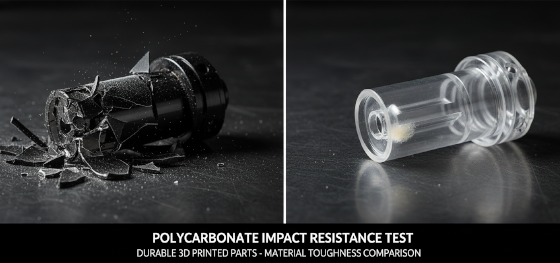
Jucheng Precision opera como un centro de alta fidelidad para las marcas automotrices y aeroespaciales más exigentes del mundo. Reconocemos que para un alojamiento de sensor robusto o una guía de luz de alta claridad, "casi fuerte" es un fracaso de ingeniería. Al integrar sistemas FDM y SLA de grado industrial que utilizan cámaras de construcción calentadas activamente, proporcionamos un santuario técnico para esta resina temperamental. Hemos superado la era de las maquetas genéricas "transparentes" para proporcionar hardware funcional y listo para volar que mantiene su integridad bajo vibraciones supersónicas y ciclos térmicos intensos. Esta guía es una inmersión profunda de 2000 palabras en la termodinámica de la fusión a 300 °C, la lógica del refinamiento óptico en fase de vapor y por qué el enfoque integrado de JUCHENG para el Servicio de Impresión 3D en Policarbonato garantiza que sus diseños sobrevivan la transición del modelo digital a la brutal realidad del campo.
La rentabilidad en la creación de prototipos de alto rendimiento la obtienen quienes pueden validar la física del impacto temprano. No solo está comprando una pieza de plástico; está comprando la certeza verificada de que su ensamblaje sobrevivirá una prueba de caída o una oleada de fluido a alta presión. Ya sea que esté construyendo una válvula médica innovadora o un escudo protector para un brazo robótico, la lógica del enlace de carbonato es su mayor ventaja táctica. Analicemos las leyes físicas de la producción industrial de PC y veamos cómo la previsión técnica puede fijar el alma de su próximo diseño de hardware en la realidad física.
Combate termodinámico: gestión de la transición vítrea a 140 °C
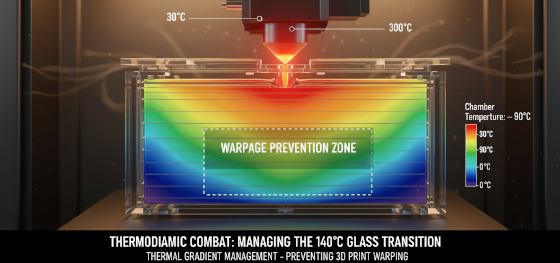
El principal diferenciador entre una maqueta visual y un componente estructural es la gestión de la tensión interna. El policarbonato posee una alta temperatura de transición vítrea (Tg) de aproximadamente 147 °C. Cuando un servicio de impresión 3D en policarbonato utiliza máquinas de escritorio estándar, el material se extruye en aire a temperatura ambiente. Esto crea un choque térmico violento. A medida que el plástico se enfría desde su punto de fusión de 300 °C a 25 °C en segundos, las cadenas de polímero se contraen de manera desigual, lo que provoca "deformación" y delaminación entre capas. Estos no son solo defectos cosméticos; son fracturas estructurales en potencia.
JUCHENG elimina este riesgo mediante una soberanía térmica absoluta. Nuestros centros FDM industriales operan dentro de cámaras de construcción calentadas activamente y con circulación que mantienen un ambiente constante de 90 °C a 110 °C. Esto mantiene el plástico en un estado semirrelajado y recocido durante todo el ciclo de construcción de varios días. Al minimizar la diferencia de temperatura entre la boquilla y la atmósfera, aseguramos que las capas se fusionen a nivel molecular, creando un sólido estructural denso en lugar de una pila de hilos pegados. Este control ambiental es lo que nos permite entregar carcasas de PC de gran tamaño, de hasta 400 mm de longitud, con una planitud y precisión dimensional que rivalizan con las piezas moldeadas por inyección. No solo "ejecutamos" una máquina; orquestamos una curva de enfriamiento que fija la geometría en su lugar, asegurando que sus características de acoplamiento encajen perfectamente en la línea de ensamblaje.
Realismo óptico: logrando transparencia similar al vidrio
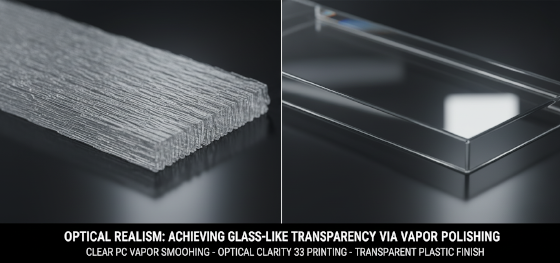
La transparencia en el mundo de los materiales de impresión 3D a menudo es una mentira. Una impresión 3D en bruto de policarbonato es, en el mejor de los casos, translúcida, cubierta de líneas de capa que dispersan la luz como una ventana esmerilada. Para los ingenieros automotrices que validan una nueva guía de luz LED o los diseñadores médicos que construyen un colector de fluidos transparente, esta opacidad es un defecto terminal. Lograr un verdadero "Realismo Óptico" requiere una transición del piso de la máquina al laboratorio de acabado químico. Jucheng Precision ha dominado la alquimia del alisado con vapor específicamente para policarbonato.
Este proceso automatizado expone la pieza a un vapor químico controlado que funde los picos microscópicos de la superficie a nivel molecular. A medida que la superficie se licúa momentáneamente, la tensión superficial la aplana, "borrando" efectivamente las líneas de capa. Una vez que el solvente se evapora, el resultado es una "piel" sellada de alto brillo que es virtualmente indistinguible de una superficie moldeada por inyección. Este tratamiento no solo mejora el aspecto; sella los poros internos, haciendo que la pieza sea hermética y resistente a la adhesión bacteriana, un factor crítico para los prototipos de instrumentos quirúrgicos. Salvamos la brecha entre "prototipo rugoso" y "hardware listo para el mercado", proporcionando la profundidad visual que su identidad de marca exige.
Invencibilidad estructural: PC como el escudo de impacto definitivo
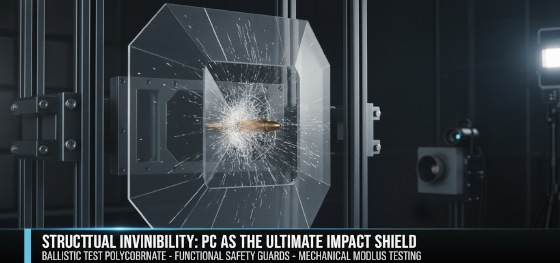
¿Por qué pagar por un servicio profesional de impresión 3D en policarbonato cuando el nailon estándar es más barato? La respuesta es "Tenacidad a la fractura". El policarbonato es único debido a su capacidad para absorber energía cinética y deformarse plásticamente antes de romperse. En una prueba de impacto Izod, las resinas estándar fallan con menos de 50 J/m. El policarbonato supera rutinariamente los 600 J/m. Esta "Invencibilidad Estructural" lo convierte en la opción obligatoria para componentes expuestos a escombros de alta velocidad, como escudos protectores para celdas robóticas o carcasas funcionales para escáneres industriales de mano.
At JUCHENG, we utilize the material's high flexural modulus to build "Living Frames"—parts that can bend and flex under stress but return to their original shape without fatigue cracking. This resilience is vital for aerospace interiors where safety-critical components must not shatter into dangerous needles during a structural load-event. We provide the mechanical baseline data to prove that our 3D printed PC components possess 90% of the strength of a wrought sheet, ensuring your functional prototypes survive the most brutal vibration and drop audits. We treat the part’s survival as a functional specification, providing the engineered armor needed for your most ambitious designs to thrive in the real world.
Additive Technology Divide: FDM vs. SLA for Polycarbonate
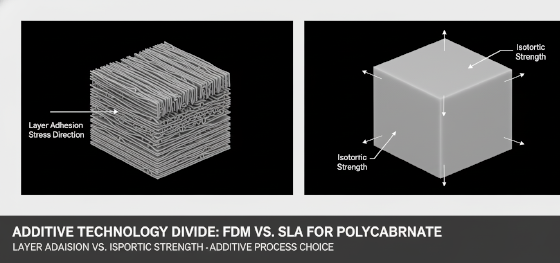
Navigating the equipment choice is the first fork in the road for any engineering project. Not all polycarbonate is processed using the same physics. At our facility, we utilize two distinct additive pathways based on the part's mechanical destiny. Industrial FDM (Fused Deposition Modeling) is the champion of structural "Grit." It utilizes a solid filament of PC that is melted and extruded. Because the material is a production-grade thermoplastic, the resulting parts possess the highest impact strength and thermal resistance. This is the preferred method for machine guards and rugged internal brackets where aesthetics are secondary to raw survival. However, FDM is anisotropic; its strength is dependent on the layer orientation. We manage this through precise tool-path orchestration, ensuring that the highest stress loads align with the strongest axis of the material.
SLA (Stereolithography) represents the "Optical" alternative. Instead of melting a filament, it utilizes a liquid photopolymer resin that has been engineered to simulate polycarbonate’s properties. While these simulants may lack the extreme fracture toughness of FDM-extruded PC, they offer absolute "Geometric Sovereignty." SLA produces nearly isotropic parts with mirror-smooth surfaces and microscopic detail resolution. This is the definitive choice for clear lenses, light pipes, and complex medical manifolds where internal fluid flow must be visible. JUCHENG helps our clients perform a "Mission Audit"—if your part must withstand a sledgehammer, we go FDM; if it must pass an optical bench test, we go SLA. By providing both technologies under one roof, we eliminate the bias found in smaller bureaus, ensuring your delivers the specific physics your assembly requires.
Environmental Survival: Heat, Flame, and Chemical Resistance
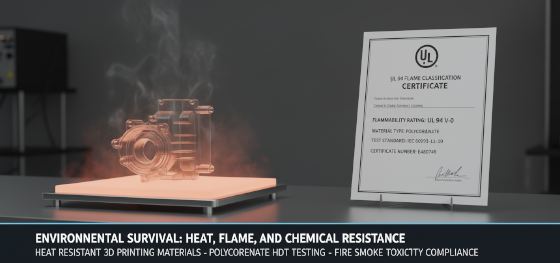
Industrial environments are hostile to standard plastics. A part designed for the medical sector or the automotive engine bay must survive more than just physical impact; it must survive the chemistry of its surroundings. Polycarbonate is favored by JUCHENG’s clients for its impressive Heat Deflection Temperature (HDT), which typically reaches 135°C to 140°C. Unlike lower-grade polymers that soften in a warm enclosure, PC maintains its structural "spine," ensuring that mounting points don't loosen and seals don't weep under thermal load.
Safety compliance is another critical pillar of our polycarbonate 3d printing service. For our aerospace and electronics partners, we utilize specialized PC resins that meet the UL94 V-0 flame-retardant standard. These materials are "self-extinguishing," meaning they won't contribute to the spread of a fire—a mandatory requirement for aircraft cabin interiors and high-voltage power enclosures. However, we also provide a technical warning regarding chemical exposure. Polycarbonate is notoriously sensitive to common alcohols and certain industrial solvents. Exposure to these chemicals can trigger "Crazing"—thousands of tiny hairline fractures that destroy both the clarity and the impact strength of the part. JUCHENG’s engineers evaluate your cleaning and sterilization protocols before we start the build, suggesting protective coatings or material alternatives like PEEK if your environment is chemically aggressive. We don't just print a part; we engineer its long-term survival against the elements.
Hybrid Metamorphosis: CNC Machining the Unprintable Fits
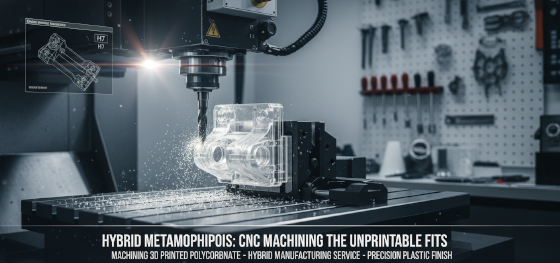
Complexity is a superpower, but it shouldn't come at the cost of precision. Additive manufacturing provides the "Impossible Geometry"—internal labyrinths and topologically optimized frames—but it often fails at the "Critical Interface." A 3D printer cannot consistently deliver an H7 bearing bore or a mirror-finish seal surface to a +/- 0.01mm tolerance. Jucheng Precision eliminates this "Accuracy Gap" through our hybrid manufacturing workflow. We treat the 3D printer as a high-tech foundry that produces an "Advanced Preform."
Our polycarbonate 3d printing service includes the option for "Post-Build Precision." We print your complex PC parts with an extra 1.5mm of "Machining Stock" on all critical assembly datums. Once the part has been thermally stabilized to release internal stresses, it moves to our 5-axis CNC floor. Our high-speed mills then carve away the near-net texture, revealing the surgical accuracy needed for high-performance assemblies. This integrated approach is why JUCHENG is the preferred partner for global robotics and medical firms. We eliminate the accountability gap between vendors, providing a single, verified engineered solution that possesses the lightweight freedom of additive and the sub-micron certainty of CNC. We bridge the gap between design theory and real-world assembly, ensuring your parts fit perfectly the first time, every time.
Technical Validation: Locking in Component Integrity
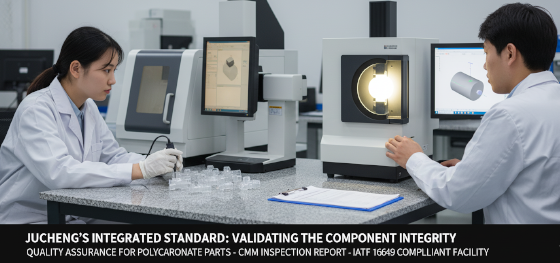
The final hallmark of a professional 3D printing partner is the refusal to accept visual quality as a proxy for technical precision. In the world of high-stakes aerospace and medical hardware, an unverified part is a dangerous liability. Jucheng Precision operates a facility where additive manufacturing is a documented engineering discipline, not a visual craft. Our polycarbonate 3d printing service protocol includes full material lot-traceability and documented process validation. We understand that your reputation depends on the integrity of the plastic we extrude or cure.
Our metrology lab utilize high-resolution CMM (Coordinate Measuring Machines) and laser scanners to generate 3D "Error Maps" of your components. We compare the physical part against your master STEP file to identify any thermal drift that occurred during the cooling phase. We also perform "Shore Hardness" audits and cross-hatch adhesion tests on secondary coatings to ensure the structural "skin" of the part is as tough as the core. For our automotive clients, we provide full PPAP documentation, providing the paper trail required for Tier-1 supply chain compliance. When you receive a shipment from JUCHENG, you aren't just getting 3D prints; you are getting verified engineered solutions that have been audited for survival. We don't just ship plastic; we manufacture trust through data-driven quality control.
Strategic Verdict: Why Professional PC Printing Defines Success
Success in the modern market requires the ability to move from CAD to a functional, field-ready component in days. The decision to utilize a professional impresión 3D en policarbonato is a strategic move toward manufacturing agility. It allows your engineers to test real impact physics and thermal loads without the anchor of high-pressure tooling costs. By choosing Jucheng Precision, you are accessing a decade of industrial data and a facility that treats polymers with the technical reverence usually reserved for aerospace metals.
Our integrated approach—combining 5-axis CNC precision, chemical vapor smoothing, and IATF 16949-aligned quality standards—makes us the definitive partner for your most challenging transparent and high-strength designs. We remove the uncertainty of material behavior, delivering parts that are visually striking and structurally invincible. Don't let your innovation be limited by the low quality of desktop prints or the high cost of fragmented vendors. Experience the clarity and the capability that industrial-grade polycarbonate replication can bring to your next breakthrough. Contact Jucheng Precision today for a technical DFM review and let our engineers help you build a bigger, better, and more profitable physical reality. We clarify the complex, ensuring your most ambitious visions are armored for survival in the real world.

