


Coloque dos cubos transparentes sobre una mesa de ingeniería. A tres pies de distancia, parecen idénticos. Ambos capturan la luz con perfección cristalina; ambos se sienten fríos y sustanciales al tacto. Sin embargo, golpee uno con un martillo y se hará añicos en mil agujas peligrosas. Golpee el otro, y el martillo simplemente rebota, dejando solo una marca de roce débil. Este es el enigma fundamental y de alto riesgo de policarbonato vs acrílico.

Para diseñadores y gerentes de compras, elegir entre estos dos "titanes" transparentes rara vez se trata de estética y casi siempre de supervivencia ambiental. Uno es un artista de alta claridad diseñado para el centro de atención; el otro es un soldado resistente construido para soportar impactos que pulverizarían el vidrio. En Jucheng Precision, nuestra experiencia en mecanizado CNC de acrílico nos permite llevar estos materiales a sus límites físicos, pero el éxito de su proyecto comienza con la selección de la base química correcta antes de que se programe la primera trayectoria de herramienta.
Comprender las compensaciones entre el polimetilmetacrilato (PMMA) y el policarbonato (PC) es la diferencia entre un producto que dura una década y uno que falla en su primera semana de servicio. Esta guía elimina la exageración de marketing para ofrecer un desglose técnico de las brechas de rendimiento, los comportamientos de mecanizado y las realidades de costos de los dos polímeros transparentes más importantes en la fabricación moderna.
contenido:
ADN molecular: Química de la transparencia
Análisis de resistencia: El multiplicador de 250x
Fidelidad óptica: Realidades de transmisión de luz
Dureza superficial: Resistencia a rayones y químicos
Rendimiento de mecanizado: Frágil vs gomoso
Matriz de ingeniería: La decisión final
ADN molecular: Química de la transparencia

Para entender la brecha de rendimiento, debemos mirar la columna vertebral de las moléculas. El acrílico, o PMMA, es un polímero sintético de metacrilato de metilo. Es esencialmente un vidrio orgánico. Su estructura molecular es rígida y organizada, que es exactamente por qué es tan claro. La luz lo atraviesa con interferencia mínima porque las cadenas están estrechamente empaquetadas y son estables. Sin embargo, esta rigidez es un arma de doble filo. Hace que el material sea duro, pero también lo hace incapaz de absorber energía repentina.
El policarbonato es una criatura completamente diferente. Es un termoplástico que contiene grupos carbonato en su estructura química. A nivel microscópico, estas cadenas son mucho más largas y más "enredadas" que las del acrílico. Cuando una fuerza golpea el policarbonato, estas cadenas tienen la capacidad de desplazarse y doblarse, absorbiendo la energía cinética en lugar de romperse. Esta flexibilidad molecular es la razón por la que el policarbonato se usa para ventanas a prueba de balas, mientras que el acrílico se usa para tanques de acuario de alta gama. En el policarbonato vs acrílico debate, está eligiendo entre la elegancia frágil de un "vidrio orgánico" y la resistencia flexible de una "resina de ingeniería"."
Análisis de resistencia: El multiplicador de 250x

En el mundo de la ingeniería, la "resistencia al impacto" es la métrica que generalmente resuelve la discusión. Si usamos el vidrio estándar como nuestra línea base (1x), las diferencias entre los dos plásticos son asombrosas. El acrílico es aproximadamente 17 veces más fuerte que el vidrio. Puede soportar un golpe moderado de una herramienta extraviada o un trozo de escombro sin fallar. Para la mayoría de las vitrinas o paneles decorativos, este multiplicador de 17x es más que suficiente protección.
However, Polycarbonate exists in a different dimension of durability. It is rated at roughly 250 times the impact strength of glass. This is the material that survives sledgehammer blows and high-velocity projectiles. At Jucheng Precision, we recommend polycarbonate for machine guards, safety visors, and any functional part that lives in a "danger zone" where physical impact is a daily reality. While acrylic breaks into sharp, dangerous shards, polycarbonate tends to dent or deform. If safety and survival are your primary design constraints, the 250x multiplier of polycarbonate makes it the only viable choice.
Fidelidad óptica: Realidades de transmisión de luz
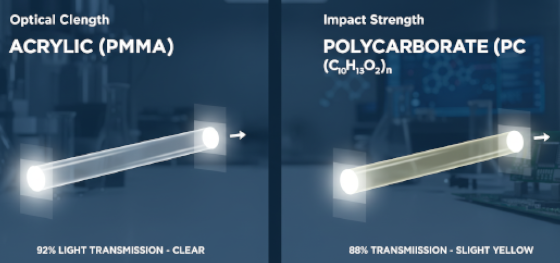
While polycarbonate wins on strength, acrylic takes the trophy for optical purity. Acrylic has a light transmission rate of approximately 92%. This is actually higher than most standard glass. It is "water white," meaning it has no inherent color tint. When you look through a thick block of machined acrylic, the image on the other side is undistorted and vivid. This is why it is the gold-standard for light pipes, camera lenses, and museum-grade displays.
Polycarbonate has a slightly lower light transmission rate, usually around 88%. More importantly, PC often has a very faint blue or yellow tint, which becomes more noticeable as the thickness of the part increases. Furthermore, polycarbonate is susceptible to UV degradation. Without specialized coatings, a polycarbonate part exposed to the sun will eventually turn yellow and become brittle. Acrylic, by contrast, is naturally UV stable. It will remain crystal clear for decades even in direct sunlight. If your project is a light-transmitting component for a premium automotive interior, acrylic’s 92% transmission and eternal clarity often outweigh polycarbonate’s strength.
Dureza superficial: Resistencia a rayones y químicos
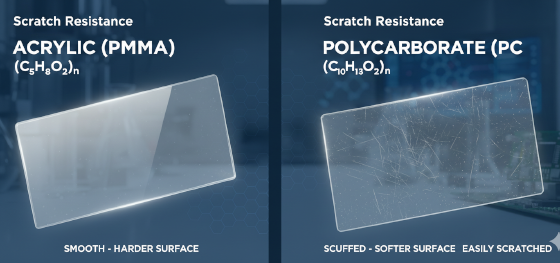
Surface durability is a hidden factor that often catches engineers by surprise after a few months of field use. Acrylic is a much harder material than polycarbonate. On the Rockwell M scale, acrylic typically rates higher, which translates to superior scratch resistance. You can wipe an acrylic panel with a dry cloth dozens of times without leaving visible swirls. This hardness also allows acrylic to be polished to a mirror shine using mechanical buffing wheels—a process that is far more difficult with the softer surface of polycarbonate.
Polycarbonate is relatively soft. It scratches very easily. A stray fingernail or a rough cleaning sponge can leave permanent scars on an untreated PC surface. While "hard-coated" versions of polycarbonate exist, they add significant cost to the raw material. Additionally, the two materials react differently to chemicals. Acrylic is sensitive to alcohols and certain solvents, which can cause it to "craze" or develop tiny surface cracks. Polycarbonate is generally more resistant to acids but can be severely damaged by strong alkalis. At JUCHENG, we advise our clients on these environmental factors to ensure the material choice survives not just the machine, but the cleaning protocols of the final user.
Rendimiento de mecanizado: Frágil vs gomoso
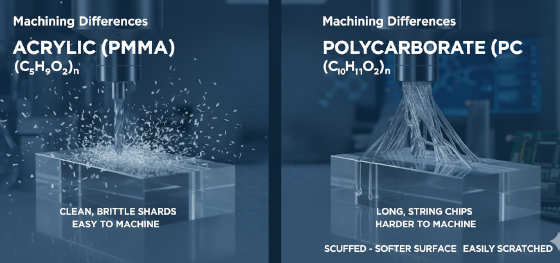
Inside our CNC centers, the policarbonato vs acrílico choice dictates every parameter from spindle speed to tool geometry. Acrylic is a "clean" cutter. Because it is brittle, the chips fracture easily and fly away from the tool in crisp, cold flakes. This makes it easier to achieve a high-quality surface finish directly off the mill. However, that same brittleness makes acrylic prone to "chipping" at the edges if the tool isn't razor-sharp or if the feed rate is too aggressive.
Polycarbonate is a "gummy" material. Because it is designed to absorb energy, it resists the shearing action of the tool. Instead of fracturing, the chips want to peel away in long, stringy ribbons. These ribbons can wrap around the spindle and trap heat, leading to the plastic melting and welding itself to the cutter. Machining polycarbonate requires much lower speeds and higher chip loads to keep the material cool. While it won't chip at the edges like acrylic, it is much harder to "vapor polish" or mechanically buff to a high-gloss finish. For parts requiring intricate internal details and maximum transparency, the superior machinability of acrylic often makes it the preferred candidate in our precision workshop.
Matriz de ingeniería: La decisión final
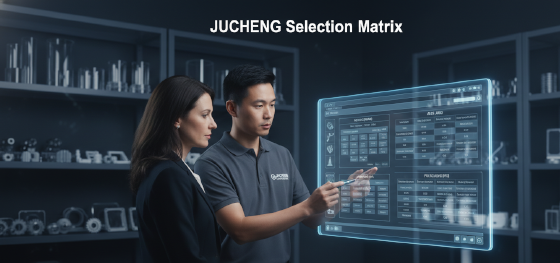
To simplify your material selection, Jucheng Precision uses a definitive comparison matrix. We weigh the physical realities against your specific application to ensure the lowest scrap rate and the highest field reliability.
| Característica | Acrílico (PMMA) | Policarbonato (PC) |
|---|---|---|
| Resistencia al Impacto | Good (17x glass) | Extreme (250x glass) |
| Transmisión de luz | 92% (Optical Grade) | 88% (Standard Grade) |
| Resistencia al Rayado | Alto | Bajo |
| Estabilidad UV | Excelente | Poor (unless coated) |
| Maquinabilidad | Excellent (Brittle) | Fair (Gummy) |
| Relative Cost | Inferior | Más alto |
The Verdict: If your part is a cosmetic display, a light guide, or an outdoor architectural panel where optical clarity and scratch resistance are paramount, Acrylic is the winner. If your part is a structural machine guard, a safety enclosure, or a component exposed to high-velocity impacts where safety is non-negotiable, Polycarbonate is the only answer. At Jucheng Precision, we stock both high-quality cast acrylic and engineering-grade polycarbonate to ensure your prototypes move to production without delay. Contact our engineering team today for a full DFM review and see how our plastic manufacturing expertise can clarify your design process.

