


El polipropileno (PP) es uno de los materiales más utilizados en la fabricación, valorado por su baja densidad, excepcional resistencia química y capacidad para crear bisagras vivas. Sin embargo, procesar con éxito el moldeo por inyección de polipropileno es un desafío significativo debido a su estructura material inherente, que conduce a una contracción alta y no uniforme y a un alto riesgo de alabeo de la pieza.
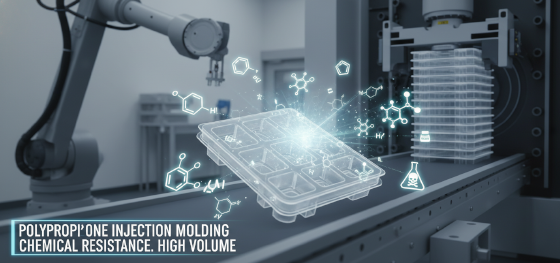
Para los compradores B2B, gestionar estos problemas es crítico para componentes estructurales y cosméticos en los sectores médico, de consumo y automotriz. Esta guía detalla las estrategias especializadas de herramientas, gestión térmica y estructurales necesarias para dominar el moldeo de PP y su integración con materiales flexibles como TPE y TPU.
Naturaleza Semicristalina: La Causa Raíz de la Alta Contracción y el Alabeo
Gestión Térmica: Controlando la Temperatura del Molde para Prevenir el Alabeo
Integración de TPE/TPU: Co-Moldeo de Empuñaduras Suaves con Estructuras Rígidas de PP
Estrategias de Herramientas: Gestionando el Cizallamiento y el Flujo para un Llenado Uniforme
Acabado Superficial: Preparando PP de Baja Energía Superficial para la Adhesión
Naturaleza Semicristalina: La Causa Raíz de la Alta Contracción y el Alabeo

El polipropileno es un polímero semicristalino, lo que significa que su estructura molecular interna contiene regiones ordenadas (cristalinas) y desordenadas (amorfas). Esta estructura es la fuente tanto de su resistencia como de su dificultad de procesamiento:
Alta Contracción: A medida que el plástico se enfría en el molde, las regiones cristalinas se empaquetan firmemente, causando una gran reducción de volumen no uniforme. El PP típicamente se contrae significativamente más (hasta un 2%) que los plásticos amorfos como el ABS o el PC.
Anisotropía: La contracción no es la misma en todas las direcciones. El material se contrae más en la dirección del flujo y menos perpendicular a él. Esta diferencia direccional es la causa principal del alabeo, especialmente en componentes grandes y planos.
Resistencia: Las regiones cristalinas le dan al PP su alta rigidez, tenacidad y superior resistencia química, lo que lo convierte en una opción ideal para piezas industriales duraderas.
Gestión Térmica: Controlando la Temperatura del Molde para Prevenir el Alabeo
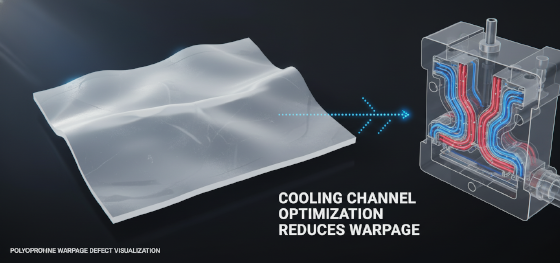
Precise control of mold temperature is the most effective way to manage shrinkage and prevent the warping that plagues Polypropylene Injection Molding:
Uniform Cooling: The primary rule is to ensure the mold cools the part as uniformly as possible. Uneven cooling causes the material to solidify and shrink at different rates, pulling the part into a warped shape.
High Mold Temperature: PP benefits from a moderately high mold temperature. This slows the cooling rate, allowing the crystalline structure to form more uniformly and reducing the overall shrinkage differential.
Cooling Channel Design: Advanced tooling features cooling channels placed strategically to maintain thermal balance. For difficult parts, conformal cooling channels can be used to follow the part's contour and ensure consistent heat removal.
Integración de TPE/TPU: Co-Moldeo de Empuñaduras Suaves con Estructuras Rígidas de PP
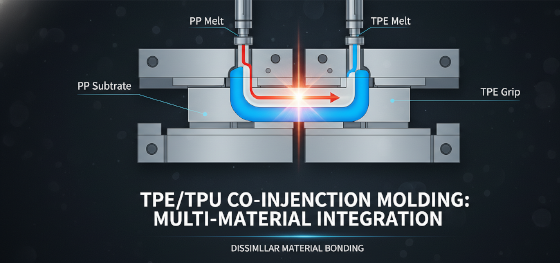
PP's chemical inertness makes it difficult to bond with adhesives, but its unique chemistry allows it to be efficiently co-molded (overmolded) with TPE and TPU elastomers:
Chemical Bonding: TPE and TPU grades are specifically formulated to chemically bond with the PP substrate during the two-shot Injection Molding process. This creates a permanent, high-strength soft-touch grip on a rigid PP body.
Functional Applications: Co-molding is essential for consumer devices, medical grips, and automotive parts that require rigid structural support (PP) and flexible, ergonomic or sealing surfaces (TPE/TPU).
Design Challenge: The mold design must account for the different shrinkage rates of PP and TPE. The tooling must be built to perfectly manage this differential shrinkage to prevent internal stress and separation between the two materials.
Estrategias de Herramientas: Gestionando el Cizallamiento y el Flujo para un Llenado Uniforme
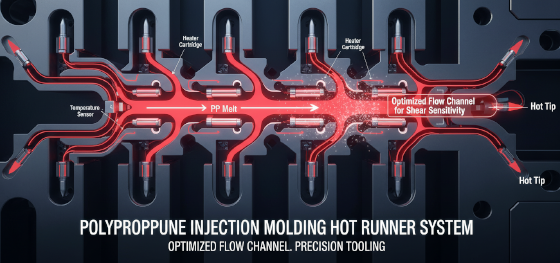
The tooling itself must be optimized to manage the low viscosity and high flow rate of molten PP:
Hot Runner Systems: These systems keep the plastic molten right up to the mold cavity, eliminating cold slugs and improving flow uniformity. For PP, the precise thermal control of the hot runner is vital to prevent material degradation.
Shear Sensitivity: PP is highly sensitive to shear (friction) as it flows through the runner system. Excessive shear can break down the polymer chains, leading to material weakness and inconsistent part quality. Gating systems must be designed to minimize turbulence and shear.
Weld Line Placement: Weld lines (where two flow fronts meet) are always weak points in PP. Tool design (gate location) must be used to place these weld lines in low-stress, non-visible areas of the component.
Acabado Superficial: Preparando PP de Baja Energía Superficial para la Adhesión
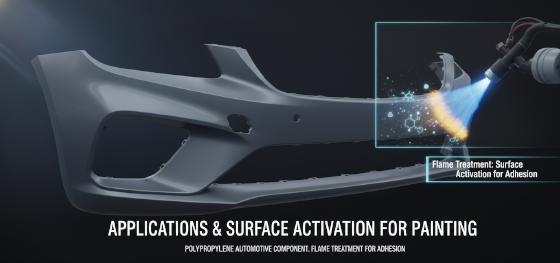
PP’s superior chemical resistance also means it has low surface energy, making it naturally resistant to bonding with paints, adhesives, and coatings:
Surface Activation: For painting or printing, the surface of the PP must be activated using specialized methods like flame treatment or plasma treatment. This chemical modification increases the surface energy, allowing primers and coatings to adhere.
Texture and Appearance: PP tends to show a lower gloss finish than amorphous plastics. Mold textures (like VDI finishes) are often etched into the mold steel to give the part a uniform, appealing surface texture.
Welding Capability: PP is excellent for ultrasonic welding and hot plate welding, making it ideal for creating large, fully sealed assemblies (like containers or ducts) from smaller molded components.
Mastering Polypropylene Injection Molding requires sophisticated thermal and tooling strategies to manage high shrinkage and warpage risk. Jucheng Precision Technology offers specialized expertise in tooling design, TPE co-molding, and surface activation to ensure your PP components achieve maximum dimensional accuracy and functional integration.
Secure warp-free, high-toughness PP components. Contáctenos hoy to discuss the optimal Injection Molding and multi-material strategy for your next project.

