


Safety in the stratosphere is not a variable; it is a hard-coded technical requirement. When an aircraft interior component or an under-the-hood automotive bracket is designed, the primary fear is not just structural failure, but the danger of fire. In the vast catalog of the plástico para impresión 3d industry, most materials are essentially fuel. They melt, burn, and emit toxic fumes. There is, however, an elite exception that bridges the gap between plastic versatility and aerospace survival. This is the sophisticated world of ultem 3d printing. Polyetherimide (PEI), known by the brand name Ultem, is a high-performance amorphous thermoplastic that offers an incredible strength-to-weight ratio combined with inherent flame retardancy. It is the only additive material that allows engineers to move from a digital mock-up directly to a flight-certified, end-use component.

At JUCHENG, we recognize that printing with high-heat resins like Ultem is a move into a high-liability manufacturing tier. You cannot achieve the necessary molecular bonding of PEI on a standard desktop machine. If the build chamber is not actively heated to extreme levels, the part will suffer from catastrophic warping and "internal delamination" that isn't visible until the part fails under load. We have engineered our additive facility to satisfy the rigorous demands of the aerospace and defense sectors, utilizing industrial-grade FDM systems that maintain thermal sovereignty over the entire build volume. This guide moves past the basic definitions to explore the chemistry of FST compliance, the mechanical divide between Ultem 9085 and 1010, and why JUCHENG’s integrated approach to high-temperature extrusion is the final step in ensuring your critical designs survive the heat of the real world.
Reliability in extreme environments is found in the management of the thermal shock. You aren't just stacking layers of resin; you are managing a phase-change event at 400°C that must result in a stable, monolithic solid. Whether you are building a lightweight air duct for a satellite or a high-voltage electrical connector, the logic of the melt is your greatest engineering asset. Let us examine the technical pillars of industrial Ultem extrusion and see how JUCHENG locks the integrity of your most ambitious designs into reality.
Thermal Sovereignty: The 180°C Chamber Requirement
Material Selection: Deciphering 9085 vs. 1010 Logic
FST Sovereignty: Why Aerospace Relies on PEI Chemistry
Precision Overhangs: Managing Soluble Support in High Heat
JUCHENG’s Certification Standard: Beyond the Spindle
Technical Data: Ultem Mechanical Property Baseline
Thermal Sovereignty: The 180°C Chamber Requirement

The primary enemy of high-performance extrusion is the temperature gradient. When you melt Ultem filament at 360°C and extrude it into an uncontrolled environment, the material experiences immediate thermal shock. Amorphous resins like PEI have a high glass transition temperature (Tg) of approximately 186°C. If the ambient air around the part is cooler than this threshold, the polymer chains freeze instantly, preventing them from bonding with the next layer. This results in parts that are visually correct but structurally "delaminated"—they will split apart along the layer lines the moment they are subjected to torque or vibration.
At JUCHENG, we eliminate this mechanical vulnerability through absolute thermal sovereignty. Our industrial FDM platforms utilize actively heated build chambers that maintain a constant 180°C environment. This keeps the entire part in a semi-relaxed state during the hours-long build cycle. By maintaining this elevated temperature, we ensure that the interface between layers remains chemically active, allowing for the maximum possible cross-linking across the Z-axis. This thermal discipline is the only way to achieve the +/- 0.15mm tolerances required for aerospace interior components. We don't just "print" Ultem; we manage a slow, controlled cooling event that locks in the dimensional accuracy and structural homogeneity your designs demand. This technical rigor is what separates industrial ultem 3d printing de fallos a nivel de aficionado.
Material Selection: Deciphering 9085 vs. 1010 Logic

Elegir el grado adecuado de Ultem es un ejercicio de compensaciones técnicas. Aunque ambos materiales se basan en la molécula de PEI, están optimizados para diferentes "teatros de guerra"." Ultem 9085 es el campeón indiscutible de la cabina aeroespacial. Es una resina mezclada que ofrece alta ductilidad y resistencia al impacto. Si un soporte aeroespacial necesita sobrevivir a una vibración violenta o un impacto repentino sin romperse en fragmentos peligrosos, el 9085 es el material elegido. Su superpoder es su tenacidad; se dobla y deforma ligeramente antes de romperse, proporcionando un margen de seguridad que los materiales frágiles no pueden ofrecer.
Ultem 1010 es el atleta de la resistencia pura al calor y a los químicos. Es una resina PEI de alta pureza sin mezclar que ofrece la mayor resistencia a la tracción y temperatura de deflexión térmica en la familia FDM. Si su pieza es un colector de procesamiento de alimentos que debe soportar limpieza con vapor a alta presión, o una carcasa de motor automotriz que ve temperaturas constantes de 200°C, el 1010 es la única opción lógica. Sin embargo, el 1010 es significativamente más frágil que el 9085; se comporta más como un polímero relleno de vidrio. En JUCHENG, ayudamos a nuestros clientes a auditar sus casos de carga. No solo miramos el punto de fusión; miramos el ciclo de fatiga. Al emparejar el grado específico de Ultem con el destino estructural de su pieza, aseguramos que su materiales de impresión 3D estrategia sea tan precisa como sus planos de ingeniería.
FST Sovereignty: Why Aerospace Relies on PEI Chemistry
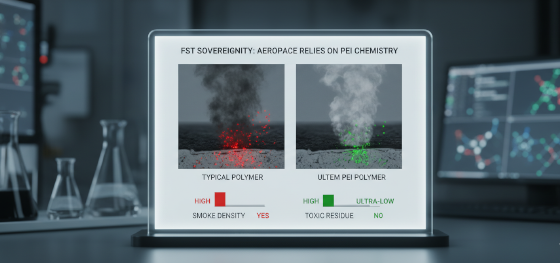
En el mundo aeroespacial y de defensa, el "rendimiento" es secundario al "cumplimiento normativo". El guardián definitivo para las piezas interiores de aeronaves es el protocolo FST: Llama, Humo y Toxicidad. Si un componente se coloca dentro de una cabina presurizada, debe demostrar que no contribuirá a un incendio y, más importante, que no emitirá gases tóxicos que puedan incapacitar a los pasajeros. Aquí es donde ultem 3d printing se gana su lugar. Las resinas Ultem son inherentemente retardantes de llama. No requieren la adición de aditivos halogenados—que son tóxicos por sí mismos—para alcanzar una clasificación UL94 V-0.
Cuando se expone a la llama directa, Ultem forma una capa aislante de "carbonización" que evita que el fuego se propague. Su emisión de humo es excepcionalmente baja, y su perfil de toxicidad cumple con los estándares más estrictos de la FAA y EASA. En JUCHENG, tratamos el cumplimiento FST como una línea base de fabricación. Proporcionamos trazabilidad completa del material y certificados de conformidad para cada pedido aeroespacial, asegurando que las piezas de 9085 que enviamos sean supervivientes documentados. Esta seguridad química, combinada con la naturaleza ligera del polímero, nos permite reemplazar conductos de aire de aluminio pesados y cajas de conexiones con piezas de Ultem optimizadas topológicamente, reduciendo kilogramos del peso de una aeronave mientras aumentamos la seguridad general del vehículo.
Precision Overhangs: Managing Soluble Support in High Heat

La complejidad en la impresión 3D a menudo está limitada por la capacidad de eliminar el andamiaje que la sostiene. En el entorno de boquilla a 400°C de una impresión de Ultem, los soportes desmontables estándar son una pesadilla. Se adhieren demasiado a la pieza, dejando feas marcas superficiales que requieren horas de lijado manual. Para resolver el enigma de los canales internos y los socavados complejos, Jucheng Precision utiliza materiales de **Soporte Soluble a Alta Temperatura** especializados. Estos son polímeros diseñados que pueden soportar la temperatura de la cámara de 180°C sin fundirse, pero se disuelven completamente en un baño químico especializado después de que la impresión haya terminado.
Esta eliminación de soportes "sin intervención manual" es vital para piezas funcionales como colectores de aire ligeros o carcasas de instrumentos médicos con compartimentos electrónicos internos. Asegura que las superficies internas sean tan suaves y precisas como las exteriores. Al utilizar tecnología de doble extrusión, podemos imprimir geometrías que son físicamente imposibles de desmoldar en la fundición tradicional. Esta libertad permite a nuestros clientes diseñar para "Flujo Laminar" o "Eficiencia Estructural" sin preocuparse por el acceso de herramientas. Nuestro dominio de la química de soportes asegura que sus visiones internas más intrincadas se realicen sin las cicatrices de fabricación de la intervención manual, ofreciendo un nivel de fidelidad geométrica que define la plástico para impresión 3d producción de clase mundial.
JUCHENG’s Certification Standard: Beyond the Spindle

Elegir un socio para polímeros de alto riesgo es una decisión de responsabilidad técnica. En Jucheng Precision, operamos una instalación certificada ISO 9001 e ISO 13485, con controles de proceso alineados con IATF 16949. Entendemos que para una carcasa de batería de vehículo eléctrico automotriz o un componente de robot quirúrgico médico, "adivinar" la resistencia del material no es una opción. Nuestro ultem 3d printing protocolo incluye "Verificación Capa por Capa". Utilizamos monitoreo en proceso para detectar cualquier variación de extrusión que pueda indicar un vacío interno.
We also manage the "Hygroscopic Threat." Ultem resin is extremely sensitive to moisture. If the filament is not dried to a -40°C dew point before it enters the nozzle, the water molecules will turn to steam inside the part, creating microscopic "bubbles" that destroy the part's tensile strength. JUCHENG maintains a closed-loop dry-air system from the material dryer directly to the machine's sealed intake. This ensures that the material we print is as pure as the day it was synthesized. When you receive a shipment from JUCHENG, you aren't just getting 3D prints; you are getting verified engineered solutions. We provide the documentation, the precision, and the material science to ensure your next breakthrough survives the most hostile environments.
Technical Data: Ultem Mechanical Property Baseline
To finalize your design-for-manufacturing review, Jucheng Precision provides the following mechanical baseline for our industrial-grade Ultem components. These values reflect parts produced in our stabilized thermal environments.
| Propiedad | Ultem 9085 (Aerospace) | Ultem 1010 (High Temp) |
|---|---|---|
| Tensile Strength (XY) | ~70-75 MPa | ~80-85 MPa |
| Deflexión Térmica (HDT) | 153°C | 216°C |
| Elongación a la Rotura | ~6.0% (Ductile) | ~3.0% (Brittle/Stiff) |
| FST Rating | Full Aerospace Compliance | High (UL94 V-0) |
| Ideal Use Case | Cabin Interiors, Brackets | Engine Zones, Molds |
Success in the modern market requires the ability to replace metal with high-performance plastics without sacrificing safety. JUCHENG’s expertise in ciencia de los materiales de impresión 3D ensures that your designs are not just realized, but verified for flight. Contact our engineering team today for a comprehensive technical review and see how our Ultem protocols can armor your next industrial project.

