Seleccionar el grado correcto de acero inoxidable determina el modo de fallo y el margen de seguridad de los componentes industriales. El SUS 304, equivalente al AISI 304, se destaca como el acero inoxidable austenítico más utilizado en la fabricación global. Sin embargo, los ingenieros frecuentemente interpretan mal la distinción crítica entre Yield Strength and Tensile Strength. This confusion leads to catastrophic design failures where parts permanently deform under load or structurally fracture during operation. Yield strength defines the exact limit of elastic recovery, representing the point where the metal begins to stretch permanently. Tensile strength, conversely, measures the absolute maximum stress the material can withstand before snapping. Mastering the gap between these two mechanical values reveals the "plastic deformation zone," a critical parameter for predicting how SUS 304 will behave during aggressive CNC machining, sheet metal bending, and high-pressure forming operations.
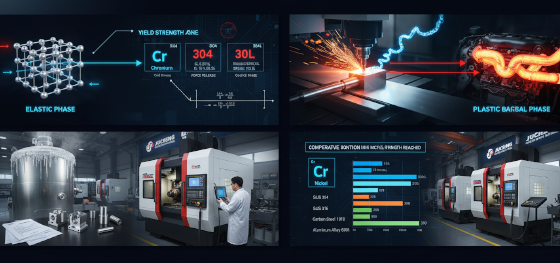
La fabricación de SUS 304 requiere un profundo conocimiento metalúrgico específicamente debido a sus características únicas de resistencia. A diferencia del aluminio o del acero dulce, el acero inoxidable 304 exhibe una propensión significativa al endurecimiento por deformación. Cuando una herramienta de corte deforma el material para generar una viruta, el límite elástico localizado del metal sin cortar aumenta inmediatamente, volviéndose efectivamente más duro que el material base. Los maquinistas CNC deben mantener agresivamente las cargas de viruta para cortar por debajo de esta capa endurecida. De manera similar, los operadores de chapa metálica deben calcular ángulos de sobrecurvado precisos para contrarrestar la memoria de retroceso elástico del material. Jucheng Precision integra estos principios de ciencia de materiales directamente en nuestra programación CAM y estrategias de herramientas, asegurando que las propiedades mecánicas teóricas en la hoja de datos coincidan con la realidad física de sus piezas fabricadas a medida.
Definición del Límite Elástico y la Mecánica del Punto de Fluencia
Fenómenos de Endurecimiento por Deformación en el Mecanizado CNC
Implicaciones del Retroceso Elástico y el Conformado de Chapa Metálica
La Zona de Deformación Plástica y la Resistencia Última a la Tracción
Impactos de la Temperatura en el Rendimiento Mecánico
Factores de la Composición Química en la Variación de la Resistencia
Tabla de Análisis Comparativo de Aleaciones Comunes
Fabricación de Precisión y Aseguramiento de Calidad de Jucheng
Definición del Límite Elástico y la Mecánica del Punto de Fluencia

Los ingenieros priorizan el límite elástico como la principal restricción de diseño para aplicaciones no destructivas. Para el acero inoxidable SUS 304, el límite elástico típicamente se sitúa alrededor de 215 Megapascales (MPa). Este valor representa el esfuerzo máximo que el material puede soportar mientras aún actúa como un resorte. Si una carga permanece por debajo de este umbral, la red atómica se estira temporalmente y vuelve a su forma original una vez que se retira la fuerza. Diseñar un soporte estructural o un recipiente a presión requiere mantener los esfuerzos operativos muy por debajo de este límite de 215 MPa para prevenir la distorsión geométrica permanente. Cualquier fuerza que exceda este valor específico causa que los planos atómicos se deslicen unos sobre otros, resultando en deformación plástica irreversible.
Distinguishing the exact yield point in austenitic stainless steels presents a technical challenge. Unlike carbon steels which show a sharp yield point drop, SUS 304 exhibits a gradual transition from elastic to plastic behavior. Metallurgists utilize the "0.2% Offset Method" to standardize this measurement. They draw a line parallel to the initial elastic modulus curve but shifted by 0.2% strain on the X-axis. The intersection of this theoretical line with the stress-strain curve defines the official yield strength. Understanding this gradual transition is crucial for precision stamping, as the material begins to flow microscopically before macroscopic deformation becomes visible to the naked eye.
Fenómenos de Endurecimiento por Deformación en el Mecanizado CNC
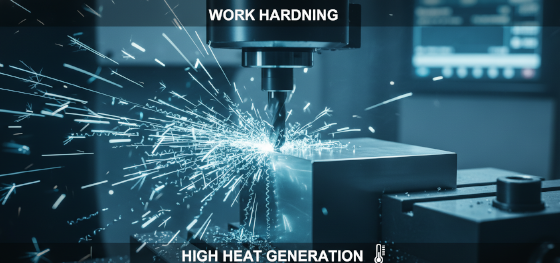
El mecanizado de acero inoxidable SUS 304 exige una desviación completa de las estrategias estándar de procesamiento de aluminio debido al fenómeno del endurecimiento por deformación. Este material posee una alta ductilidad y una estructura cristalina única que se endurece rápidamente cuando se somete a fuerzas de trabajo en frío. Durante una operación de fresado o torneado, si la herramienta de corte roza contra la superficie en lugar de cortarla, el calor y la presión aumentan instantáneamente el límite elástico local de la pieza de trabajo. El material directamente delante de la cortadora se vuelve significativamente más duro que el material en masa, causando desgaste rápido de la herramienta, rotura catastrófica de la cortadora y malos acabados superficiales.
Overcoming this "gummy" yet hard characteristic requires aggressive CNC parameters. Machinists must maintain a constant, heavy chip load to ensure the cutting edge penetrates beneath the work-hardened zone created by the previous pass. Dwelling in the cut or allowing the tool to idle against the part is strictly prohibited. High-pressure coolant delivery becomes essential not just for temperature control, but to provide lubricity that prevents the material from seizing or welding onto the tool bit (Built-Up Edge). Jucheng Precision employs specialized coated carbide tooling with sharp positive rake angles specifically designed to shear austenitic stainless steel cleanly, preventing the heat buildup that triggers hardening.
Implicaciones del Retroceso Elástico y el Conformado de Chapa Metálica
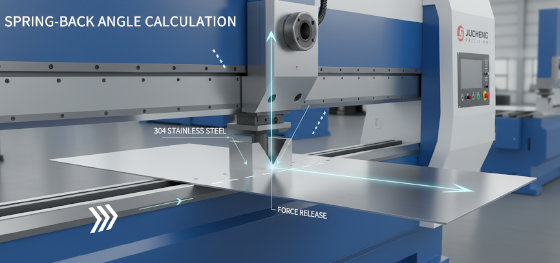
Fabricating chapa metálica components from SUS 304 introduces the complex variable of elastic recovery, commonly known as spring-back. Because the yield strength determines the limit of elasticity, it directly dictates how much the metal will try to return to its original flat shape after bending. Since SUS 304 has a relatively high yield strength compared to mild steel, it stores more elastic energy during the forming process. When the press brake punch retracts, the bent flange relaxes, opening the angle by several degrees. A ninety-degree bend programmed into the machine might result in a ninety-three-degree angle on the physical part.
Predicting and compensating for this deviation requires sophisticated bending calculations. Operators must over-bend the material effectively to account for the relaxation. For a target angle of ninety degrees, the tooling might need to drive to eighty-seven degrees. The exact amount of spring-back varies depending on the sheet thickness, the bend radius, and the specific rolling grain direction of the raw material. Bending perpendicular to the grain offers different resistance than bending parallel to it. Jucheng Precision utilizes adaptive laser bending systems that measure the angle in real-time during the stroke, automatically adjusting the punch depth to guarantee precise geometric tolerances despite the material's inherent elastic memory.
La Zona de Deformación Plástica y la Resistencia Última a la Tracción

Ultimate Tensile Strength (UTS) defines the absolute breaking point of the material. For SUS 304, this value typically ranges between 505 and 700 MPa, significantly higher than its yield strength. The vast gap between the 215 MPa yield point and the 505 MPa tensile limit represents the "plastic deformation zone." This wide range indicates high ductility, meaning the material can stretch significantly—often up to 40% elongation—before finally fracturing. This property makes 304 excellent for deep drawing processes, such as manufacturing kitchen sinks or industrial chemical tanks, where the metal must flow extensively without tearing.
Designers must understand that reaching the tensile strength means the component has already failed structurally. While the part has not physically separated into two pieces, it has undergone massive, permanent distortion and "necking," where the cross-sectional area thins dramatically at the stress concentration point. In safety-critical applications like lifting rigging or pressurized piping, engineers apply a safety factor based on the yield strength, not the tensile strength. The tensile strength serves primarily as a buffer against catastrophic separation, providing a margin of safety where the material deforms visibly, giving warning before total collapse occurs.
Impactos de la Temperatura en el Rendimiento Mecánico
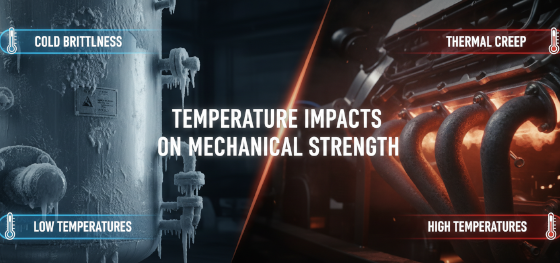
Thermal environments drastically alter the mechanical relationship between yield and tensile strength. SUS 304 maintains excellent toughness at cryogenic temperatures, avoiding the brittle fracture transition that plagues carbon steels. At temperatures as low as minus 196 degrees Celsius, 304 actually gains tensile strength while retaining usable ductility, making it the standard choice for liquid nitrogen storage tanks. The face-centered cubic crystal structure remains stable, preventing sudden shattering under impact in freezing environments.
Conversely, elevated temperatures degrade these mechanical properties. As the operational environment exceeds 500 degrees Celsius, both yield and tensile strength begin to drop precipitously. Furthermore, the material becomes susceptible to "creep," a phenomenon where the metal slowly deforms over time under constant stress, even if that stress is below the yield point. For high-temperature exhaust manifolds or industrial furnace components, engineers might switch to stabilized grades like 321 or 347, or move to high-nickel alloys like Inconel. Understanding the thermal service curve is mandatory for preventing long-term structural failures.
Factores de la Composición Química en la Variación de la Resistencia
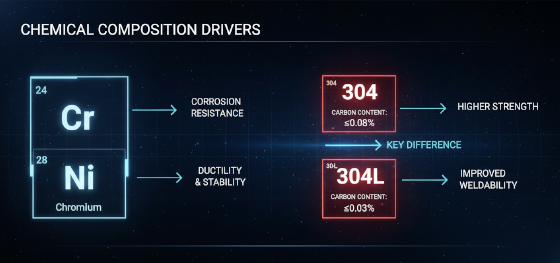
The mechanical muscle of SUS 304 derives directly from its specific alloy recipe. It contains nominally 18% chromium and 8% nickel, often referred to as "18/8 stainless." The carbon content plays a pivotal role in determining strength. Standard 304 allows for up to 0.08% carbon, which acts as an interstitial strengthening agent within the iron lattice. This carbon helps lock the crystal planes, boosting tensile strength. However, this same carbon can lead to carbide precipitation during welding, causing corrosion issues.
The low-carbon variant, SUS 304L (with carbon below 0.03%), solves the welding corrosion problem but sacrifices some mechanical strength. The reduction in carbon atoms allows the crystal lattice to slip more easily, slightly lowering both the yield and tensile values compared to standard 304. To compensate for this, steel mills often add nitrogen to 304L, creating "dual-certified" 304/304L. The nitrogen atoms replace the strengthening role of carbon, restoring the yield strength to standard levels while maintaining the superior weldability. Procurement managers must verify the specific mill test reports to ensure the material batch meets the structural calculations of the design.
Tabla de Análisis Comparativo de Aleaciones Comunes
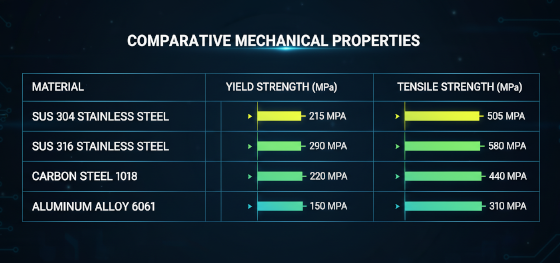
Benchmarking SUS 304 against other manufacturing materials clarifies its position in the engineering hierarchy. While it offers excellent corrosion resistance, its yield strength is relatively modest compared to heat-treated alloy steels. However, its massive gap between yield and tensile strength (ductility) far exceeds that of aluminum or hardened tool steels. The following data highlights why 304 is chosen for forming and corrosion resistance rather than pure structural rigidity.
| Grado del Material | Límite Elástico (MPa) | Resistencia a la Tracción (MPa) | Primary Fabrication Characteristic |
|---|---|---|---|
| SUS 304 (Annealed) | ~215 | ~505 | High ductility, work hardens rapidly |
| SUS 316 (Marine) | ~205 | ~515 | Superior corrosion resistance, slightly harder to machine |
| Aluminio 6061-T6 | ~276 | ~310 | Excellent machinability, low ductility (snaps easily) |
| Acero al carbono 1045 | ~310 | ~565 | Higher strength, poor corrosion resistance |
Fabricación de Precisión y Aseguramiento de Calidad de Jucheng
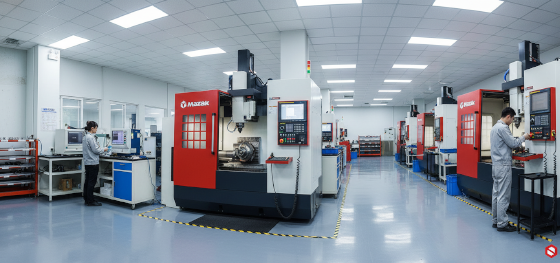
Sourcing reliable stainless steel components requires a manufacturing partner who understands the nuance of material science. Jucheng Precision eliminates the risks associated with SUS 304 fabrication by implementing strict material verification and process controls. Before any CNC machining or sheet metal forming begins, our quality team analyzes the incoming raw material using advanced spectrometers to confirm the Nickel and Chromium content matches international standards. This prevents the accidental use of sub-standard materials that may fail prematurely in the field.
Our manufacturing facility, spanning 8000 square meters, houses over 150 CNC machines, including 25 high-rigidity 5-axis Mazak centers capable of powering through work-hardened stainless steel without vibration. We offer comprehensive services from rapid prototyping to low-volume production with absolutely no minimum order quantity (No MOQ). Whether you require complex machined manifolds with tight tolerances or precision bent sheet metal enclosures, Jucheng provides free DFM reviews to optimize your design for the specific mechanical behaviors of SUS 304. Backed by ISO9001:2015, ISO 14001, and IATF16949 certifications, we deliver components that perform exactly as engineered, balancing cost, quality, and speed.