


La luz no suele considerarse una herramienta para tallar, pero en el ámbito de la fabricación de alta precisión, los fotones se han convertido en los escultores definitivos. Mientras que la mayoría de los métodos en la proceso de impresión 3D moderna dependen de fundir filamentos de plástico o sinterizar polvos metálicos, existe un enfoque más elegante que opera a nivel molecular. Este es la impresión 3D SLA, o Estereolitografía. Es la tecnología aditiva original, y sin embargo sigue siendo el estándar de oro indiscutible en cuanto a acabado superficial, complejidad geométrica y detalle microscópico. Cuando un diseño requiere la suavidad de una pieza moldeada por inyección sin la espera de seis semanas por una herramienta de acero, SLA es el santuario técnico principal para ingenieros y diseñadores por igual.
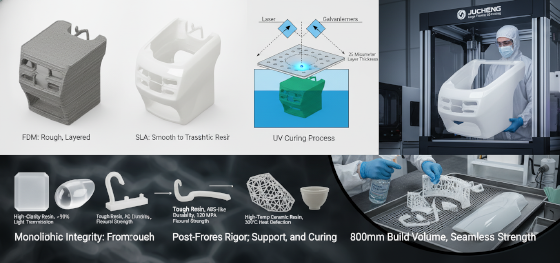
En Jucheng Precision, no tratamos la impresión con resina como una curiosidad de escritorio. Operamos a nivel industrial, donde se utilizan máquinas de gran formato y fotopolímeros diseñados para crear carcasas funcionales, lentes transparentes y prototipos médicos complejos. Entendemos que el éxito en impresión 3D SLA se encuentra en la gestión del punto focal del láser UV y la pureza química del baño de resina. Si el láser está mal calibrado o se omite el ciclo de post-curado, el resultado es un componente frágil y deformado que no representa el maestro digital. Esta guía explora la mecánica molecular de la polimerización en cuba, la física del enlace isotrópico y por qué la instalación de alta capacidad de JUCHENG es el socio preferido para los modelos estéticos y funcionales más exigentes del mundo.
Pasar de un charco líquido a un objeto sólido requiere más que una luz brillante. Requiere una sinergia de software de alta gama y hardware rígido para manejar el delicado equilibrio de la tensión superficial y el entrecruzamiento químico. Examinemos los pilares técnicos que definen la fabricación SLA profesional y veamos cómo redefine la integridad de sus diseños más detallados.
Mecánica del Curado Ultravioleta: La Física de la Luz
Integridad Superficial: Por Qué SLA Gana la Guerra Estética
Especialización de Materiales: De Resinas Resistentes a Resinas de Alta Temperatura
Rigor en el Post-Procesado: Limpieza, Soportes y Curado
El Poder de Gran Formato de JUCHENG: Innovación Monolítica
Mecánica del Curado Ultravioleta: La Física de la Luz
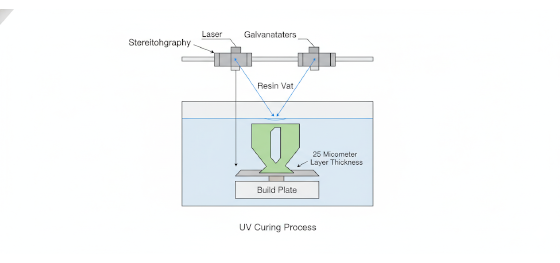
La brillantez fundamental de impresión 3D SLA es el concepto de fotopolimerización. El proceso tiene lugar dentro de una gran "cuba" llena de una resina líquida sensible a los rayos UV. A diferencia de las máquinas FDM que extruyen plástico como una pistola de pegamento, una máquina SLA utiliza un láser ultravioleta altamente enfocado, que normalmente opera a una longitud de onda precisa de 355nm. Este láser es dirigido por un par de espejos de precisión, conocidos como galvanómetros, que escanean el haz láser a través de la superficie de la resina con una velocidad increíble. Dondequiera que la luz toque el líquido, se desencadena una reacción química. Los fotoiniciadores en la resina absorben la energía UV y hacen que los monómeros líquidos se unan en largas cadenas de polímero sólido. Esto sucede en una fracción de segundo, efectivamente "dibujando" la sección transversal 2D de la pieza sobre la superficie del líquido.
Once a single layer is cured, the build platform moves. In the industrial "top-down" machines at Jucheng Precision, the platform lowers into the resin by a specific increment—often as thin as 25 microns (0.001 inches). A recoater blade then sweeps across the top, ensuring a perfectly level and fresh layer of liquid resin is ready for the next laser pass. This cycle repeats thousands of times to build the part vertically. Because the liquid-to-solid transition is a "low-stress" event, the resulting part is not subjected to the heavy thermal gradients or mechanical pressures found in the metal proceso de impresión 3D. This mechanical stillness is what allows SLA to achieve the world’s tightest tolerances in additive manufacturing, making it the primary choice for complex electronic housings and medical prototypes that must fit perfectly into existing assemblies.
Integridad Superficial: Por Qué SLA Gana la Guerra Estética
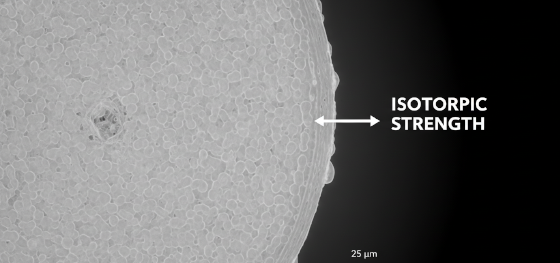
The visual hallmark of a high-end prototype is the absence of a "manufactured" texture. In the impresión 3D SLA environment, surface integrity is defined by the chemistry of the bond. Because each new layer of resin is cured directly onto the previous one while both are still chemically active, the bonds between layers are as strong as the bonds within the layer itself. This results in an "Isotropic" part—a component with uniform mechanical properties and a nearly invisible stair-step effect. When you run your finger across an SLA part, it doesn't feel like a series of stacked layers; it feels like a solid, homogeneous block of plastic.
This microscopic smoothness is why JUCHENG utilizes SLA for cosmetic "look-and-feel" prototypes. It provides a perfect substrate for secondary finishing. An SLA part requires significantly less sanding than an SLS or MJF part to reach a high-gloss finish. For our automotive clients, we can take a large-format SLA print and apply a premium clear coat or a metallic paint that looks indistinguishable from a production-grade part. Furthermore, the precision of the laser ensures that intricate engravings, sharp corners, and thin-walled features are crisp and well-defined. We don't just print a shape; we provide a surface that is ready for the boardroom or the showroom. In a market where first impressions are everything, the superior surface integrity of industrial SLA is the ultimate competitive shield for your innovative designs.
Especialización de Materiales: De Resinas Resistentes a Resinas de Alta Temperatura
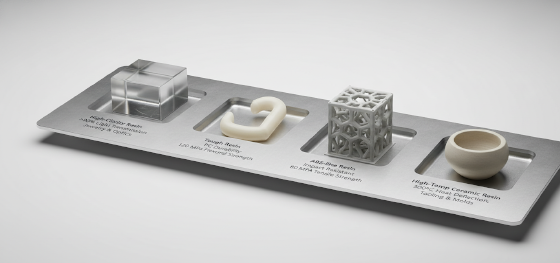
Modern photopolymer chemistry has evolved into a diverse engineering palette. While early resin prints were brittle, Jucheng Precision sources specialized resins designed for functional performance. For instance, our "Tough" resins offer high impact resistance and elongation, making them ideal for functional snap-fits and living hinges that must survive repeated cycles without snapping. These materials allow engineers to perform functional testing on prototypes that previously would have required expensive injection molded samples.
For the medical and high-tech sectors, we utilize "High-Temp" resins that can withstand temperatures exceeding 200°C without warping. These are used for low-volume molding inserts or electrical enclosures exposed to intense heat. We also specialize in "Water-Clear" resins. When processed through JUCHENG’s proprietary polishing and UV-protection cycle, these parts achieve the transparency of glass. This capability is vital for the proceso de impresión 3D of light pipes, lenses, and transparent fluid manifolds where internal flow must be visually verified. By selecting a resin that matches the mechanical destiny of your part, we bridge the gap between a visual mockup and a functional prototype. We treat material selection as an engineered decision, ensuring the chemistry of the light-cured polymer matches the rigor of your physical application.
Rigor en el Post-Procesado: Limpieza, Soportes y Curado
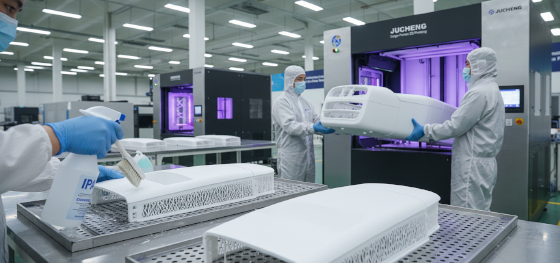
A raw part straight out of the resin vat is technically incomplete. It is in a "green" state—partially cured and covered in a film of sticky liquid resin. At Jucheng Precision, we believe that the quality of impresión 3D SLA is decided in the post-processing lab. The first step is a multi-stage ultrasonic bath using High-purity Isopropyl Alcohol (IPA) to remove every trace of uncured resin from the part’s intricate features. Any residue left behind will cure during the final stage, potentially clogging small holes or ruining the surface finish.
After cleaning, we manually remove the support structures. These are the thin, needle-like columns that hold overhanging features in place during the print. JUCHENG technicians use surgical precision to Peeling off these supports, followed by a light sanding to ensure the contact points are invisible. The final, mandatory step is UV Post-Curing. The part is placed in a specialized chamber where it is flooded with high-intensity UV light and, in some cases, heat. This completes the cross-linking reaction, locking in the material’s final mechanical properties and dimensional stability. Without this final cure, the part will stay soft and brittle. We manage this entire cycle with the technical rigor of a cleanroom facility, ensuring that when you receive your parts, they are dry, stable, and ready for the most demanding engineering scrutiny.
El Poder de Gran Formato de JUCHENG: Innovación Monolítica
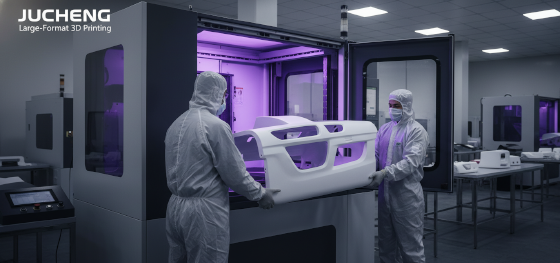
The greatest limitation of many 3D printing providers is the "size barrier." Most desktop machines can only print parts the size of a coffee mug. At Jucheng Precision, we have broken this barrier by operating a fleet of large-format industrial SLA machines capable of printing monolithic parts up to 800mm in a single piece. This is a game-changer for the automotive and appliance industries. Instead of printing five different sections and gluing them together—which introduces structural weak points and visible seams—we can print a full dashboard panel or a large medical device housing as a single, high-integrity block.
Printing monolithic large parts requires an expert understanding of resin shrinkage and build plate adhesion. JUCHENG’s engineers utilize advanced compensation algorithms to account for the way large volumes of resin react as they cure. We also offer integrated secondary services, including CNC Machining for critical mating surfaces on these large prints. This hybrid approach—3D printing for complexity and CNC for tolerance—ensures that your massive prototypes are not just visual models, but functional engineering components. When you receive a large-scale shipment from JUCHENG, you are getting the benefit of optimized physics and massive manufacturing capacity. Whether you are building the next generation of satellite hardware or a high-performance EV interior, our large-format SLA protocols ensure your vision is delivered with absolute precision and zero seams. Contact Jucheng Precision today for a technical DFM review and see how our industrial impresión 3D SLA can clarify and elevate your next manufacturing challenge.

