


Picture a development review where the working end looks correct, but nobody has defined the shaft envelope or the passage through which the instrument must move. Approving the tip alone would leave an important part of the design unresolved. A bone graft tamp brief should describe the complete manual instrument and its relevant interfaces, including the grip, shaft, working end, and any specified companion channel.
The scope here is a solid manual instrument for component development. Inflatable bone tamps and their associated systems are different products. The discussion below concerns manufacturing definition and bench-level review, not clinical technique, recommended force, surgical access, or patient outcomes.
Define the complete instrument before dividing the work
El AccessGUDID record for a named bone graft tamp places the device within the surgical-tamp category. Its description supports the distinction between a manual instrument with a shaft, working end, and handle and a completely different inflatable device. It does not establish the geometry or material requirements for every product using the same name, nor does it provide approval for another manufacturer.
Describe the intended construction using controlled drawings. Is the instrument one piece, or does it contain a separate grip or other assembled components? Does the working end share the shaft’s section, or is there a transition that matters to the envelope? Which features must pass through a defined channel? These questions determine how the manufacturing scope should be divided and what an incomplete sample cannot demonstrate.
For a bone graft tamp development project, Jucheng Precision’s prototyping discussion can start with the complete instrument rather than a detached tip model. That makes it possible to separate a shape-review sample, a component manufacturing sample, and a coordinated assembly intended for a defined bench evaluation. Each type needs its own material and use limitations.
Match the sample route to the question
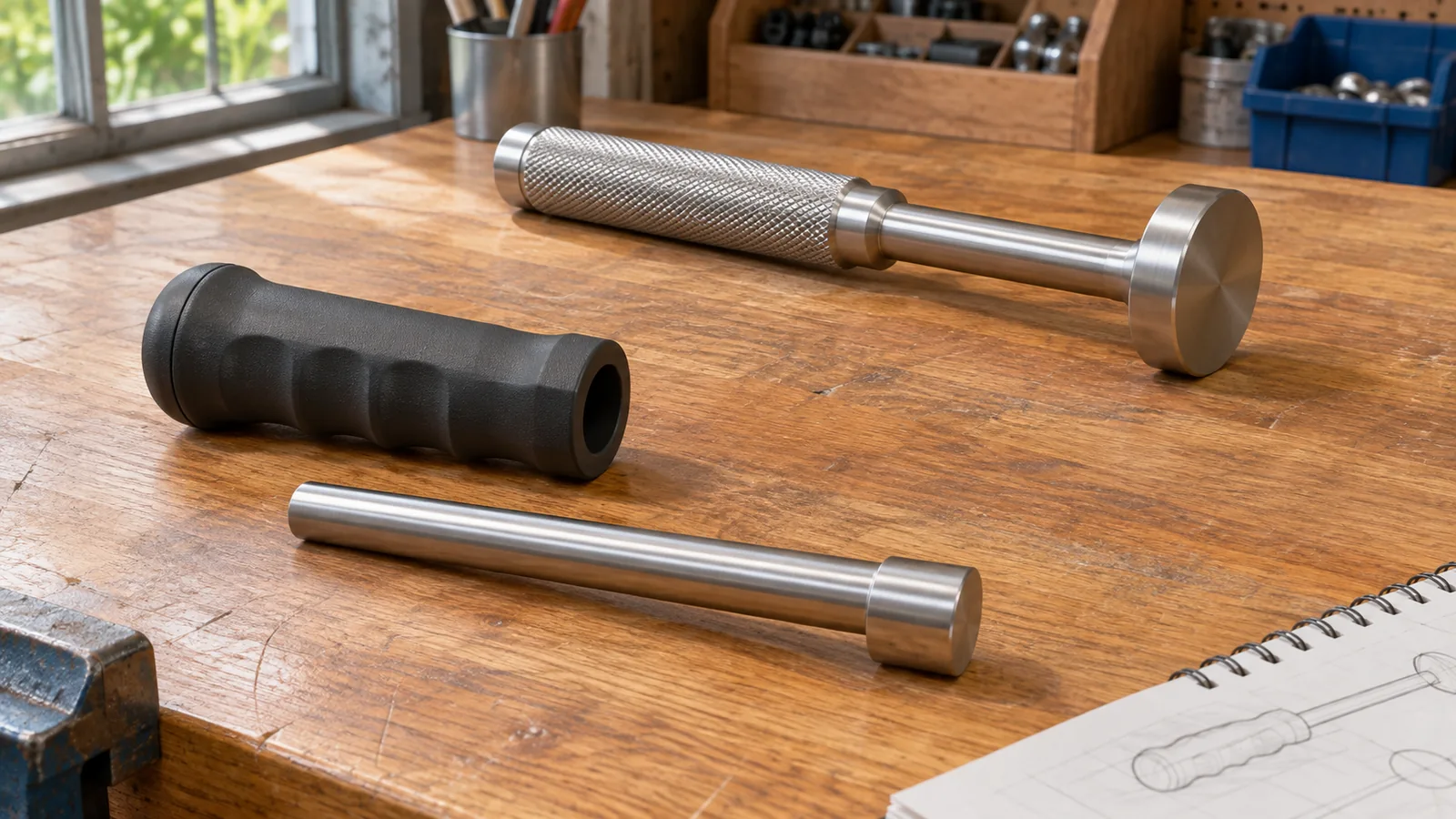
A one-piece metal sample may help examine the continuity of shaft and working-end geometry. A separate grip model may help a nonclinical review of external shape and assembly space. A complete assembled prototype can address relationships that neither loose component shows. These are complementary development tools, not automatically equivalent representations of a final reusable instrument.
| Development question | Sample that may help | Limitation to record |
|---|---|---|
| Is the external instrument envelope represented? | Complete shape or assembly model | Material and mechanical behavior may differ from the intended final state |
| Are shaft and working-end features defined consistently? | Machined metal component in a stated condition | Does not by itself validate use or reprocessing |
| Does a separate grip construction assemble as intended? | Identified grip and shaft samples | Joining and retention need their own acceptance definition |
| Can the defined instrument pass the specified channel? | Matched instrument and channel references | Does not replace system-level or clinical validation |
Use the table to state a decision, rather than merely requesting a realistic-looking sample. If the team is comparing two grip shapes, it may not need the same material route as a sample intended to investigate shaft geometry. Conversely, a simplified visual model should not quietly enter an evaluation that depends on the final material or assembly construction.
Review the passage as a relationship, not one diameter
Where a companion cannula or channel is part of the design, supply its controlled interface definition. A nominal opening dimension alone may leave transitions, local protrusions, straightness references, and entry geometry unresolved. State which part of the instrument is intended to enter and which features must remain outside. Do not infer an access path from a catalog image.
A useful engineering review follows the complete passing envelope. Consider the shaft section, the working-end transition, any orientation-dependent shape, and the relevant channel references. The inspection method should address the specified relationship. Checking a single shaft diameter does not automatically demonstrate clearance for every section that is intended to pass through the channel.
For example, in a hypothetical nonclinical development trial, a straight shaft sample passes a reference opening while a complete prototype does not. Before changing the channel size, compare the complete entering envelope and confirm the reference revisions. The difference may involve a transition or another feature omitted from the simplified sample. The point is to isolate the geometric question, not to prescribe a clinical clearance or fit value.
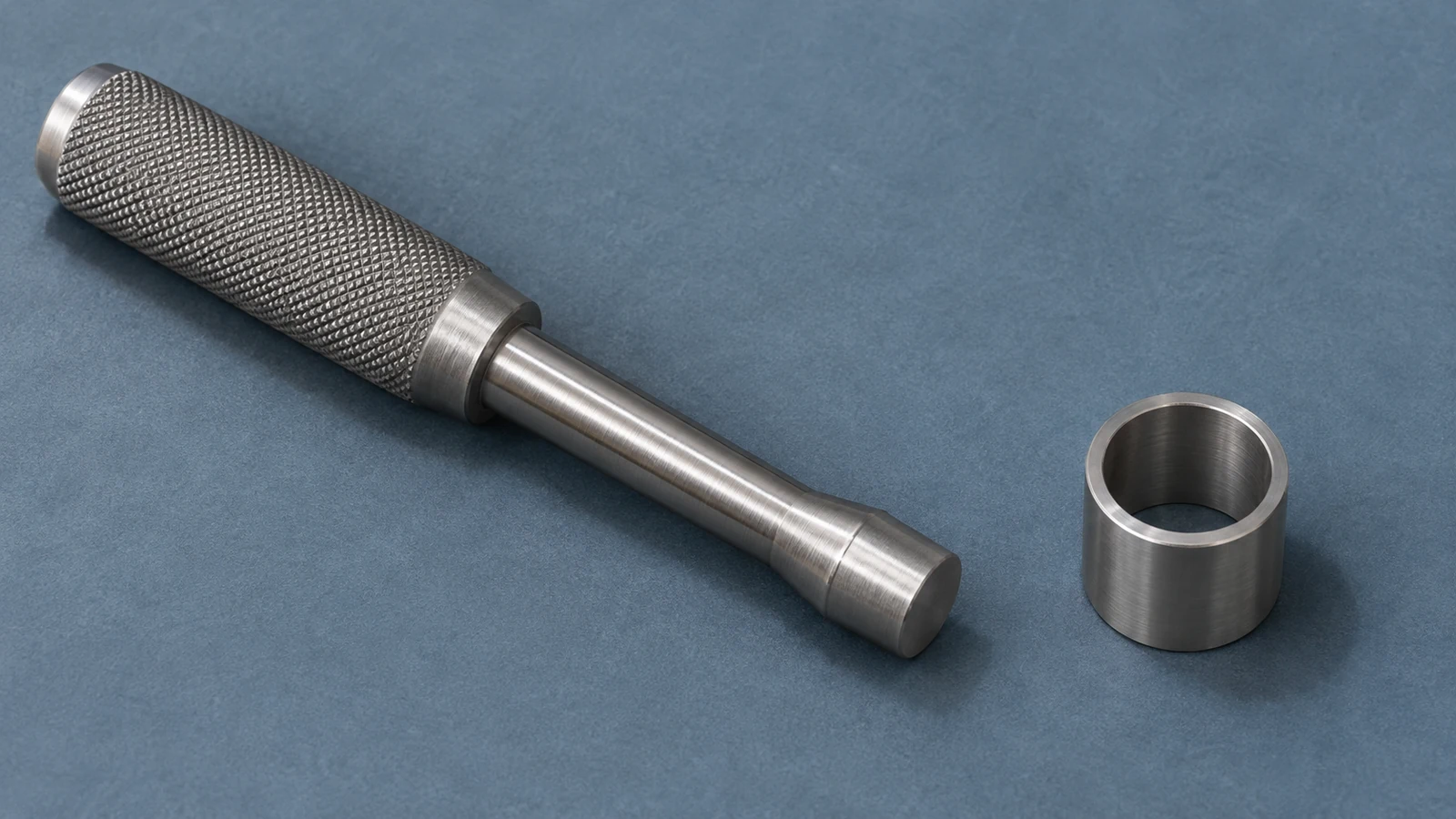
Identify reference components used in these checks. If a channel sample is only a development model, record that status. If a purpose-made gauge is used, define what it checks and what it cannot check. A simple pass-through check may answer one envelope question while leaving profile, location, surface, or other drawing requirements to separate measurements.
Treat the grip construction as its own manufacturing decision
An integral metal grip and a separate polymer grip introduce different component and assembly requirements. Choose between them using the approved product requirements and development objective. A convenient prototype material is not automatically suitable for the final instrument, and a familiar polymer name does not establish compatibility with the intended cleaning, processing, or use conditions.
If a metal shaft is combined with a separate grip, identify the connection definition and the assembly state to inspect. Keep manufacturing access, material traceability, and any later processing requirements visible. Do not rely on an attractive assembled appearance to establish retention, internal condition, or suitability for repeated use. Those characteristics require defined evidence and an appropriate evaluation plan.
Jucheng Precision’s stainless steel machining information provides a relevant entry point for reviewing a specified metal shaft or working end. The material grade, condition, surface requirement, and instrument-specific acceptance criteria must still be supplied or agreed. The service page is not evidence of medical-device qualification or a validated reprocessing route.
Define what must remain true after finishing
Surface work can affect a transition, edge, or textured grip feature. Distinguish deliberately controlled geometry from general edge treatment. If a drawing needs a particular working-end profile, identify how that profile will be protected and checked after the last relevant operation. “Smooth all surfaces” is not a complete instruction when different regions serve different functions.
Plan the inspection order around the complete delivered state. Retain intermediate measurements when they help process review, but do not substitute them for final checks of characteristics that may change later. For an assembled instrument, identify which relationships can be checked before assembly and which require the assembled condition. Record any inaccessible characteristic and the agreed evidence used to address it.
The useful role for Jucheng Precision is a component and prototype review grounded in those requirements: what the metal geometry must do, what the grip sample represents, and which interface checks belong in the quoted scope. Joining qualification, instrument validation, and any claimed cleaning or sterilization performance remain separate items requiring actual supporting evidence.
Procurement questions that often arrive late
Should an evaluation kit include a spare grip or reference channel?
Include them when the agreed review needs them, and identify each item’s status. A spare component can help isolate assembly questions, while a controlled reference channel can make an envelope check reproducible. Neither should be added without documenting its revision and the purpose it serves.
Can the same sample support photography and technical evaluation?
Possibly, but preserve its handling history and agreed evaluation condition. Cosmetic preparation, marking, adhesive mounting, or repeated handling for photography may change whether it remains suitable for a later check. Keep display-only models distinguishable from controlled evaluation samples.
To begin a focused review, send Jucheng Precision the complete instrument and companion-interface files. An effective brief connects the bone graft tamp’s full construction to a clear prototype decision, rather than asking one visually accurate tip to stand in for the whole instrument.

