


Navegar el volátil "Valle de la Muerte" en el escalamiento de hardware requiere más que solo talento en ingeniería; exige un pragmatismo despiadado en la fabricación. Las startups frecuentemente se encuentran en una encrucijada aterradora después de validar con éxito un lote piloto de cincuenta unidades. La demanda del mercado ha aumentado a dos mil unidades, pero el capital necesario para lanzar una producción en masa a gran escala permanece bloqueado detrás de una factura de molde de acero de treinta mil dólares. Esta coyuntura específica es donde la mayoría de las empresas de hardware se desangran. Decidir entre una estrategia de Molde de Silicona vs Herramental Duro no es simplemente una elección de materiales; es un cálculo de alto riesgo de tiempo de comercialización, riesgo y amortización del costo unitario. Mientras que el vaciado al vacío de silicona sigue siendo el rey indiscutible de la agilidad y fidelidad cosmética para lotes de bajo volumen, su lógica económica colapsa bajo el peso de miles. Por el contrario, el herramental duro—ya sea fresado de aluminio 7075 o acero H13 endurecido—exige un enorme "sacrificio financiero" inicial que solo tiene sentido cuando el pronóstico de producción abarca años, no semanas. Jucheng Precision reconoce que nuestros clientes requieren una hoja de ruta de fabricación que evolucione junto con sus ingresos. Esta guía desglosa los umbrales físicos, económicos y logísticos que definen el salto del herramental blando al duro.
Resistencia Física: La Batalla entre Elasticidad y Rigidez
Matriz Comparativa: Cuantificando la División del Herramental
Economía del Tiempo de Ciclo: Segundos vs Horas
Soberanía Dimensional: Precisión a Escala
Puente JUCHENG: El Protocolo de Fabricación Escalonada
Resistencia Física: La Batalla entre Elasticidad y Rigidez
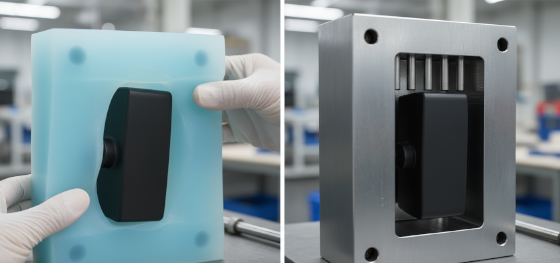
La divergencia mecánica entre herramientas blandas y duras comienza a nivel molecular. La silicona es un elastómero; prospera en la flexibilidad. Esta elasticidad permite al fabricante de moldes extraer piezas con socavados profundos y características de cero ángulo de desmoldeo que serían físicamente imposibles de expulsar de una cavidad metálica rígida. En las primeras etapas del lanzamiento de un producto, esta flexibilidad actúa como una "red de seguridad geométrica." Permite a los diseñadores pasar por alto ciertas restricciones de moldeo por inyección mientras se enfocan en la sensación ergonómica y la aprobación cosmética. Sin embargo, esta misma elasticidad es enemiga de la consistencia en alto volumen. Cada vez que se vierte resina en un molde de silicona, las paredes se flexionan ligeramente bajo el peso del líquido. Esta "respiración" del molde introduce variaciones dimensionales sutiles que se acumulan a lo largo de veinte ciclos.
El herramental duro opera bajo la lógica de la restricción rígida absoluta. Ya sea que estemos mecanizando una herramienta rápida de aluminio o un molde de acero P20 de múltiples cavidades, la geometría está encerrada en una jaula metálica. Estas herramientas no "respiran." Soportan cientos de toneladas de fuerza de cierre y decenas de miles de libras de presión de inyección sin desplazarse ni un solo micrón. Esta rigidez permite el uso de moldeo por inyección de alta presión, forzando termoplástico fundido en las costillas más profundas y delgadas de su diseño. Si bien se pierde la capacidad de "sacar" fácilmente las piezas de la herramienta—requiriendo deslizadores mecánicos complejos y pasadores eyectores—se gana la capacidad de fabricar diez mil unidades idénticas con cero desviación geométrica. Este cambio de "acomodación flexible" a "aplicación rígida" representa el paso de un vertido artesanal manual a un motor industrial automatizado.
Matriz Comparativa: Cuantificando la División del Herramental
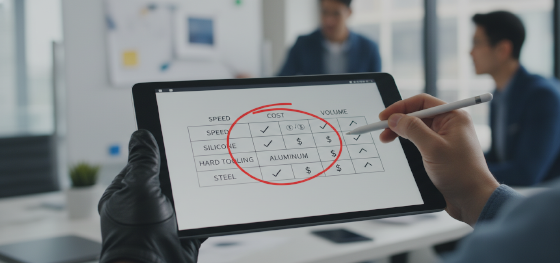
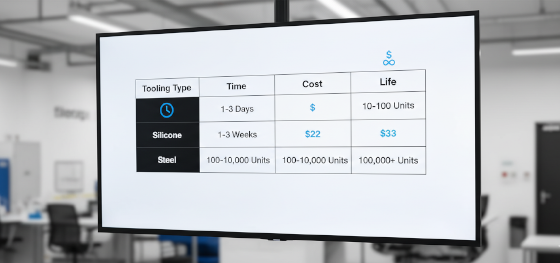
Los números cuentan una historia que los folletos de marketing a menudo ignoran. Todo ingeniero de hardware debe enfrentar la brutal curva de ROI (Retorno de Inversión) al escalar. A continuación se presenta un desglose definitivo de cómo JUCHENG evalúa el Molde de Silicona vs Herramental Duro matriz de decisión:
| Métrica | Molde de silicona | Herramienta de Aluminio | Molde de Producción de Acero |
|---|---|---|---|
| Costo Inicial | Bajo ($300 - $1,500) | Medio ($3,000 - $8,000) | Alto ($15,000 - $50,000+) |
| Plazo de Entrega | 1 - 2 Semanas | 2 - 4 Semanas | 5 - 10 Semanas |
| Vida Útil del Molde | ~25 Ciclos | ~5,000 Ciclos | 100,000 - 1,000,000 Cycles |
| Part Unit Price | High ($20 - $200) | Low ($2 - $15) | Minimal ($0.50 - $5) |
| Elección del Material | Urethane Simulants | Thermoplastics | Any Injection Grade |
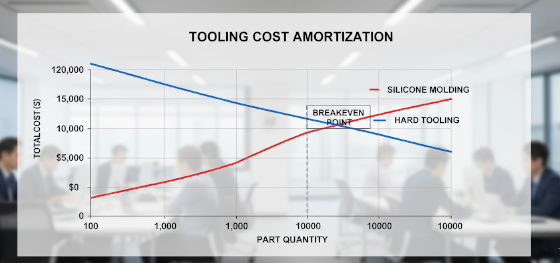
Looking at this data through a procurement lens, the choice is determined by the "Total Cost of Ownership." If your pilot run is fifty units, silicone is the only rational choice. If your demand is a thousand units, aluminum rapid tooling becomes the "Golden Mean"—offering injection-molded quality without the six-figure price tag of hardened steel. Steel production molds are reserved for products with guaranteed market traction, where the goal is to shave every possible penny from the unit price over years of fulfillment. At JUCHENG, we don't just quote the most expensive option; we run these numbers for you, ensuring your tooling investment is perfectly synchronized with your current bank balance.
Economía del Tiempo de Ciclo: Segundos vs Horas
Thermodynamics and labor hours are the silent killers of low-volume margin. Vacuum casting is a rhythmic, manual process. A technician mixes the resin, pours it into the mold, and then the tool must spend anywhere from one to four hours in a curing oven. Even with multiple molds running in parallel, a single casting station can only produce a handful of units per day. This "throughput ceiling" is what makes silicone tooling unsuitable for urgent, high-volume demand. You are paying for the technician's skilled hands and the oven's energy for hours at a time, keeping your unit price high and inflexible.
Hard tooling flips the manufacturing clock on its head. In the injection molding world, we measure success in seconds, not hours. A well-engineered steel mold with advanced cooling channels can eject a complex housing every thirty seconds. This lightning-fast cycle time is enabled by the thermal conductivity of the metal. Aluminum and steel dissipate the heat of the molten plastic nearly instantly, allowing the part to solidify and eject with mechanical precision. This velocity is what drives the unit price down to negligible levels. When you switch to hard tooling, you are buying "speed as a commodity." You are trading a massive upfront payment for the ability to produce a year's worth of inventory in a single week. For a brand ready to hit retail shelves, this manufacturing velocity is the only way to sustain a profitable supply chain.
Soberanía Dimensional: Precisión a Escala
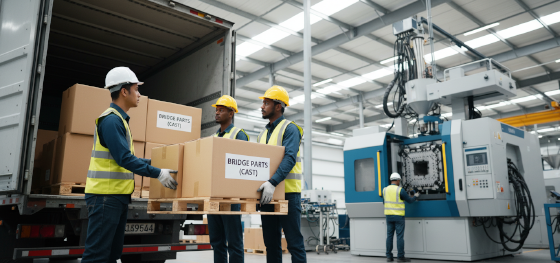
Consistency across ten thousand units is a requirement, not a luxury. In medical device and automotive sectors, "Prototype Drift" can be fatal. Silicone tools, as we have established, degrade chemically and physically. By the twentieth pour, the heat of the resin has often caused the mold's interior to "orange peel," and the parting lines have begun to widen. While this is acceptable for a trade show model, it is unacceptable for a high-pressure manifold or a safety-critical enclosure. A silicone-based part from Monday might have a different fit than the part produced on Friday.
Metal tools provide dimensional sovereignty. A hardened H13 steel mold will produce its ten-thousandth part with the exact same sub-millimeter precision as its first. This repeatability is the bedrock of mass assembly lines. When you have five separate components coming from five different factories, you need the absolute certainty that they will all snap together without rework. This is why hard tooling is the mandatory destination for any product graduating from "testing" to "shipping." The metallic cavity acts as an immutable physical contract—ensuring that the digital perfection of your CAD file is replicated across every single unit in your warehouse, without exception.
Puente JUCHENG: El Protocolo de Fabricación Escalonada
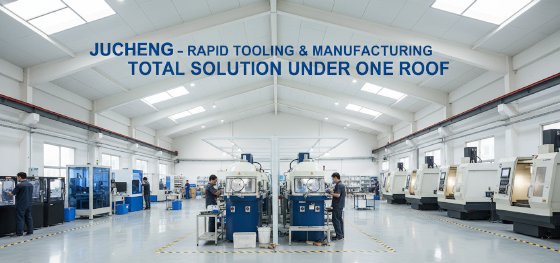
Mastery of the scaling process requires a partner who houses all these disparate technologies under a single roof. Fragmentation in the supply chain—using one vendor for casting and another for injection molding—introduces dangerous data loss and cosmetic discrepancies. Jucheng Precision eliminates this risk through our "Stair-Step" protocol. We act as your manufacturing navigator. We start with vaciado al vacío de silicona to deliver your first fifty marketing samples and functional testers within days. While those units are in the field gathering data, our CNC mold shop is already machining your "Bridge Tool" from 7075 aluminum.
Executing this seamless transition is how JUCHENG protects your market momentum. We use the dimensional data gathered during the casting phase to optimize the gating and venting of your future metal molds. We already know your parting line challenges; we’ve already identified your potential sink marks. By the time you are ready to authorize the investment in a permanent steel production mold, we have already de-risked your geometry through two stages of physical reality. Stop guessing about when to scale. Leverage JUCHENG’s integrated industrial ecosystem to ensure you are always using the right tool for the current volume, and never paying for a steel mold before you've earned the revenue to justify it. Contact our engineering team today, and let us map out the perfect scaling strategy for your next hardware breakthrough.

