


The material comparison that actually changes the design
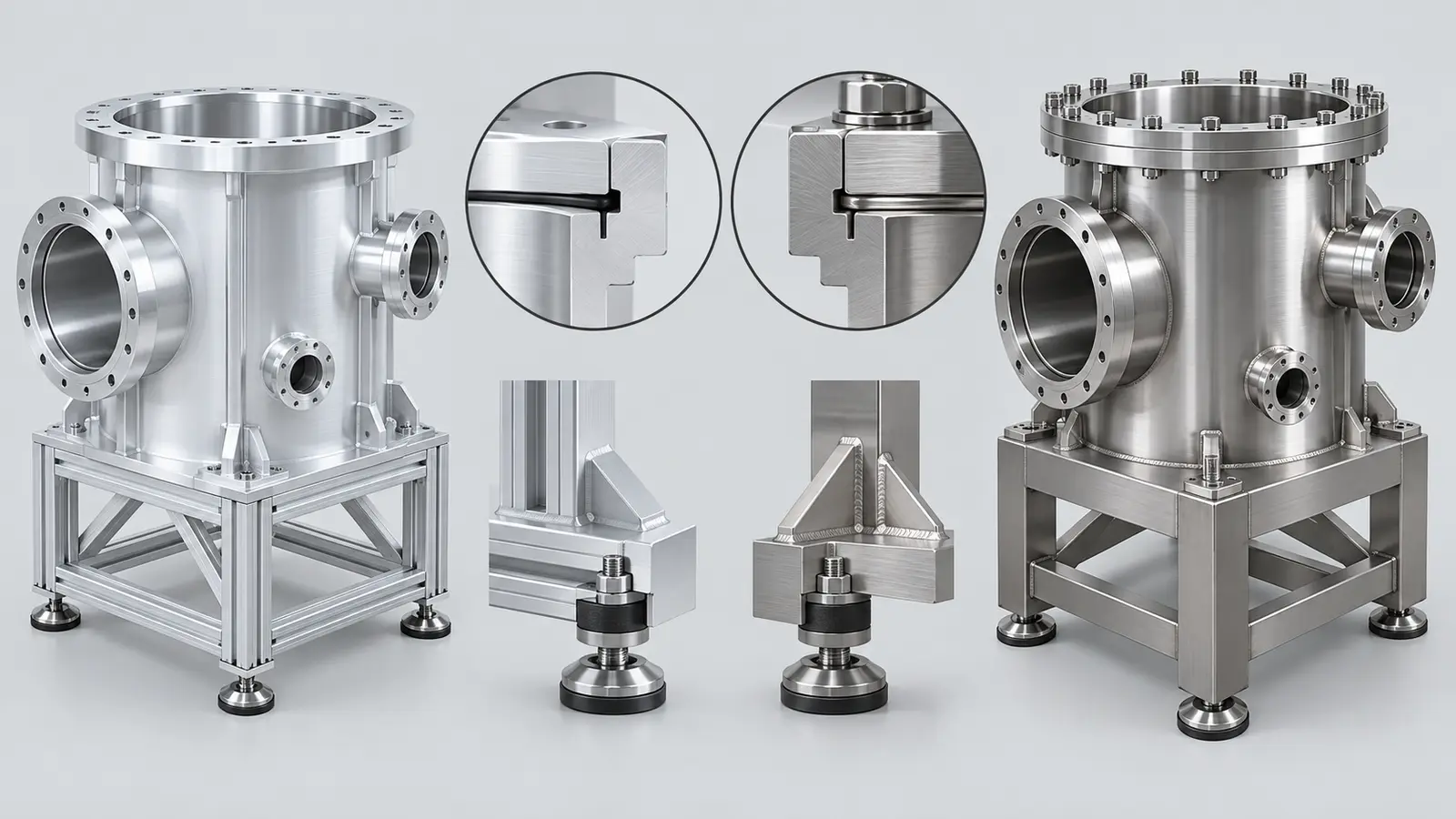
The useful question is not whether aluminum is lighter or stainless steel is stronger. It is which constraint would force you to redesign the chamber. A lid handled every shift presents a different problem from a chamber that stays closed through repeated high-temperature conditioning.
| Decision factor | Aluminum chamber | Stainless steel chamber |
|---|---|---|
| Mass and handling | Lower density can reduce handling loads; final geometry still matters | Greater density increases lifting and support demands |
| Heat distribution | Generally conducts heat more readily | Generally conducts heat less readily; temperature gradients deserve attention |
| Elastic stiffness | Lower elastic modulus means a section may need more thickness or reinforcement | Higher modulus helps limit deformation for the same geometry |
| Machining route | Attractive for integrated pockets, ports and lightweight lids | Often requires more attention to cutting heat, work hardening and tooling |
| Joining | Weld quality and post-weld material condition need explicit control | Low-carbon grades are common welded-chamber candidates |
| Surface exposure | Cleaning and process chemistry can rule out an otherwise convenient alloy | Corrosion resistance is grade- and environment-dependent, not universal |
This is a directional comparison, not a design-property table. Final calculations require values for the specified alloy, temper, product form and temperature. A statement such as “stainless” does not identify a purchasable material, and “aluminum plate” does not establish the condition after welding.
The distinction between structural, thermal and chemical requirements also applies to other materials used in semiconductor equipment. Keep those requirements separate long enough to identify which one controls the decision.
Three chamber scenarios, three different answers
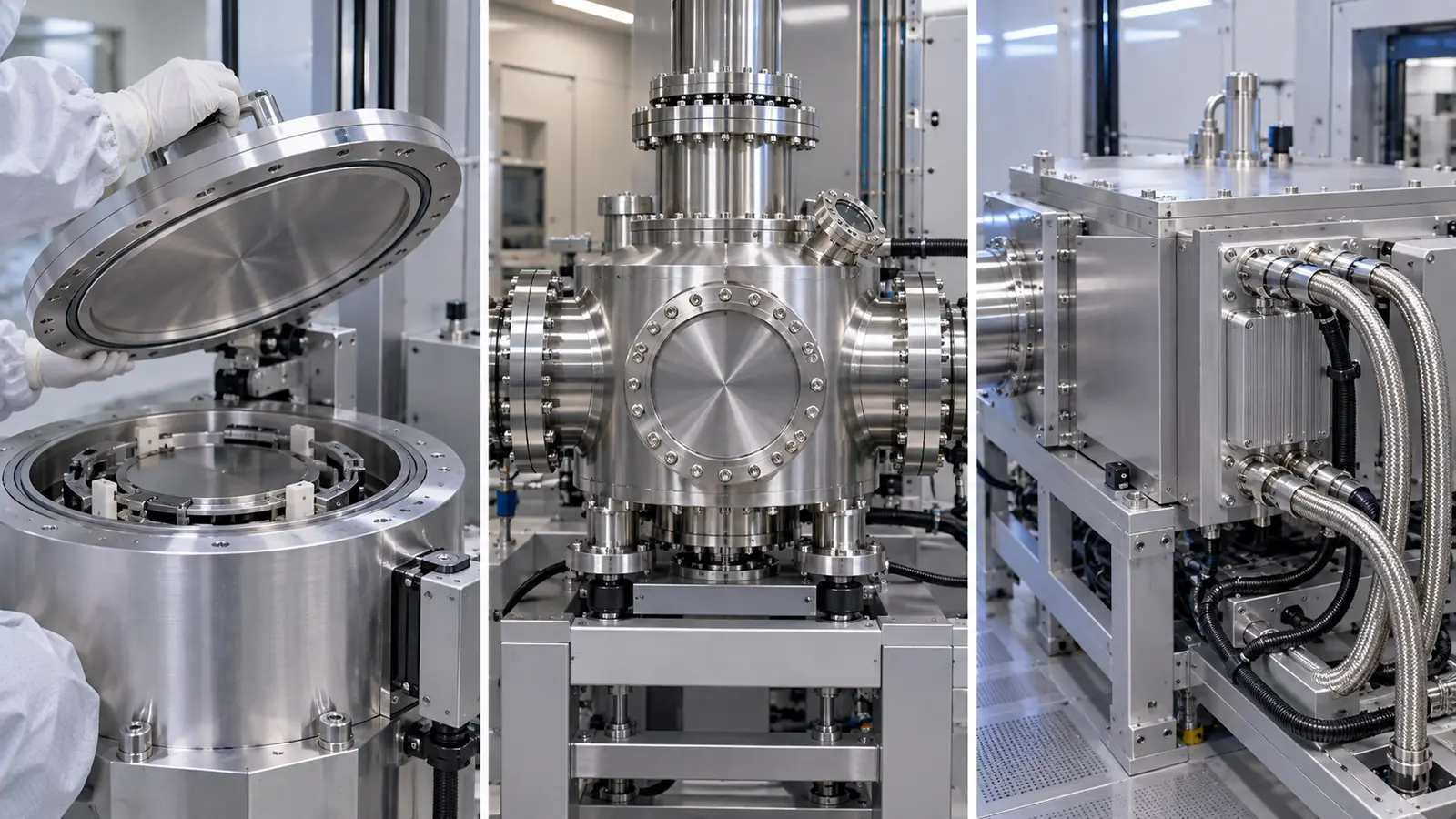
A frequently opened load lock
Here, lid mass, opening cycles and pump-down behavior may dominate. A machined aluminum body or lid can be a sensible starting point, provided the selected seal, finish and cleaning process meet the equipment requirements. Lower mass can simplify handling, but a lighter lid that bends excessively at the seal is not a successful substitution.
Compare finished assemblies, including reinforcement, hinges, inserts and lifting hardware. A density ratio alone overstates the mass saving if aluminum requires a thicker section.
A welded chamber with demanding thermal conditioning
A low-carbon austenitic stainless grade may fit a welded construction with compatible metal-sealed interfaces. The choice still depends on temperature, chemicals and the attached components. The maximum allowable bake temperature of an assembly is limited by its least suitable component, not simply the chamber-wall alloy.
Consider the cost of protecting sealing faces during fabrication and recovering alignment afterward. A lower-cost shell blank can be offset by difficult machining of distorted ports.
A temperature-controlled process module
Aluminum’s thermal conductivity may support heat spreading or cooling-channel integration. However, the process-facing surface may need a qualified treatment, shield or separate liner. That makes the decision an assembly design exercise rather than a raw-metal contest.
For semiconductor deposition or etch equipment, evaluate both intended process exposure and cleaning cycles. A material that survives the nominal operating gas can still be unsuitable when deposits are removed or when moisture enters during maintenance.
Specify the grade, stock and joining condition together
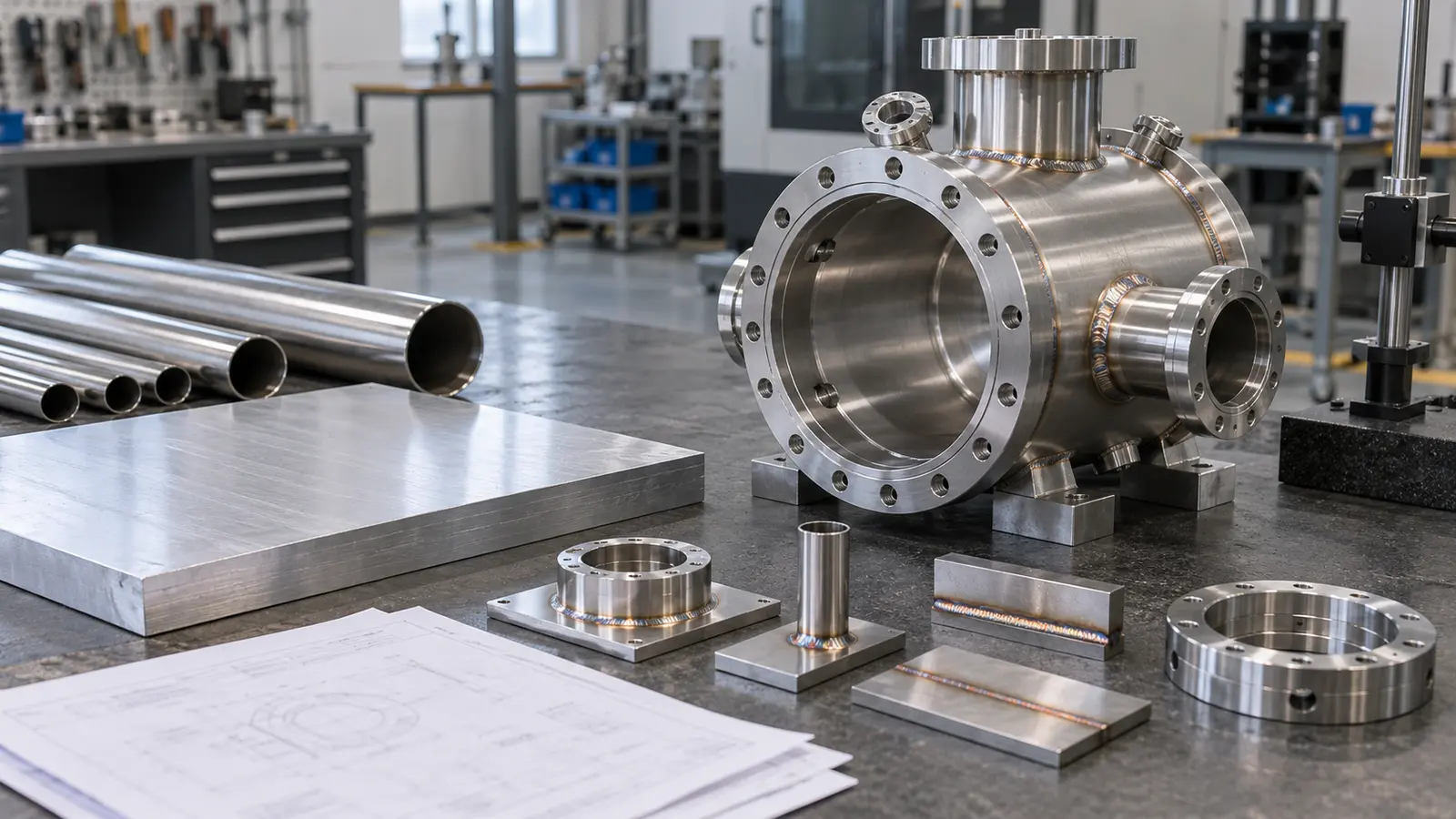
6061 is a familiar candidate for machined aluminum components; 5083 may be considered where its product form and fabrication characteristics fit the design. Neither is automatically the answer for every chamber. A precision plate sold for dimensional stability also needs a suitable material pedigree and qualification for the pressure boundary.
For stainless construction, 304L and 316L are common candidates. The molybdenum in 316L can improve resistance in some corrosive environments, but it does not make the alloy immune to every semiconductor chemical. Free-machining substitutions should not be accepted merely because a supplier can cut them faster.
Connect the machining specification to the actual stock condition: plate or forging, heat or lot identification where required, permissible repairs, and the condition in which critical dimensions will be inspected. If welding changes strength or distortion, the drawing and analysis must reflect that change.
Ask for substitution approval before procurement, not after roughing. Material substitutions can alter tool strategy, treatment compatibility, seal behavior and the evidence needed for acceptance. They are engineering changes, not administrative equivalents.
Outgassing is not a verdict printed on the alloy label
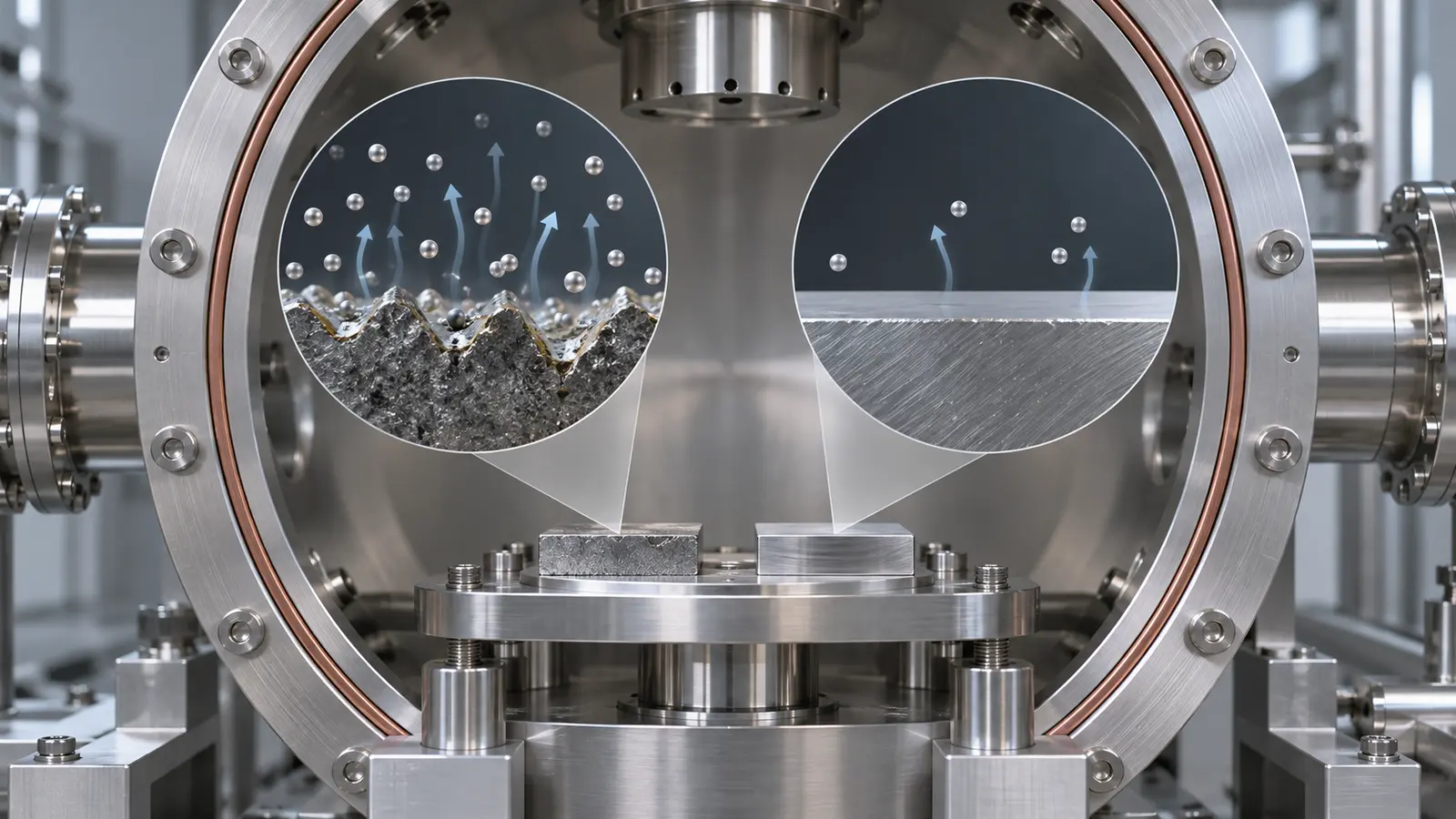
Outgassing is gas released from materials or their surfaces into the evacuated volume. It depends on more than alloy identity: preparation, absorbed contamination, exposure to air, heat treatment and temperature all influence the result.
A published comparison of geometrically similar chambers examined aluminum, several stainless conditions and titanium. Its results illustrate why preparation and thermal history matter; they do not justify a universal claim that one commercial chamber material always has the lowest gas load. See the chamber outgassing comparison by Fedchak and colleagues for the tested conditions.
Likewise, an anodized aluminum surface is not automatically cleaner than bare metal, and an electropolished stainless surface is not automatically qualified for a particular process. Treatment residues, pores, edge coverage, cleaning compatibility and dimensional changes must be considered.
Keep the vocabulary precise when specifying semiconductor finishing and cleanliness controls. Surface roughness describes texture. Cleanliness describes residual contamination under a defined assessment. Outgassing describes gas release under defined conditions. One certificate cannot casually stand in for all three.
Compare the cost of an accepted assembly
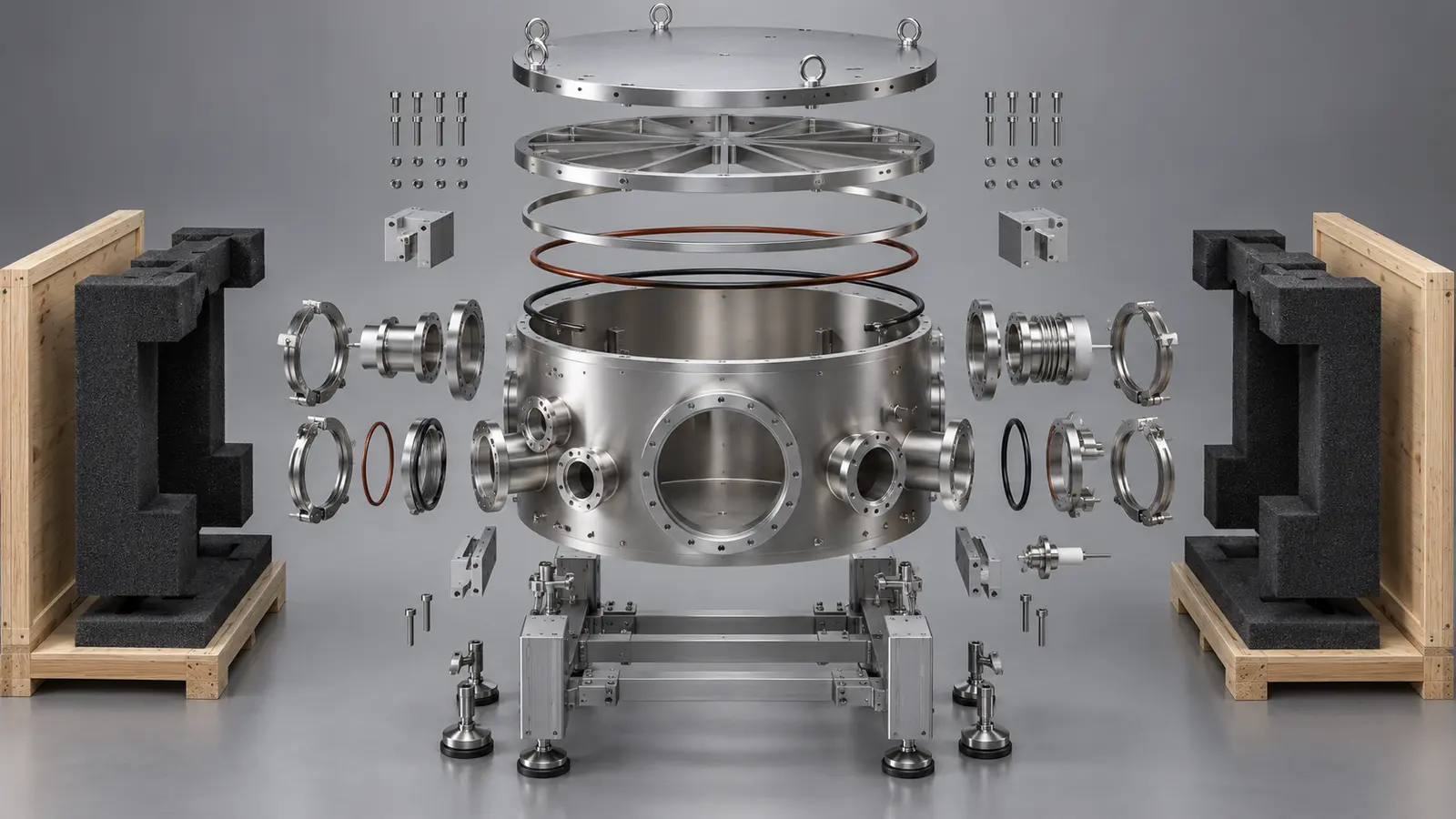
A useful cost model includes stock, machining, joining, treatment, inspection, test fixtures, cleaning, packaging and rework risk. Raw material price alone is often a weak predictor of the delivered chamber cost.
- Large material removal: estimate the stock envelope and retained geometry, not just the finished mass.
- Welded construction: allow for fixtures, joint preparation, weld access and final machining.
- Mixed-material interfaces: include adapters, differential expansion and the chosen joining method.
- Frequent servicing: count handling equipment, replaceable seals and the consequences of damaged faces.
- Qualification changes: consider whether a material substitution requires new leak, thermal or contamination evaluation.
A mixed construction may be appropriate: for example, a stainless chamber with a separately engineered aluminum access door. Such combinations exist commercially, but their success depends on the interface design. Do not directly weld dissimilar metals or borrow a gasket arrangement without an approved joining and sealing solution.
Jucheng Precision can be approached for the custom machined body, lid, flange adapters and supporting components within its manufacturing scope. For a meaningful comparison, request two quotations against equivalent functional requirements—not identical wall dimensions. State which qualification activities belong to the component supplier and which remain with the equipment integrator.
Resolve these selection questions before the purchase order
Is aluminum unsuitable for high or ultra-high vacuum?
No blanket exclusion is justified. Qualified aluminum systems can serve demanding vacuum applications. Suitability depends on construction, preparation, seals, thermal limits and the gas-load requirement. It must be demonstrated for the proposed assembly rather than inferred from material name.
Will 316L always outperform 304L?
Not in every relevant measure. The choice depends on the chemicals, fabrication route, availability and acceptance criteria. Paying for a different grade without a defined requirement may add cost without solving the actual source of leakage, distortion or contamination.
Should the lid use the same metal as the chamber?
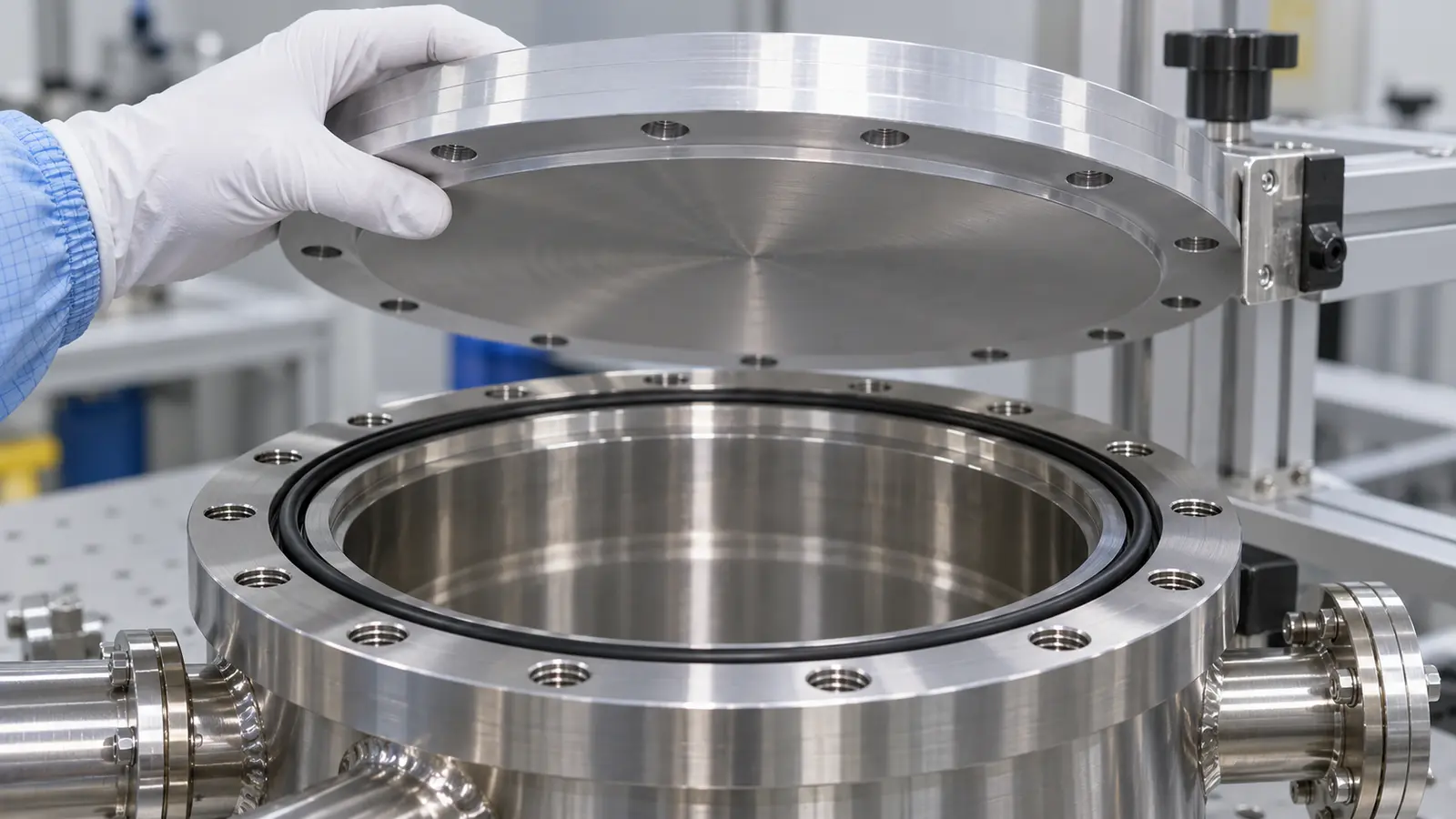
Using the same material can simplify thermal-expansion behavior, but it is not mandatory. Different materials require evaluation of relative movement, fastener loading, seal compression and corrosion exposure during cleaning or handling.
Selection rule: eliminate materials that fail the exposure or temperature requirements first, compare structurally adequate constructions second, and compare manufacturing and maintenance cost last. Reversing that order often produces an inexpensive drawing that is expensive to qualify.

