A sample carousel in a clinical chemistry analyzer has to do more than hold tubes or cups. Its pockets, center opening, locating features, and index reference must place each sample where the instrument expects it, while leaving room for loading, sensing, cleaning, and service. A carousel may appear to be a simple disk, but its usable accuracy comes from the relationship between repeated positions and the features that locate the disk in the analyzer.
Clinical chemistry analyzer sample carousel manufacturing should therefore begin with the motion and interface definition: what feature establishes the angular zero, how are sample positions distributed, and which dimensions control clearance at the loading and sensing stations? Once those questions are answered, the team can compare CNC machining, molded components, or a mixed construction without treating the part name as a complete specification.
Contents
- What the carousel must align with
- Why pocket layout and indexing are linked
- Choosing a machined, molded, or mixed route
- How to inspect geometry and registration
- What information helps a prototype move forward
- Frequently asked questions
What does the carousel have to align with?
First identify the physical and control references in the instrument. The carousel may locate on a hub, shaft, bearing, or drive interface; the analyzer may detect a home position through a slot, mark, flag, or other feature. The sample pockets must then relate to that center and index reference. The actual system varies by design, so use the product drawing and interface-control documents rather than ass
uming a particular drive or sensing scheme.
Potentially important characteristics include the center opening, mating face, pocket diameter or profile, pocket depth, angular spacing, radial position, edge condition, and clearance to surrounding components. Some systems may use adapters or several container formats. If so, clarify whether one carousel supports all formats or whether the instrument uses separate carriers. That changes which dimensions are functional and what must be inspected.
The pocket pattern also interacts with user handling. Openings need sufficient clearance for the specified container and loading path, but unnecessary looseness may compromise the instrument’s intended positioning. Do not select a tolerance by analogy with another analyzer. Confirm the allowed container variation, the registration method, and any design-defined clearance in the controlled documentation.
Why are pocket layout and indexing a single problem?
A pocket can be accurately machined relative to a local edge and still be in the wrong place relative to the instrument’s center or home reference. For a circular array, the relevant coordinate system generally includes a center, a radial distance, and an angular relationship. If the first pocket is indexed incorrectly, the error may repeat around the disk. If pitch or position drifts gradually, later locations can deviate more than the first.
This makes the datum scheme central to both manufacturing and inspection. Establish how the drawing defines the center and angular zero, then preserve those references through machining, setup changes, and measurement. A fixture that locates only the outside diameter may not reproduce the intended center if the outer profile is not itself a datum. Similarly, a decorative notch should not be treated as the indexing feature unless the design defines it that way.
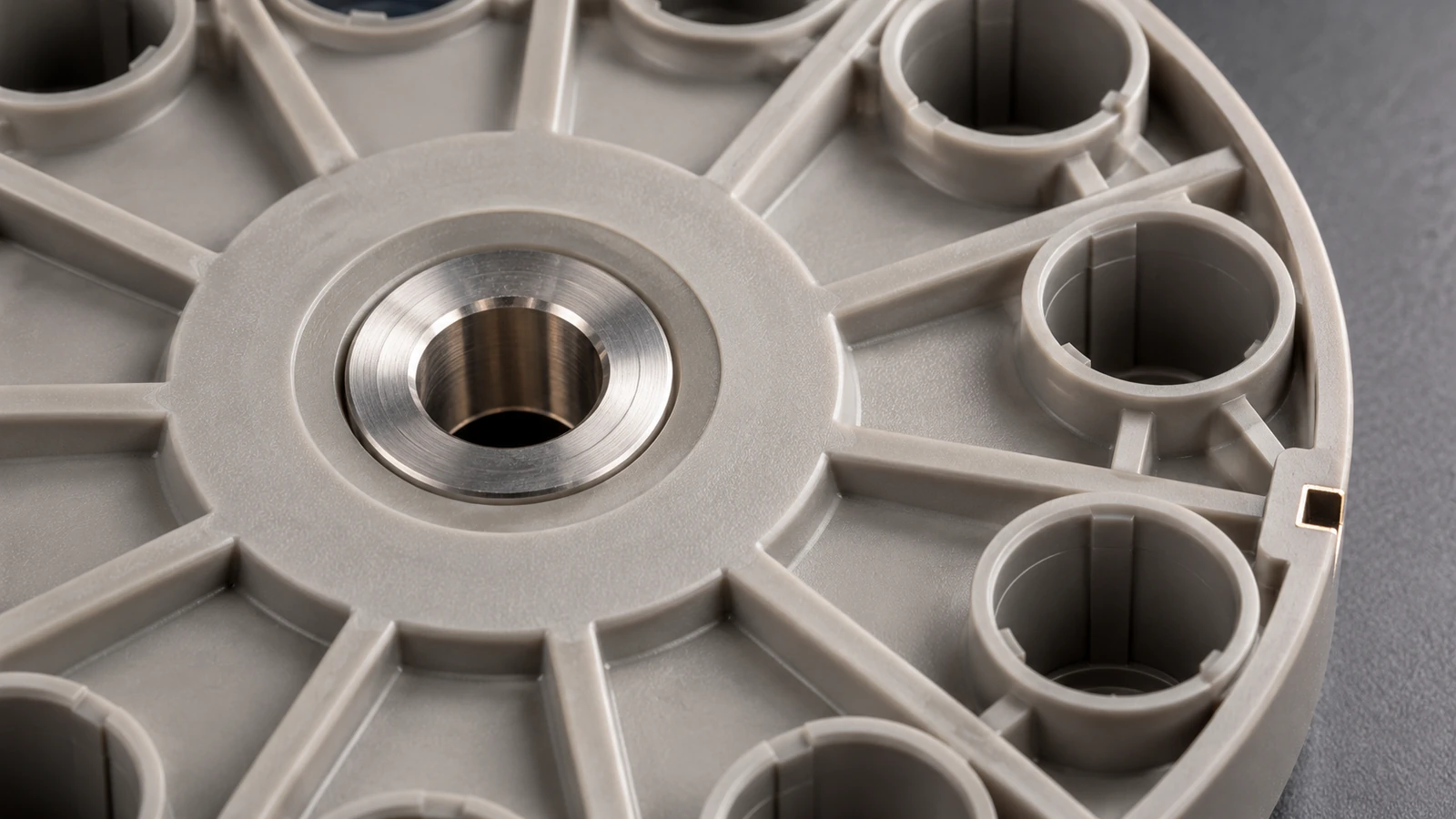
Where the carousel is lightweight or has thin webs between pockets, clamping and material removal can influence flatness. A part that is forced flat in the fixture can spring after release. The sequence may need balanced stock removal, support near the functional regions, or an intermed
iate inspection before finishing. These are design-for-manufacture questions, not assumptions that can be resolved from a photograph.
Which process route fits the development stage?
CNC machining can be useful for low-volume prototypes, revisions, and designs where pocket geometry or interface details are still changing. It allows the team to evaluate fit and layout without immediately committing to production tooling. The route should be compared with the part’s geometry, material specification, quantity, expected changes, and the purpose of the prototype.
For higher planned quantities or a design with features suited to molding, a molded component may become worth evaluating. That decision introduces draft, wall-thickness, gate, shrinkage, and tooling considerations. A mixed design may retain a machined hub or insert while using a molded carrier, but this should be driven by the instrument design rather than a generic cost claim. The site’s low-volume injection molding capability can be considered when discussing a bridge or limited production route, subject to part-specific review.
Material selection is equally tied to function. Some designs may use a metal carrier for stiffness; others may use an engineering plastic for weight, electrical isolation, or manufacturability. Verify chemical exposure, cleaning agents, temperature range, wear, dimensional stability, and any contact or contamination requirements with the responsible engineering and quality teams. The broader medical device manufacturing processes page provides context but is not evidence that a component is validated for clinical use.
How should the carousel be inspected?
Translate the drawing into a short list of acceptance questions. Is the center interface correct? Are the pocket sizes and depths within the specified limits? Does the full pattern remain positioned relative to the center and index feature? Is the mating face or reference plane within its required form tolerance? Are
there burrs, chips, or edge conditions that interfere with loading or cleaning?

Coordinate measurement may be appropriate for evaluating the complete pattern, while dedicated fixtures or gauges can support repeated checks once their relationship to the datum system is verified. For angular features, inspect against a defined zero rather than aligning to an arbitrary pocket. If the design includes an optical or sensor target, include its location in the same coordinate relationship where the drawing requires it.
Inspection reports should identify the drawing revision, material, and measured characteristics. For a prototype, capture the complete position pattern when the purpose is to validate indexing; for routine production, use the documented inspection plan. Visual checks can reveal damage and contamination but cannot replace dimensional verification. If a carousel is cleaned before delivery, record the agreed cleaning and packaging requirements rather than claiming a cleanliness level that was not specified.
What should an RFQ or design review include?
Share the 2D drawing, 3D model, revision, material and condition, quantity, target schedule, finish, and inspection expectations. Include the mating hub or shaft interface and the index reference, not just the disk drawing. State which sample container formats are intended and whether the prototype is for envelope checks, motion testing, or another purpose.
If the design is not frozen, mark provisional dimensions and identify who will approve changes. Ask for feedback on tool access, wall thickness, pocket cleanout, burr control, and how the datum scheme will transfer from machining to inspection. For a molded route, also discuss draft, parting line, shrinkage compensation, and expected tooling iteration. Those conversations prevent the prototype from being judged against requirements that were never shared.
When the carousel is one component within a broader analyzer assembly, coordinate the part review with the system team. Manufacturing can report whether the geometry is producible and measurable; product engineering and quality remain responsible for defining inte
nded use, system performance, and applicable validation. For machined components, the CNC machining service overview is a starting point for discussing part geometry and manufacturing fit.
Frequently asked questions
Can the pocket pattern be measured from the outside diameter?
Only if the design defines the outside diameter as a suitable reference. Otherwise, locate the part from the center and index features specified by the drawing. A convenient edge is not automatically a functional datum.
Should a prototype use the same material as the final carousel?
Use the intended material when the evaluation depends on its stiffness, wear, thermal behavior, cleaning response, or fit. A substitute may be acceptable for an envelope mock-up, but document what that prototype can and cannot demonstrate.
Does a machined carousel prove analyzer accuracy?
No. It can verify the component’s geometry against its drawing. Analyzer accuracy depends on the complete instrument, calibration, sensing, motion, containers, software, and validation process.
What is the first datum to agree on?
Confirm the center or locating interface and the angular index reference. These define how every repeated pocket relates to the analyzer and how the pattern can be inspected.