Medical device risk management connects a possible failure to its effect on a person or the device’s intended performance, then identifies controls and the evidence that those controls work. A list of machining defects is useful input, but it is not a complete device risk analysis. The device owner must understand the intended use, hazardous situation and possible harm; a component supplier can contribute manufacturing knowledge and objective records.
This guide looks at that interface through machined, molded and assembled parts. It does not assign a clinical risk score to an unspecified product, claim that a shop can approve a device, or replace qualified regulatory and engineering review. The point is to make manufacturing information legible to the people who own the device-level risk file.
Begin at the Device Function, Then Work Backward

Suppose a molded enclosure locates a seal around an electronics module. “Flash on part” is a manufacturing observation. The risk analysis needs more: could flash prevent seal compression, allow fluid ingress, cause loss of function and expose a user to harm? The chain may stop at any step depending on the design and use environment. Do not assume every cosmetic imperfection is a safety hazard, or that a small dimension has no consequence.
Ask the device team to identify critical interfaces, foreseeable use and relevant failure consequences. The supplier can then map how a feature is made and verified. Without that direction, it might spend effort measuring easy features while overlooking the sealing land, locating pin or electrical clearance that actually controls the device function.
The parent medical device manufacturing standards article places risk management among broader quality and regulatory frameworks. Here the question is narrower: how does a physical part or process variation become an input to a device-level risk decision?
Translate a Defect Into a Testable Chain

| Manufacturing observation | Possible device effect to investigate | Control question | Evidence to request |
|---|---|---|---|
| Burr on a machined edge | Interference with assembly or insulation | Is the edge defined and inspected? | Edge requirement and measurement or visual standard |
| Warped molded housing | Uneven seal compression | Does the datum and fixture represent assembly? | Representative fit or sealing evaluation |
| Wrong alloy or resin | Different strength, chemistry or processing behavior | How is incoming identity controlled? | Approved specification and lot record |
| Shifted hole pattern | Fastener stress or misalignment | Are functional datums used? | Inspection plan and assembly check |
| Unapproved finish change | Altered fit, corrosion or surface condition | Who assesses the change? | Approval and affected-lot trace |
Every row is an illustrative prompt, not a statement that a particular harm will occur. The device team determines the actual hazard, sequence of events, severity, probability where estimable, risk acceptability and needed controls. A supplier should contribute truthful process capability and defect mechanisms rather than invent a clinical conclusion.
ISO describes ISO 14971:2019 as the current framework for medical-device risk management across the lifecycle. It covers identifying hazards, estimating and evaluating risk, controlling it and monitoring the effectiveness of controls. It does not prescribe a universal acceptable risk level for all devices, so a generic matrix downloaded from the internet cannot settle this component’s decision.
Use Controls in the Right Order

A design change that removes a sharp edge may be more robust than relying solely on a final visual check. A locating feature that makes incorrect assembly difficult may reduce dependence on operator memory. Process controls and inspection then verify that the design intent is reproduced. The appropriate hierarchy depends on the specific hazard and available options; do not claim that inspection alone eliminates risk.
For a CNC-machined component, process choices may include tool path, fixture support and deburring sequence. The evidence might include a defined edge condition, first-part check and an in-process response when tool wear changes the result. In a molding project, gate position, tool venting, ejection and resin conditions can influence the critical interface. Each operation needs a stated acceptance basis, not a vague promise of precision.
Separate prevention, detection and containment. A controlled machining setup tries to prevent the defect. A measurement plan tries to detect it. Lot segregation limits escape if a problem appears. These are related but different controls; documenting one does not prove the others exist.
Prototype Evidence Has a Boundary

A prototype can reveal an interference, fragile feature or assembly error early. It can also mislead if its material, process or surface state differs from the intended production part. A 3D-printed test housing may answer whether components fit yet not reproduce molded knit lines, shrinkage or production tool texture. Name the question each sample was built to answer.
Record configuration: drawing revision, process, material, post-processing, assembly method and test conditions. If the test fails, preserve the part and the conditions instead of retrospectively changing the story to fit a preferred conclusion. A useful risk file can trace which evidence supports which control and where its limits lie.
The existing medical device design transfer article discusses the handoff from development to production. Risk controls are particularly vulnerable at that handoff because the production route may differ from the prototype route even when the nominal CAD geometry is unchanged.
Reopen the Analysis When the Route Changes
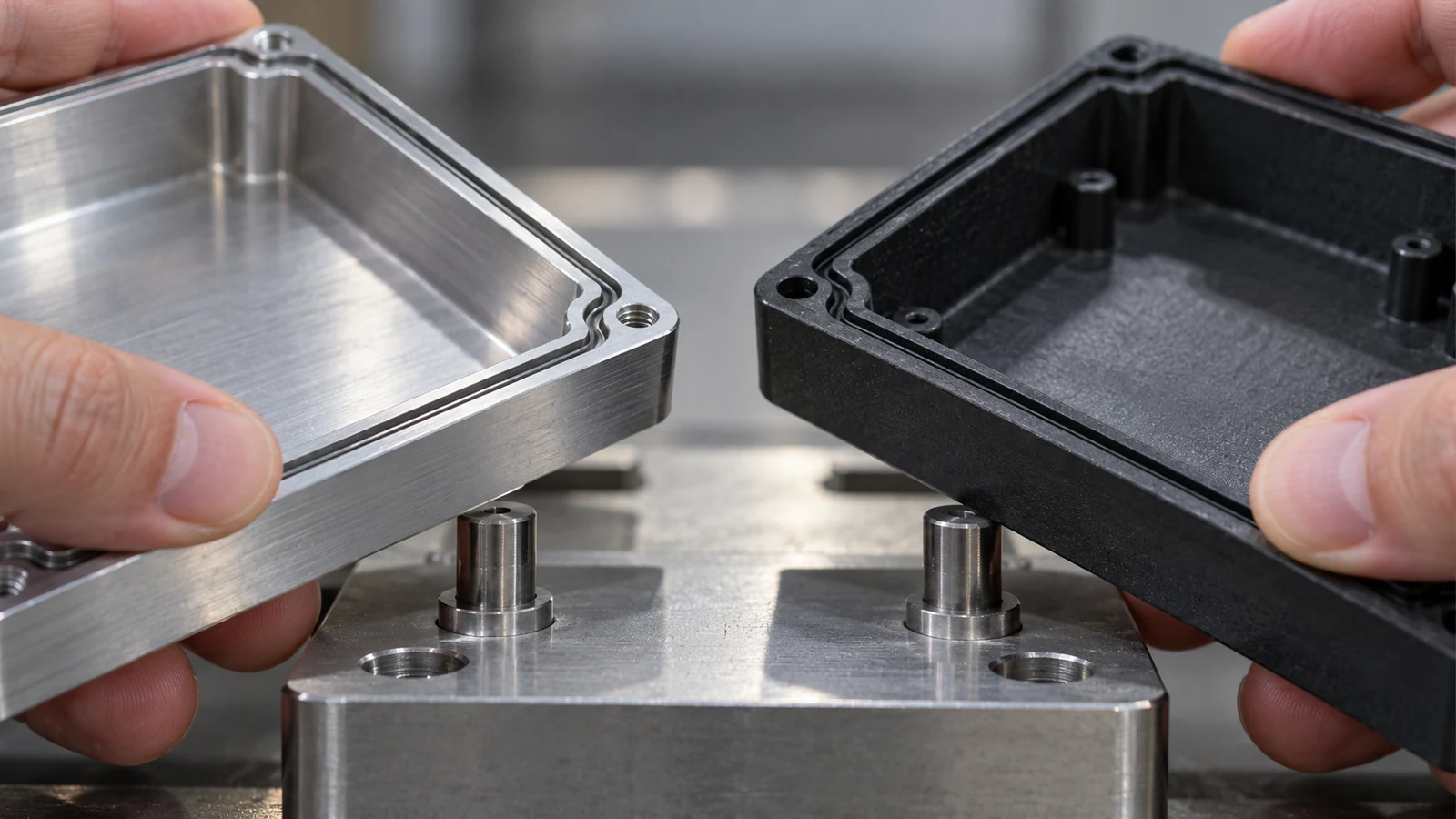
Consider a seal groove originally milled in a metal housing and later changed to a molded polymer interface. The design may still appear similar, but material behavior, corner radii, surface texture and inspection access have changed. The device team should decide which risk assumptions and tests need review before the new route becomes approved.
Not every supplier improvement requires a full device revalidation. The important point is to assess the change against the functions and evidence it could affect. An alternative finishing provider, resin source or assembly adhesive may be harmless in one design and central in another. Document the rationale, affected lots and decision authority.
For U.S. context, the FDA’s QMSR overview explains the currently effective quality-system framework for finished-device manufacturers. It should not be reduced to a supplier marketing claim. A component supplier’s role is to provide accurate specifications, controlled production information and timely change data for the responsible organization to assess.
Give the RFQ a Risk-Relevant Appendix

When requesting manufacturing input from Jucheng, identify the component’s function, critical interfaces, approved material, intended process, inspection requirements and any known failure modes that the supplier is permitted to see. Ask which features or operations are likely to be sensitive to variation and what evidence could support acceptance. The answer may be a DFM observation or test proposal, not a declaration that the device is safe.
The most useful contribution a manufacturer can make is specific: “this wall could warp under the proposed molding route, affecting the seal datum; let’s test parts from representative cavities and agree the datum method.” Such an observation can feed a risk discussion. It cannot replace the device owner’s decision about the clinical consequence or acceptability.
Is a manufacturing FMEA the same as ISO 14971 risk management?
No. A process failure-mode analysis can identify manufacturing causes and controls, but device risk management also considers hazards, hazardous situations and potential harm across the product lifecycle. The device team should connect the two where relevant.
Can a passing prototype close a production risk?
Only if it represents the condition being evaluated and the acceptance criteria are met. A one-off prototype may answer fit or feasibility while leaving production variation, process changes and long-term performance untested.